

Lion dissection in central London
Plus: Looking for cocaine in London's sewage, Lime bikes are getting regulated, the Green candidate standing for his tenth party, Reform candidate's Tooting diatribes.


Today we’ve got a mix of stories, including a curious report of a lion being cut apart in front of hundreds of people in central London. The pictures in that story might not be to everyone’s taste, so it’s at the very end of this email.
But first, we’ve got everything from the people looking for cocaine in London’s sewage works, updates on the future of Lime bikes, and the Green Party candidate standing for his tenth political party – or scroll to the end for the lion.
Want to get in touch with London Centric? Send an email or a WhatsApp.
Reform’s Tooting candidate investigated by party for anti-Muslim posts

A Reform UK candidate standing in next week’s local elections has said Islam should be banned, and called Muslims “scum that goes to mosk [sic], mass funerals, and rape young kids.”
Stephanie Dearden, who is hoping to be elected in south west London’s Tooting Broadway ward, posted a number of tweets on a now-suspended X account in 2020.
“Give them bacon and eggs three times a day, and a Bible,” said the candidate for Wandsworth council. “Once they understand British values, we might consider letting them in.”

Other tweets said that Islam “supports paedophilia” and stated that “in a civilised country Islam must be considered outlawed” and that “Islam is not just a religion, it is a state that wants to invade, occupy, gag everything it occupies.”
In another post, made during the coronavirus pandemic, she suggested any antidote should be made from pork and that the pandemic might help “stomp out” the “Islamification of the free world”.

Responding to a post from another account about an alleged attack by a Muslim migrant in Germany, she said he should be “sent to Auschwitz for a shower.”
Dearden’s posts were considered severe enough to earn the account a suspension from Elon Musk’s X, which has largely adopted a policy of not removing racist comments or inflammatory language.
If elected, Stephanie Dearden’s role as a councillor in Tooting would require her to work with other elected colleagues, as well as community groups, businesses and other local organisations, to agree and deliver on local priorities.
London Centric first approached Reform UK for comment on Dearden’s tweets eight days ago. On Wednesday a spokesperson finally responded, confirming the party does not approve of the comments and the posts are being investigated.
Wandsworth's sole Reform UK councillor Mark Justin has also told local news site Putney.News: “Language used in these posts is completely unacceptable, and we offer a sincere and unreserved apology to anyone offended by her comments.”
Transport for London will get the powers to regulate e-bikes
At some point on Wednesday the snappily titled English Devolution and Community Empowerment Bill will receive royal assent and become law.
It includes a few major changes for the future of London, most of which give slightly more power to the mayor at the expense of the capital’s local councils. Among other things, Sadiq Khan (and his successors) will have the ability to quickly overrule boroughs on large planning applications, with the intention of making it easier to build homes, including on green belt land. He’ll also have the ability to overrule local councils on licensing matters, with the objective of having a presumption in favour of making it easier for restaurants, pubs, and clubs to operate. There are also measures to make it easier for the mayor to raise money for major projects without central government approval.
But possibly the most visible change is that the law will give Transport for London the power to regulate the capital’s rental e-bike market.
At the moment the likes of Lime, Forest, and Voi operate in regulatory grey areas – and each company has struck different deals with individual local councils. In the next couple of years this will all change and a London-wide system will be put in place, with added scrutiny and regulation. As a result there’s a battle underway between the rival operators to establish dominance and shape TfL’s rules on what the companies will be allowed to do.
Do get in touch if you have any intel on this.
Hunting for cocaine at London’s sewage works
Since 2021, the Home Office’s Wastewater Analysis for Narcotics Detection programme has been monitoring wastewater in order to learn more about the nation’s consumption of illegal drugs. Rather than rely on crime statistics, it takes water samples from sewage works and tries to work out what has been passing through the population’s bodies.
Despite London’s reputation for City boys snorting lines, the study has found that the capital has dropped behind Liverpool, Sunderland, and Scotland in terms of the concentration of cocaine in sewage.
Instead, the capital’s wastewater suggests London is a disproportionate consumer of both MDMA and methamphetamine.
The data, collected from 50 wastewater sites across England and Scotland, showed that cocaine remains the most widely used drug in the UK, although usage of it had decreased by 19% over the last year. Instead, ketamine use has shot up by 54%, in a pattern that is likely to be reflected in the capital.
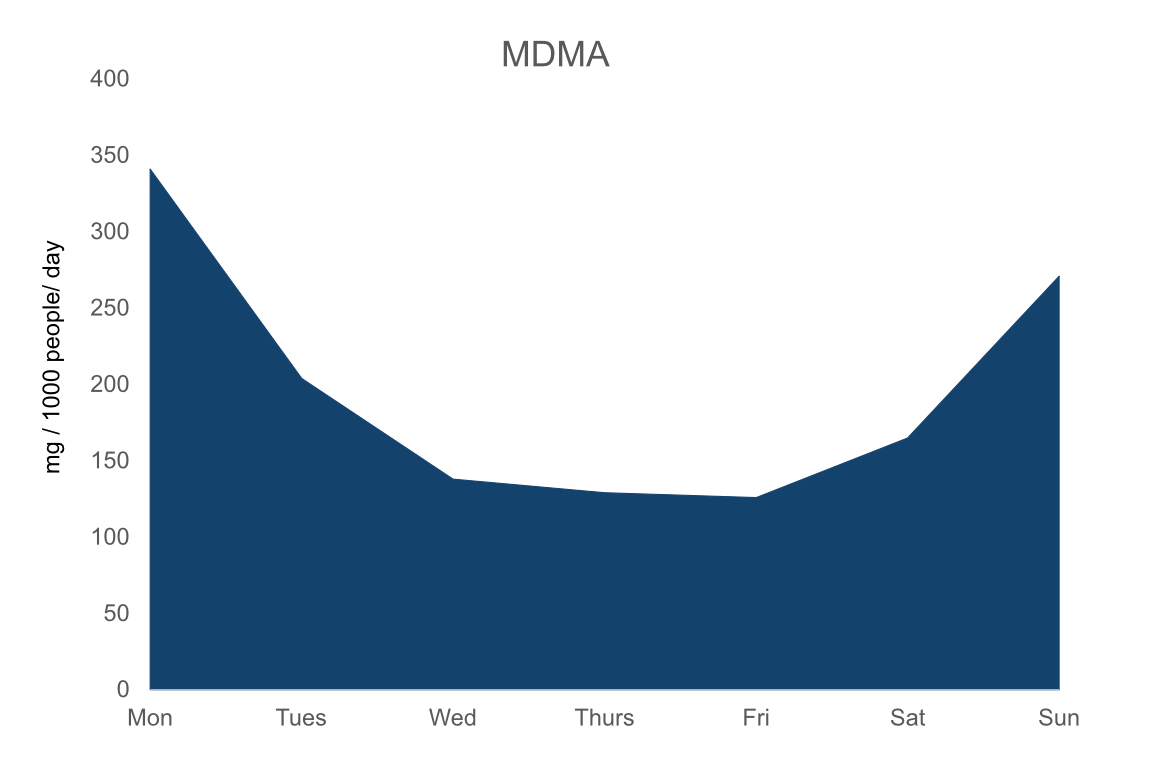
The sampling data also shows that cocaine and MDMA tend to appear in sewage over the weekend and on a Monday morning, which is consistent with recreational use.
On the other hand, ketamine is now appearing more consistently throughout the week, suggesting daily – and more problematic – use.
Once, twice, sixteen times a candidate
With such a dramatically shifting political landscape, it’s not unusual for people’s party allegiances to take them on a journey. But some journeys are more unusual than others.
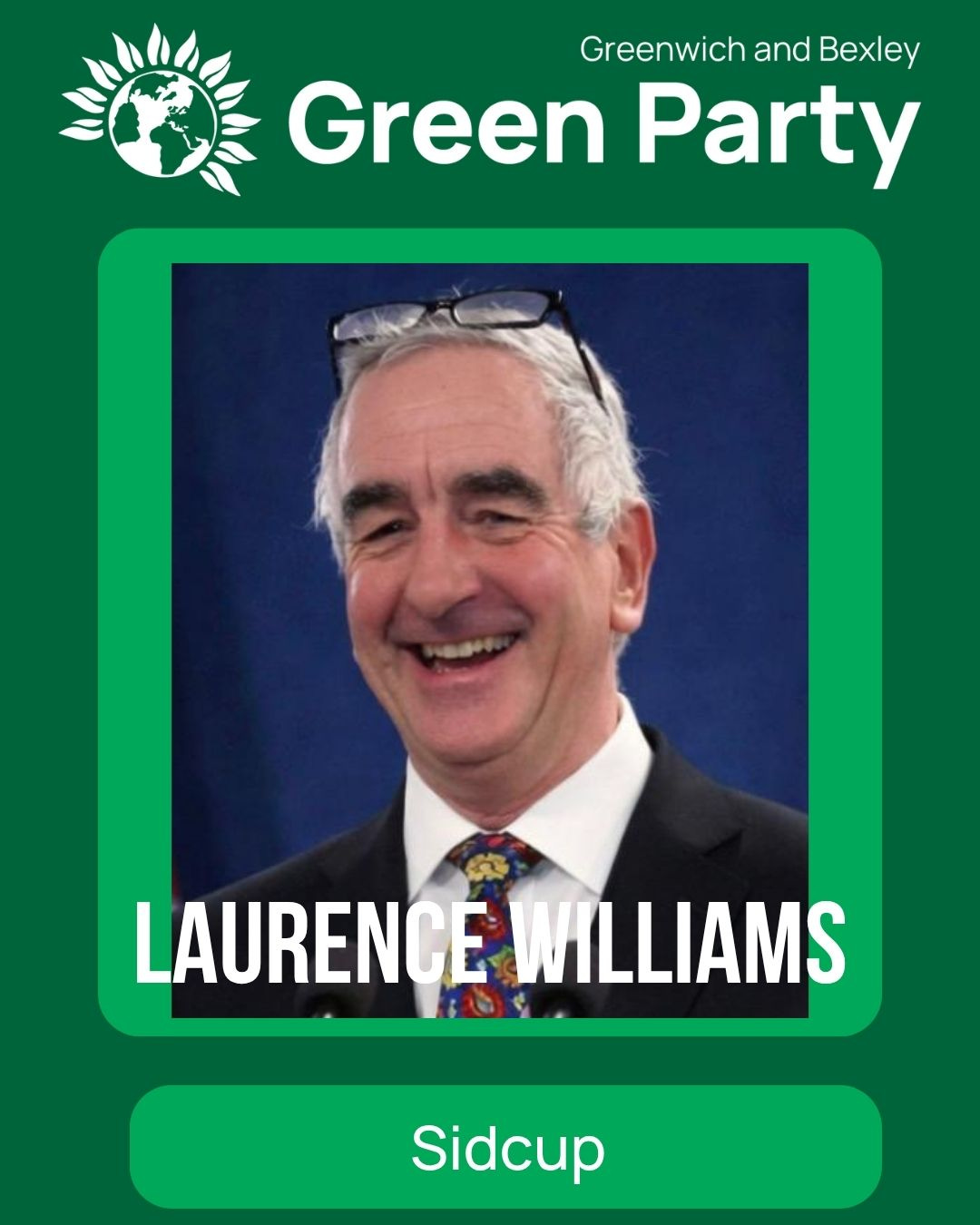
Laurence Williams, 62, is running as the Green party’s candidate for Sidcup in the borough of Bexley.
This makes it the tenth party he’s stood for in sixteen different elections. In addition to running as an independent he’s previously attempted to take office for:
The Official Monster Raving Loony Party
UKIP
The English Democrats
The Christian Peoples Alliance
The Christian Party “Proclaiming Christ’s Lordship”
The Liberals (the continuity party that rejected the merger with the SDP to form the Liberal Democrats)
The niche Welsh nationalist party Gwlad
Rejoin EU
The SDP (the continuity party that rejected the merger with the Liberals to form the Liberal Democrats).
Williams told London Centric he’d “lost count” of the number of parties he’d stood for over the last 36 years, with his political career beginning in 1990, when his local paper ran an advert encouraging people to put themselves forward.
“I just carried on going, because it was something to do every four years.”
With this now his sixteenth election, he’s hoping it will be the Green Party that finally gets him into elected office.
When asked how he justifies the seemingly contradictory parties he’s represented, Williams said: “I’ve met so many people over the years, including parliamentarians, and it’s altered my thinking as I’ve gone along.”
“The politics of the day on the world stage are forever changing, and so are my views. That’s why you see such a tapestry.”

Williams said he regretted standing for the English Democrats, a far-right party who wanted England’s “public culture” to be that of the “indigenous English.”
“They enticed me to stand as a candidate,” Williams said. “They turned out to be not really nice characters at all.”
“There was a by-election in Bexley, and I stood for the English Democrats, and actually stopped the BNP being elected. BNP looked certain to get this seat and they lost it by 8 votes and I got about 129. That night at the count, I got the biggest cheer from the Tories and Labour for stopping the BNP getting in. So that was something quite special.”
Williams said the Greens didn’t raise any objections to his English Democrat past: “Since Zack Polanski’s been on the scene, interest in the Greens has gone into hyperdrive. Lots and lots of new candidates coming on board. Some of them are actually quite controversial. I don’t think I could be cast as controversial. I’m more of a comedian.”
Having lost every single election, Williams said “I don’t expect to get elected. But you never know, do you?”
Preposterous property of the week
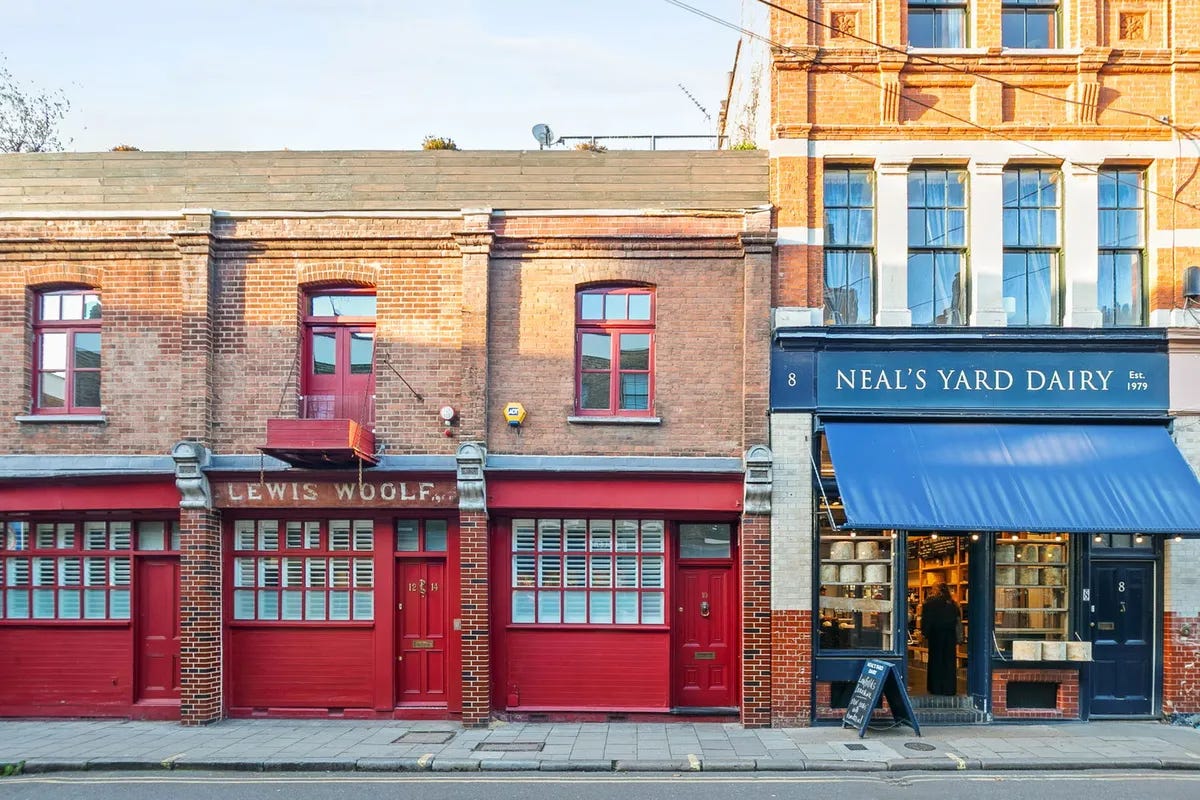
Ever wanted to fulfil your Bridget Jones fantasy, and live in Borough Market? Well now you can, for a rent of £17,500-a-month. This five-bed property on Park Street sits directly opposite the famous food market, and next door to fancy cheese shop Neal’s Yard Dairy.
Whether your generation’s cultural reference points are less “come the fuck on, Bridget”, and more the Instagram influencers filming themselves sampling the market’s various delights, it’s a pretty noteworthy address. And if the hordes of tourists on your doorstep get too much, you can always retire to the roof terrace, to literally look down on them.
A window on Criterion Capital
Earlier this year we reported at length on the “mass evictions” being carried out by billionaire Asif Aziz’s Criterion Capital.
One of the worst-affected buildings was their Britannia Point building in Colliers Wood. Back in 2022, a glass pane fell from the twelfth floor of the same building, before smashing on the ground in a busy pedestrianised area. Merton council then spent £3m on emergency scaffolding works while safety checks took place. The council is in legal dispute with the landlord over who should pick up that bill, leaving the local authority out of pocket.
Now, the same tower block has been issued with another “dangerous structure notice” by Merton council, after another window cracked in the tower.
Criterion, which is already being investigated by Merton council after London Centric revealed it had issued fake electrical safety certificates to tenants in the same building, said it blamed an air pellet that was fired at the building by a member of the public: “Criterion treats the safety of residents and the public with the utmost seriousness. Upon identifying external criminal damage to a glass panel at Britannia Point, we acted immediately to notify the police, establish an exclusion zone with the support of the Council, and conduct robust temporary repairs to eliminate any risk to people in and outside the building.”
They continued: “A permanent replacement panel has been commissioned and installation works will commence as soon as feasible. We continue to work in close collaboration with the relevant authorities, including the emergency services and Merton Council, which has acknowledged the safety measures taken by the building management to date until a permanent replacement can be fitted.”
The council said: “We are satisfied this is a suitable temporary safety fix. However, the dangerous structure notice will remain in place until the window is repaired. These repairs should be carried out by the landowner as soon as possible.”
All roads lead to Oxford Street
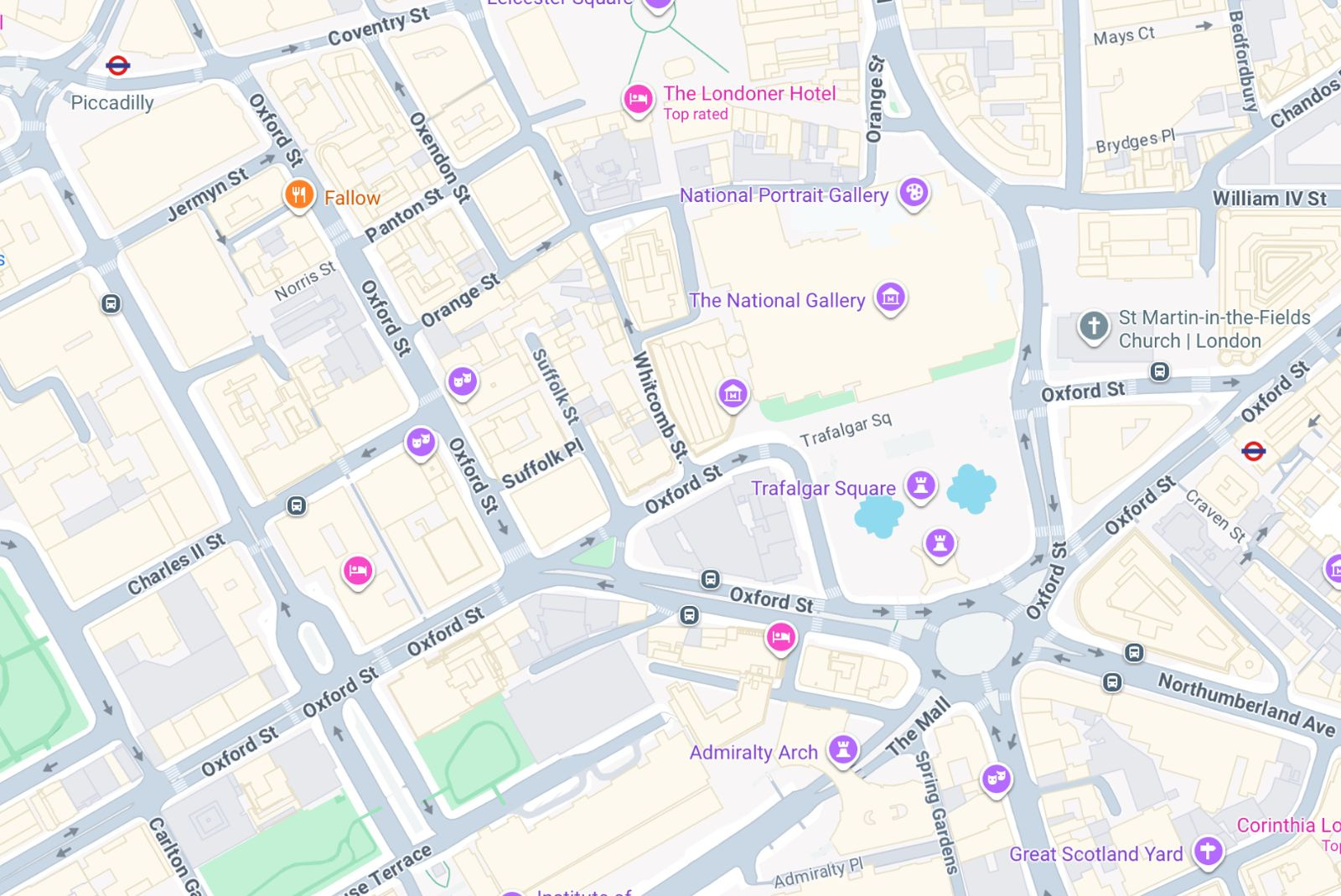
Earlier this week something went very wrong with Google Maps: Almost every road in central London was renamed ‘Oxford Street’, conjuring up images of the entire capital’s grid being filled with tax-evading sweet shops. Google said that it had taken a look internally, and the issue was “now resolved”.
Ex-Lion, Tamer: Public animal dissections return to central London
This story contains a very graphic picture and is not for those of a nervous disposition. Do not continue to scroll down if you think this might affect you.
How pungent is the smell of a dead lion’s stomach acid? Earlier this month, clutching a scarf to our nose and retching, London Centric discovered the answer in central London.
That’s because we were one of hundreds of people, including a substantial number of children, who attended a sold-out public dissection of a lion in Mayfair. Conducted by Professor Ben Garrod and zoologist Jess French, the afternoon was part of a scientific lecture series held at the Royal Institution’s central London auditorium.
The 16-year-old male lion had been euthanised due to a chronic problem with his kidneys. His ultimate fate was to be stretched out on a long spotless metal table and carefully taken apart.
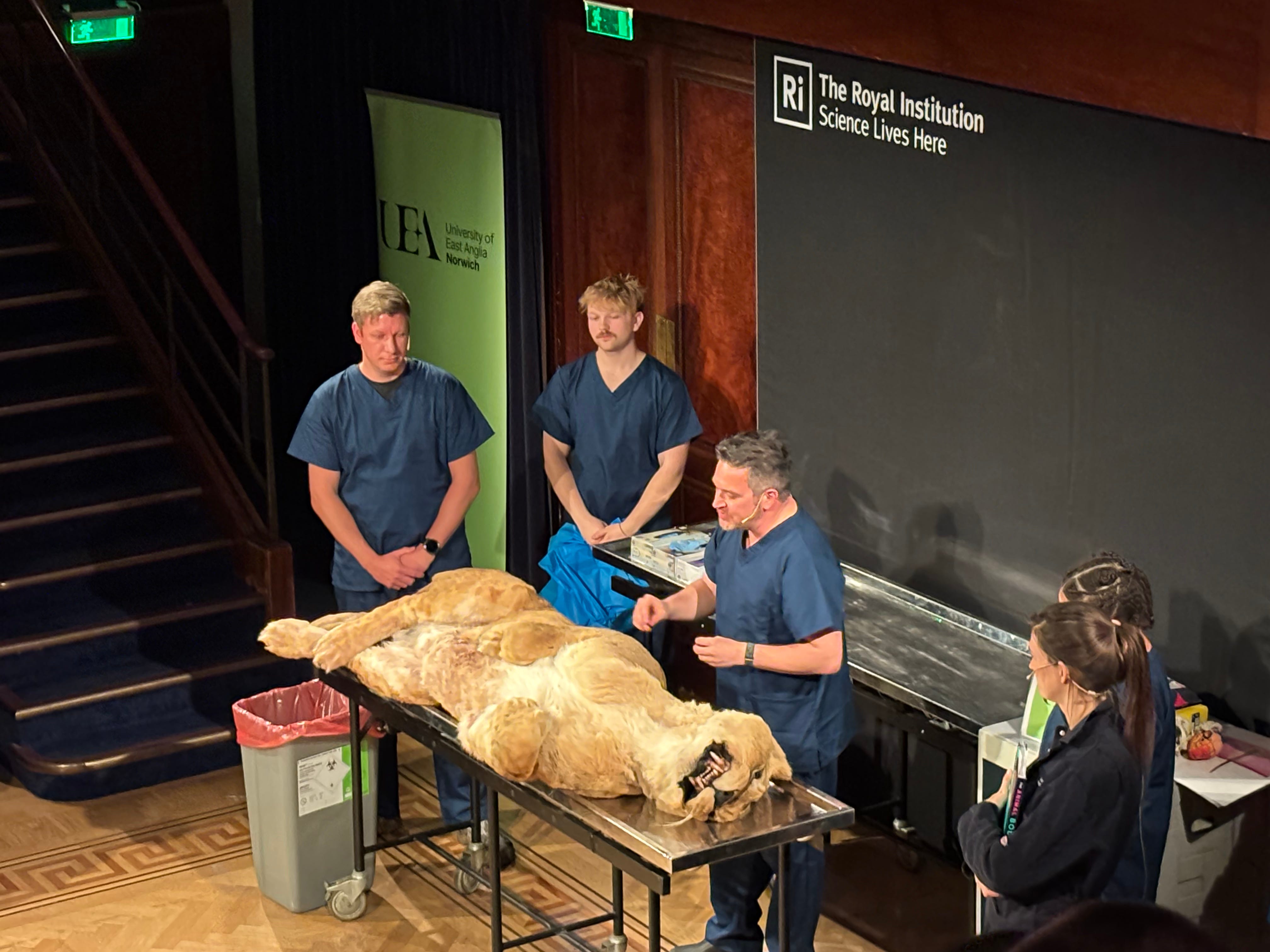
After a thorough external examination that took in his teeth, tail, and retractable claws, the dissection began with cutting through layers of fur and muscle to look at his shoulder joint.
Spectators were encouraged to shout out questions as the dissection took place, which ranged from queries about the weight of the lion’s heart, why it had a “sloppy” liver, and how Garrod squared slicing up animals for a living with being a vegetarian.
His answer? “I eat lunch before.”
However, one query from the crowd went unanswered: what was the lion’s name and where did it come from? There was no answer, due to a previous precedent.
In 2014, 18-month-old giraffe Marius was shot and publicly dissected by Copenhagen zoo, before his spotty remains were fed to the lions. The disposal sparked international outcry, with a petition for the zoo to rethink its decision receiving thousands of signatures.
Eager to engage the audience’s scientific and not sentimental faculties, Garrod explained that the point of the autopsy was not to humanise the animal in the manner of Marius. Instead, the audience were to learn from it. Plus, he explained that there is an agreement in place not to reveal the animal’s name or the zoo where it spent its life.
Outside the Royal Institution, Saturday shoppers on neighbouring New Bond Street were spending thousands of pounds in luxury stores. None of them knew that inside a neighbouring building an apex predator was being taken apart. The dissection took around three hours, with the vets giving detailed explanations of the animal’s anatomy, including digressions on the difference between house cats and apex predators, the bumpy surface of a lion’s tongue, as well as its “penile morphology.”
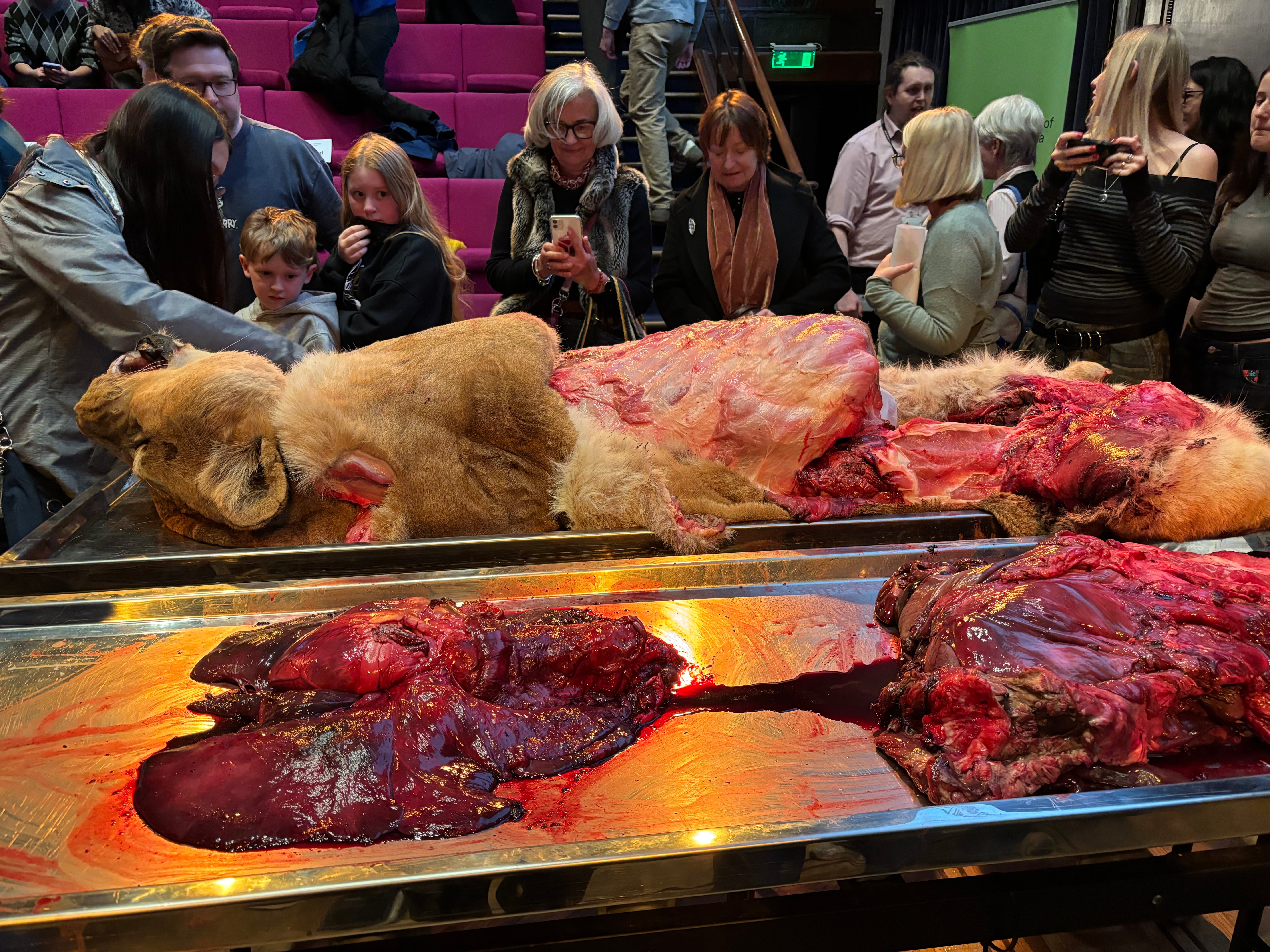
Without a mane, someone in the crowd asked why the lion looked more like a lioness. Garrod explained that, as he’d lived with his siblings, the lion had been castrated to avoid incest, but reassured spectators that the lion hadn’t “regretted living life without his balls”.
The animal had been frozen after its death, which had given its blood time to coagulate. But once the dissection got down to the organs, including the heart, lungs, and unfolding of an astonishingly long colon, blood started dripping onto the lecture hall floor. The various parts of the animal are now on their way to different institutions to be studied.
As a scientist, I'm in awe of the Royal Institution. Always going above and beyond to nurture curiosity and disseminate knowledge. I imagine this event came with a trigger warning or some kind of disclaimer, and instead of clutching our pearls perhaps it should be celebrated - I would have loved to attend! The lion was dead anyway and we need to learn from it to help future lions and related species. That's how scientific knowledge advances.
Great journalism again.
What I find staggering is not one news outlet other than yours has covered Stephanie Dearden's absolutely vile and horrendous social media posts. Not a single one. And in the run up to an election. Reform get to play politics on easy mode.