

How US-style tipping culture came to London
Plus: Andy Burnham's copy-and-paste pledge to the capital • Dawn Butler's mayoral fundraiser • The ongoing hunt for a luxury children's meal.


If you’ve stood at the bar while ordering a pint of beer, or ordered a coffee at the counter of a cafe in London, you might have been hit by the trend sweeping the capital: “optional” service charges automatically applied to purchases.
In the past, default service charges in the UK were limited to sit-down restaurants. Tipping culture, where you’re expected to add an extra payment on top at the moment you place your order, was a strongly resisted American affectation. If you were having a good night out, you might offer to buy a drink for the bar staff, or leave some money at the end of a meal, but that was the limit.
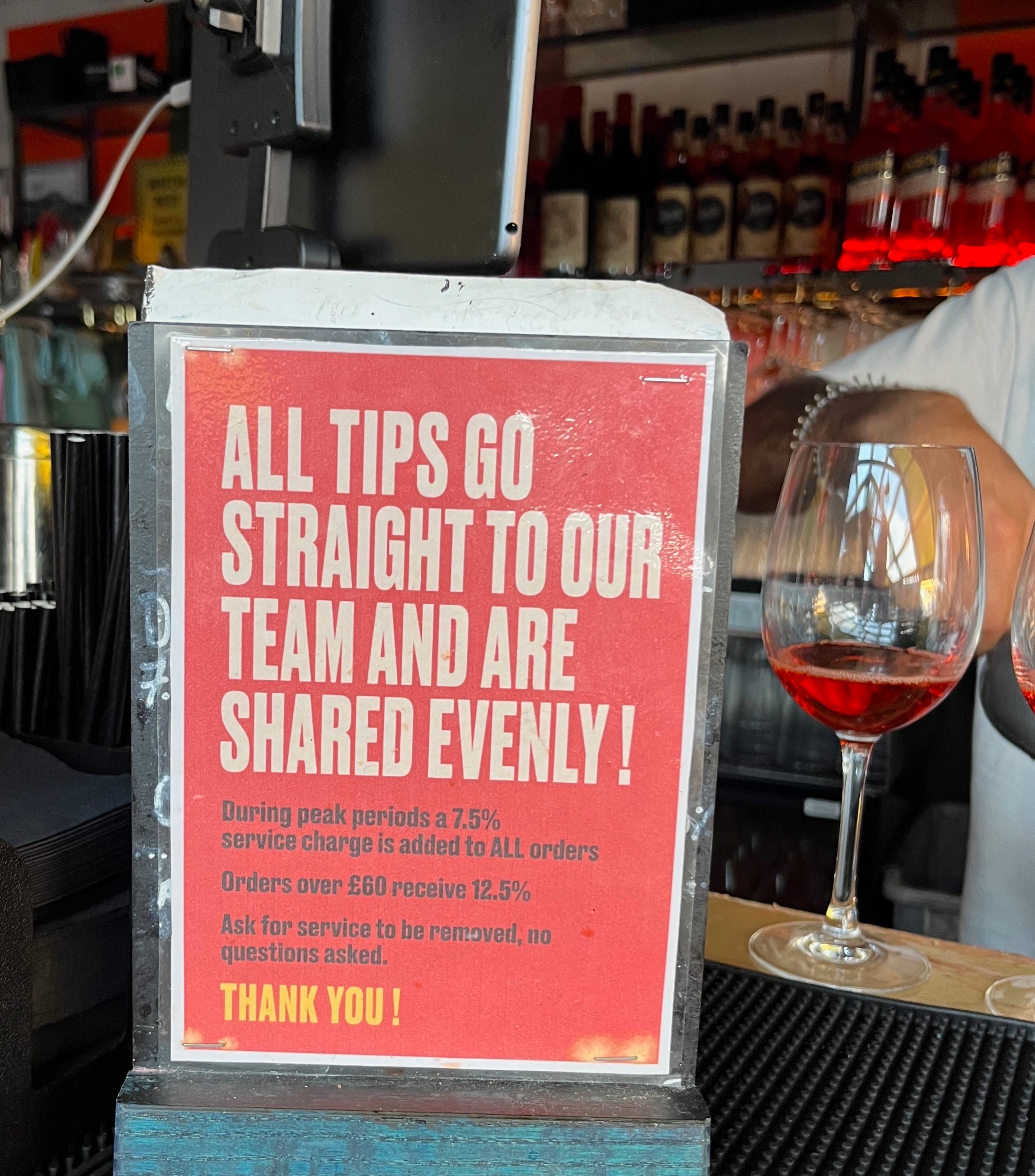
Now, in the space of just a couple of years, that has completely changed. What began as a trickle has become a tidal wave. Service charges are being automatically applied to pints served in historic pubs, cocktails in bars, and takeaway coffees in cafes where your interaction with the barista lasts a few seconds.
Paying by card? Then you’ll increasingly be asked to choose which percentage you want to add on top, while the staff member looks on awkwardly, or just find that a service charge has been added by default.
But why?
It’s always tax
London Centric has been talking to hospitality operators and workers across the capital. They say there’s a holy trinity of factors which have combined to bring automatic tipping culture to London.
Firstly, and by far the biggest reason cited by operators, is increased taxes on employers. The key moment was chancellor Rachel Reeves’ decision to substantially increase the rate of employer national insurance from April 2025. She also, in a move that attracted less attention, massively reduced the exemptions for part-time staff, hitting many pubs and cafes.
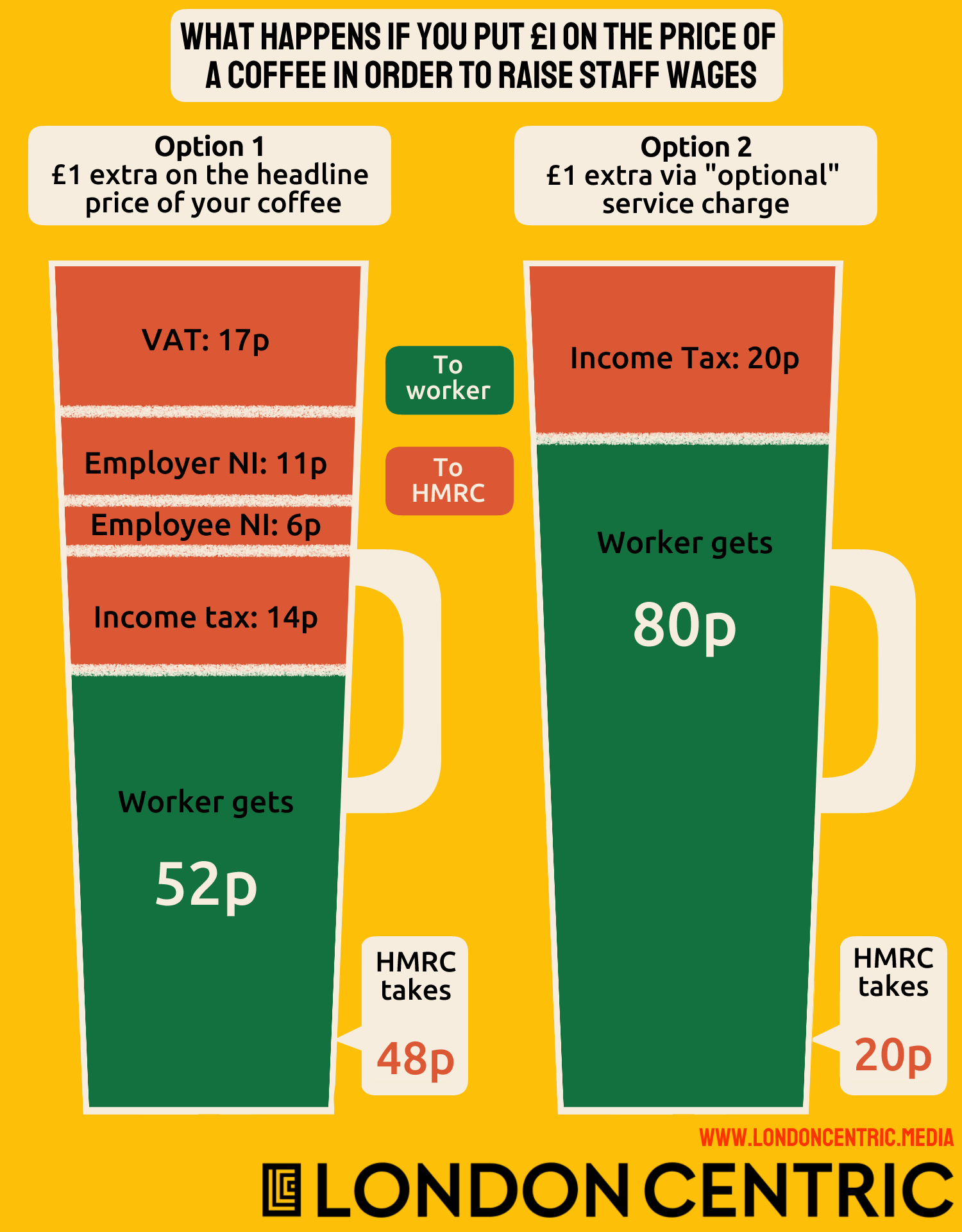
Secondly, a law introduced in late 2024 means all tips and service charges must go to staff rather than being swallowed up by a venue’s operator. The flipside of this is that, provided a service charge is genuinely optional, operated independently, and can be removed by the customer on request, the service charge money can go directly to employees with only a 20% deduction for income tax.
This means staff earn far more from increased service charges than they do from increased wages.
Thirdly, the introduction of new technologies and touchscreen credit card machines made it feasible for a venue to prompt for a tip even if you’re in a fast-moving queue.
Essentially, at a time of ever-increasing wage demands, all these factors have combined to push the capital’s struggling hospitality trade into a mass outbreak of (entirely legal and logical) tax avoidance.
Service charges are a way of getting more money to staff and giving less to the government
Vicky Chiriga, 36, is the managing director of hospitality company Quiet Enjoyment. She told London Centric that one of her venues was an early mover and introduced a default 5% service charge on bar orders in 2022: “It was a way for us to generate more funds for our staff. We were really struggling at that time to afford our team, as there’d been multiple minimum wage increases. It was a way for us to stay competitive without having to increase our menu pricing directly.”
Traditionally, if a venue wanted to pay their staff higher wages, they simply put up their menu prices. But price-sensitive customers increasingly object to these headline price increases. There’s also the tax issue.
“If we increased the drinks prices by the same amount, which is what a lot of people say you should do, that would be taxed very differently by the government, and then there’d be less to give to the staff,” said Chiriga.
In simplified terms, putting an extra £1 on the headline price of a drink will enable an employee to receive 52 pence in their bank account. But if you put £1 on the price of a drink via a service charge then that will give an employee 80 pence in their bank account, as it removes all the deductions for VAT and national insurance charges.
Matt Paice, the co-owner of Michelin-starred central London restaurant Chishuru, said the shift to service charges was a sign of strain within London’s hospitality industry: “It’s a move of desperation in the face of relentless wage increases.”
He said staff and operators now consider ubiquitous default service charges to be a reliable alternative form of salary that sidesteps the tax system: “Labour is now by a long way the principal cost of running a food and drink venue. It used to be ingredients, not any more.”
Rapid increases to the minimum wage rates are pushing up salary demands across the board. As a result, wages for London bar staff are increasing rapidly, exacerbated by a shortage of cheap European staff post-Brexit.
Rebranding part of an employee’s salary as a “service charge” also means owners get to engage in “menu engineering” to keep headline prices low.
The employee receives more money. Both sides pay less tax. And the customer? They can be left feeling a bit miffed, especially if they don’t understand the reason for the sudden proliferation of service charges.
London goes American
“For me it’s good, it adds a few hundred on a month, so I obviously like it,” said Ben Smith of The Black Penny in Covent Garden. “But as a customer it’s frustrating, I can see both sides. For the customer the bills are already very high… it’s becoming a bit too much like America.”
Harriet, who works in one central London coffee shop, said moving to an establishment that applied a service charge had made a massive difference to her take-home pay: “It’s way busier in Costa and you get paid much less.
“It works like this: the money you lose in tax, you basically get back in tips now.”
Card payment systems that automatically prompt for tips also mean people don’t have to manually input the sum they’re willing to give.
Chiriga said she asks her bar staff not to apply the service charge when someone is just buying one or two pints, or if the order is less than £10, because “everyone is going through the same economic challenges”.
She said there’s enormous pressure to keep headline prices down: “I go out myself and I’ll buy a pint and it’s £8.20, and I’m shocked because it feels so expensive. So that is always really my last port of call to put the prices up.”
In turn this is pushing Londoners out of bars and communal spaces: “People will come, they’ll buy the more expensive drink, but they might have one instead of two. Or they might come once a month, instead of two or three times a month, because it’s just too expensive for them.”
London’s hospitality industry is going through a tough period, with some operators lobbying the government for a reduction in VAT. It’s also competing for high street locations with dodgy shops that unilaterally opt out of paying taxes. These dubiously run stores have substantially lower operating costs, because they choose not to pay taxes, meaning they can afford to pay landlords higher rents than legitimate cafes. All of this incentivises legitimate outlets to find new ways to pay staff while reducing their tax burden.
Chiriga said she completely understands why people are anti-tipping and why a small number of customers ask for the service charge to be removed. But she wants the public to understand that a standardised service charge is replacing the big cash tips that used to be common pre-Covid: “London bar culture has changed over the years. When I was a bartender at 18, I used to earn more in tips than I did in my basic wages. This was before card machines were the default way that people paid, and more people paid with cash. I think it’s worth reminding people that tipping has always been a big part of hospitality wages.”
Dawn Butler raises money ahead of her mayoral run that may or may not be happening.
So far, our reporting on the 2028 London mayoral election has been dominated by unknowns: who within Labour could replace Sadiq Khan as the party’s candidate? Will Khan run for an unprecedented fourth term? Does anyone want to stand for the Greens?
Amid the speculation, only one thing has been guaranteed: despite the absence of a formal vacancy, Dawn Butler MP has repeatedly and publicly said that she’d like to be the next Labour candidate for mayor when a vacancy arrives. And she’s been campaigning as if there will be a vacancy ahead of the 2028 election which, as she is close to Khan, would indicate his time as London mayor is coming to an end.
At the end of May she denied a story by Ava Santina on PoliticsJOE that she was about to turn her informal mayoral campaign into a formal, public campaign. (London Centric has heard this didn’t go down especially well at City Hall.)
Yet despite the denials a quick look at Butler’s recently released parliamentary register of interests shows that she received more than £11,000 in donations, the sort of money that would be helpful for a mayoral campaign, around the same time that she was denying it. Two of the donors are Felicity Minton and Jacquie Lawrence. They’re former television executives who now run Jackdaw Media, which focuses on creating women-led stories. The company created a documentary about Linda Riley, the founder of Lesbian Visibility Week, who also recently donated to Butler. Back in 2017, Butler appointed Riley as the Labour party’s LGBT Diversity Lead. The rest came from Supreme Creations, a company that manufactures reusable bags and eco-friendly packaging.
Butler’s spokesperson told London Centric: “Faced with increasing pressures on workload, the donations received by Dawn’s office are to support the running of her office and its campaigns. Dawn has never hidden the fact that it would be her dream one day to serve as mayor of London, and will put her name forward to stand when there is an opportunity to do so. London is currently served by Dawn’s close friend the brilliant mayor of London, Sadiq Khan.”
Meanwhile, the clock is starting to tick for Khan to make his mind up on a potential fourth term. The mayor, who outpolls his party in the capital, would have a clear run if he wanted to aim for 16 years in power. But if Khan has had enough and stands aside too late, his replacement as Labour candidate might not have time to bed in and introduce themselves to the public. Based on previous political cycles, Khan would be expected to declare his hand by Labour party conference at the end of September.
Did Andy Burnham really pledge to cut Londoners’ transport fares?
We keep getting emails about this Standard story, in which former Herne Hill resident and future prime minister Andy Burnham appears to have committed to cutting the cost of travel in London. The headline is clear. The detail of whether this was actually Burnham’s intention is not. Everyone actually involved in London transport policy seems a bit baffled by it.
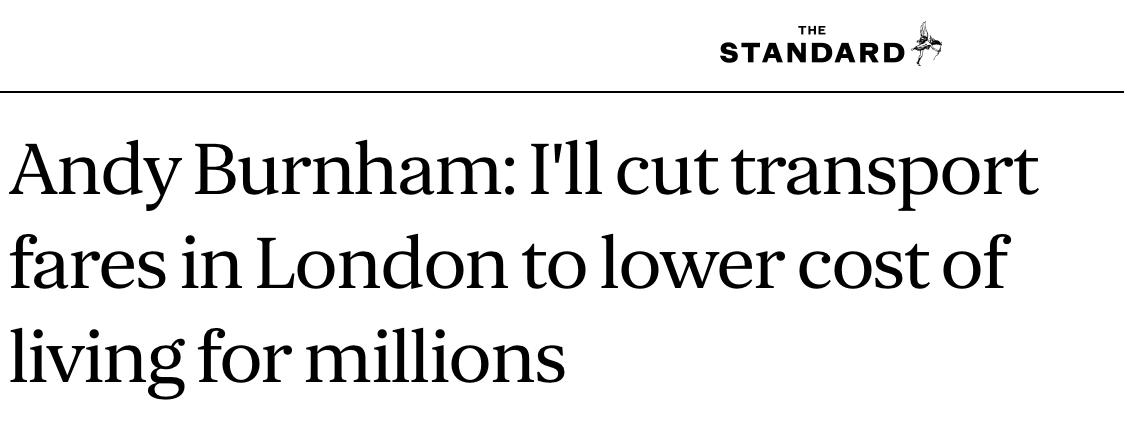
What appears to have happened, as per WalesOnline, is that someone on Burnham’s campaign team wrote an opinion piece on the need for Manchester-inspired devolution across the UK, changed a few place names, then sent subtly different versions to news outlets in Scotland, Wales, and London.
All of the different pieces carried vague pledges with the placenames changed to fit different regional audiences.
The London version went to the Standard and told Londoners that they could learn from Burnham’s Greater Manchester bus model. This is strange, as it’s essentially a copy of the system London has had since the 1980s.
For instance, in the Scottish version, Burnham described how he has an economic plan based on devolution:
“For Scotland, that means energy, housing and transport. It means taking the cost of bills, rents and buses seriously. It means making sure people are not left overpaying for the basics while their wages stand still and their communities are asked to accept less.”
With a quick copy and paste, this became a new version for London readers:
“For London, that means housing, energy and transport. It means taking the cost of rent, bills and fares seriously. It means making sure people are not left overpaying for the basics while their wages stand still and their communities are asked to accept less.”
This quote then became the basis of the headline, seen by millions of people, that Burnham would definitely be cutting London fares, even though a bus fare in the capital remains below the Manchester rate.
The same kept happening. Scottish audiences were told by Burnham that moving part of Downing Street to Manchester would improve their lives:
Number 10 North will be the nerve centre of a rewired Britain. It will be the conduit through which we redistribute power and resources across the UK. Its job will be to make power flow into places like Glasgow, Aberdeen, Dundee, Paisley and Easterhouse, not hold it back.
For London, with a quick Ctrl+F to find some London place names, this became:
Number 10 North will be the nerve centre of a rewired Britain. It will be the conduit through which we redistribute power and resources across the UK. Its job will be to make power flow into places like Lewisham, Enfield, Ealing and Harrow, not hold it back.
This continued throughout, with Scottish place names switched for London boroughs. It remains to be seen if moving parts of Downing Street out of London really is a boost for London.
Talking of Burnham, at the last count he had the backing of 369 Labour MPs in the ongoing leadership election. Then, on Tuesday afternoon, it was announced that London MP Neil Coyle, who represents the Bermondsey and Old Southwark seat, had nominated Hornsey and Wood Green MP Catherine West. No one is entirely sure why.
PS… We’ve failed to order a kids’ meal
Back in May, London Centric covered the possible tax implications of Rachel Reeves’ decision to slash VAT on “children’s meals” this summer, which covered any dish that is smaller and cheaper than normal and marketed as part of a 'children's meal', even if it isn't ordered or eaten by a child.
Since then, the adults at London Centric have been trying and failing to find a restaurant brave enough to actually explore/exploit this tax loophole. We contacted restaurant Kitty Fisher’s, which two months ago had announced a kids' menu featuring oysters, offal, and “all the other good stuff KIDS love”. They disappointingly told us this “sadly was a joke.”
Is there any restaurant in London that will let us order a luxury meal off the kids’ menu? Get in touch and we’ll send our best people there.
PPS… Note from Jim: If this landed in your inbox very late at night, apologies. I’d just finished editing this edition when I accidentally flicked a switch and started the process of emailing it to tens of thousands of readers. I couldn’t stop it being sent. But I was able to add this note at the bottom. Please take it as proof that London Centric really is a non-stop operation run by exhausted humans rather than by a soulless AI.
No, this wasn't meant to go live at 11.30pm on Tuesday night. But you can take it as proof that London Centric really is a never-ending operation run by an exhausted human from a broken laptop rather than an AI.
Still, there's a fat-fingered first time for everything. If you're up late reading this, my apologies.
I don’t like feeling guilty hitting the “No Tip” button but I do it out of principal because I reject the cultural creep. If it’s a tax dodge for the employer to save on VAT and employer NICS then so be it but I don’t have to participate in the ruse.