

How would London's "Range Rover tax" work?
Plus: Our reporting on Asif Aziz's evictions reaches the prime minister, the brief life of Londonmaxxing, and how parking became the latest frontline in Newham politics.


London Centric’s reporting on the mass evictions being carried out by Asif Aziz’s Criterion Capital has reached prime minister’s questions.
Labour MP Siobhain McDonagh, a longstanding critic of the billionaire landlord, raised the issue with Keir Starmer in a packed House of Commons.
The Mitcham and Morden MP said:
“Silently and in semi-secrecy, London and the south east of England are experiencing the largest mass eviction by a private landlord in decades. Criterion Capital have issued at least 130 no fault evictions across their portfolio including in Britannia Point in Colliers Wood in my constituency. Those affected have done nothing wrong. They have paid their rent, looked after their homes and worked hard. They are simply victims of a voracious landlord who always wants more. Will the prime minister ensure that in the final weeks before the abolition of no fault evictions his government do all they can to hold Criterion Capital to account?”
In response, the prime minister said he would “condemn any unfair evictions” and asked the housing minister to look into Criterion Capital: “Renters should have security… I’m proud to be abolishing section 21, a practice that’s pushed thousands of renters into homelessness.”
With many people in authority from the prime minister downwards now concerned about Criterion’s attempted “Azizification” of the London housing market, will the landlord cave under the pressure? Possibly.
“Concern or uncertainty”
On Friday, after the prime minister’s comments, London Centric learned that Criterion has sent a strange letter to hundreds of tenants who were told they were losing their homes.
In it, the company blamed “media reports” for creating “concern or uncertainty” over whether the tenants will have a place to live. The note denied that issuing a section 21 notice – commonly known as “no-fault eviction” – necessarily meant there had ever been an intent to evict the tenants. Instead, Criterion said that anyone who wishes to stay in their current home should give their lettings team a call and discuss the options available to them.
Many of these residents are sceptical that this is a genuine U-turn. They have been stung before, especially after London Centric’s initial reporting prompted a bizarre incident where tenants were verbally told door-to-door their evictions would be cancelled if they recorded a video message. It’s also only two weeks since Aziz paid lawyers at Carter-Ruck to tell London Centric it is libellous to suggest the evictions would ever be paused. Residents who no longer trust the company and want to move elsewhere have been unable to get references for their new properties.
In any case, Criterion’s actions have created substantial awareness at the top levels of government and among the general public about London Centric’s 18 months of reporting on the Aziz family’s business activities.
From hosting tax-evading Harry Potter gift shops and candy stores in their central London buildings, to undermining the capital’s cinemas, to threatening hundreds of tenants with eviction, broader questions remain: How did Asif Aziz come to dominate so many aspects of life in the capital with barely anyone noticing? And how did he amass the funds to do so in just a couple of decades?
PS. It’s almost three weeks since we put a simple question to Aziz’s Criterion Capital: Have you been issuing fake electrical safety certificates to your tenants, which can result in a fine of up to £40,000 per property? They’ve still not replied. We’re going to keep putting this question to one of London’s biggest landlords until they feel able to give an answer.
PPS. Thanks to the many Criterion Capital employees who have got in touch to share information about the company’s inner workings. It’s enormously helpful to our forthcoming investigations. If you have any relevant information please do get in touch. Anonymity is guaranteed.
So, how would the mayor tax large SUVs?
This week, Transport for London released an update on the mayor’s Vision Zero plan to eliminate all deaths and serious injuries from London’s roads by 2041. While the document itself contains a long list of ways to make London’s roads safer (scroll down to read that) the mayor’s team chose to push a particular aspect of it: the potential introduction of a charge on the owners of large cars such as Range Rovers and other SUVs.
The argument goes that larger and heavier cars are simply too wide for London’s parking spaces and too big for its roads. They’re more likely to cause serious injuries or death, with the occupants of the car safer but pedestrians or cyclists in a much worse position.
SUVs are also rapidly growing in popularity, now accounting for two thirds of new car sales in the UK.
But how would an SUV tax actually work?
One problem is that “SUV” – which stands for sports utility vehicle – is more of a marketing term than a set of explicit criteria. TfL would first have to decide exactly which cars would be impacted by a charge. If London defined which size of vehicle counts as an SUV, then that would become the de facto national standard, which could incentivise manufacturers to design vehicles that stay below that level.
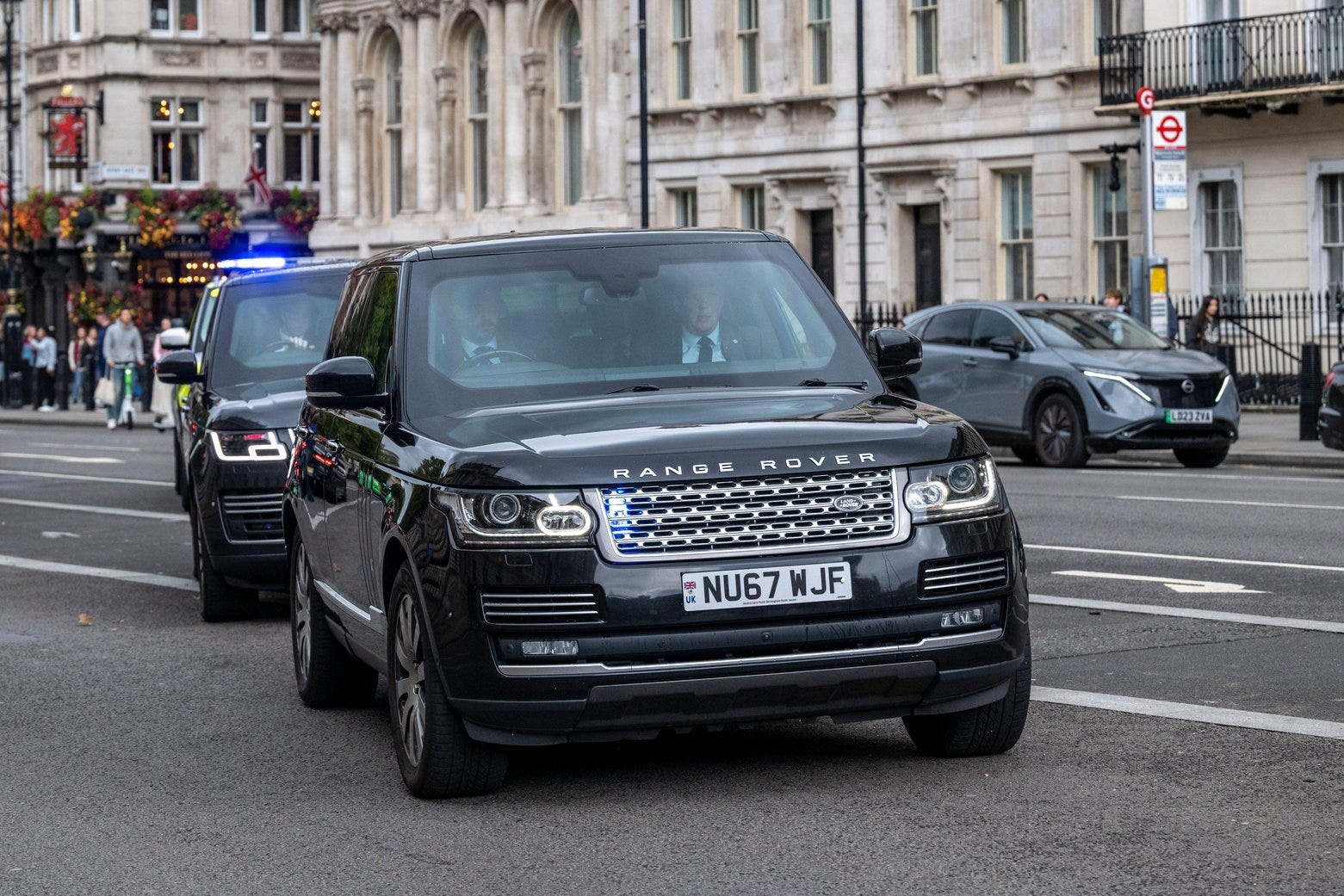
Oliver Lord, of campaigning organisation Clean Cities, said that such measures are usually enforced by taking into account either a car’s physical size or its weight. He said the rapidly increasing height of cars on London’s roads is a “major cause for concern when it comes to visibility of children, and hitting people in their vital organs”.
Reducing SUV use shouldn’t be done by purely punitive measures, he said. It’s also about providing alternatives for people, particularly after the departure of car-sharing company Zipcar from London: “TfL could be doing a lot more to point out that there are alternatives to buying huge cars.”
What are other cities doing?
Similar SUV taxes are usually achieved by charging more for parking. In Paris, fees for parking heavy cars have been tripled. In Cardiff a similar system is being introduced based on a car’s weight, while Bath is looking to charge more for parking based on vehicle size.
But the mayor and Transport for London don’t have London-wide control over parking, which tends to be devolved to the 33 local authorities. (Haringey council has already introduced a small surcharge on cars over four metres in length.)
Instead, this suggests any London-wide system would have to be enforced using TfL’s existing ULEZ and Congestion Charge cameras – if they’ve not been blown up. This system already works to enforce new safety standards on lorries entering Greater London.
What about just taxing all cars?
Fundamentally there’s a political tension at the heart of all of the mayor’s Vision Zero work. As TfL itself puts it in the report, cutting private car usage is “one of the most effective ways to cut road danger”. And the fastest way to reduce private car use is to make it more expensive and annoying to drive a car. Understandably, people who rely on their car or feel they don’t have suitable public transport alternatives, especially in outer London, don’t like the idea of having to pay more for something they see as a necessity.
As London Centric previously revealed, TfL had developed detailed plans to introduce per-mile road charging in London. But these were scrapped ahead of the 2024 mayoral election, amid fears that the policy could hit both Sadiq Khan’s re-election campaign and Labour’s national election campaign. Since then private car usage has continued to creep up in London, in direct contravention of the mayor’s objectives.
What else does the mayor’s Vision Zero report propose?
The report makes 43 commitments to reducing risks on the road, including:
Making 20mph the default maximum speed in London
More enforcement against illegal number plates by targeting the use of ghost and cloned plates
Making it easier for the public to report dangerous driving using footage from dashcams and helmet cameras
Installing 1,000 new zebra and signal-controlled pedestrian crossings
Tackling the use of unsafe and non-road-legal e-bikes and e-motorcycles.
Focusing on making high streets safer, as they are where 46 per cent of all deaths and serious injuries in London occur
Londonmaxxed out
One of the strangest things about the decay of old social media platforms, especially X – the site formerly known as Twitter – is how a trend can feel ubiquitous to users of one platform without it ever reaching the rest of the population.
Which is what happened with “Londonmaxxing”, a nebulous term that began to be used ten days ago by a group of young tech workers who were seemingly motivated by a) genuine enthusiasm about the capital’s economic prospects especially around investment in artificial intelligence, b) their enjoyment of living in a big city that, unlike Dubai, isn’t arresting Londoners for posting about drone attacks, c) both.
“Londonmaxxing” briefly went viral on Elon Musk’s social media platform, prompting Sadiq Khan to change his X bio to include the term, as part of his pitch to convince AI companies such as Anthropic to move more staff to the capital.

Anuj Mishra of City University tracked down Charlie Ward, the boss of a co-working space, who is credited with coming up with the term. He said: “People like Londonmaxxing because there’s a lot of people who actually really love living here and who see a lot of potential here. It’s definitely a reaction to the negativity.”
Within a week – according to Google search traffic – the term Londonmaxxing appears to have died. But the moment reveals a strange story: X and many other platforms have become overwhelmed with videos portraying London as being in a state of complete collapse. As a result, anyone trying to be remotely positive about the city has to come up with a whole new term if they want to cut through the negativity and express a mildly positive opinion about the capital on the platform.
“Car is a necessity not a luxury”: How Newham’s election is being fought on the right to drive
While Sadiq Khan is threatening to tax SUVs, elsewhere in London low-traffic neighbourhoods and pedestrianisation are a key battleground for May’s borough-level elections. In January, the court of appeal ruled that Tower Hamlets mayor Lutfur Rahman had acted unlawfully in carrying out his election-winning pledge to remove LTNs. In Croydon, it was ruled several LTNs were illegal because they had been introduced to raise money.
Now, the future of a key climate policy in the east London borough of Newham looks uncertain, with both Labour and its main challenger outbidding each other with pledges to make it cheaper to park a car in the borough.
Back in 2019, the local Labour leadership declared a climate emergency in the borough, introducing an emissions-based parking permit system whereby higher polluting vehicles pay more but electric vehicles get a permit for free.
Now, this is almost certain to change.
Mehmood Mirza, the Newham Independents’ mayoral candidate, initially targeted Labour over its policies on the war in Gaza but has now branched out into maintaining weekly bin collections, providing plentiful free parking, and build a new multi-storey car park in Forest Gate.
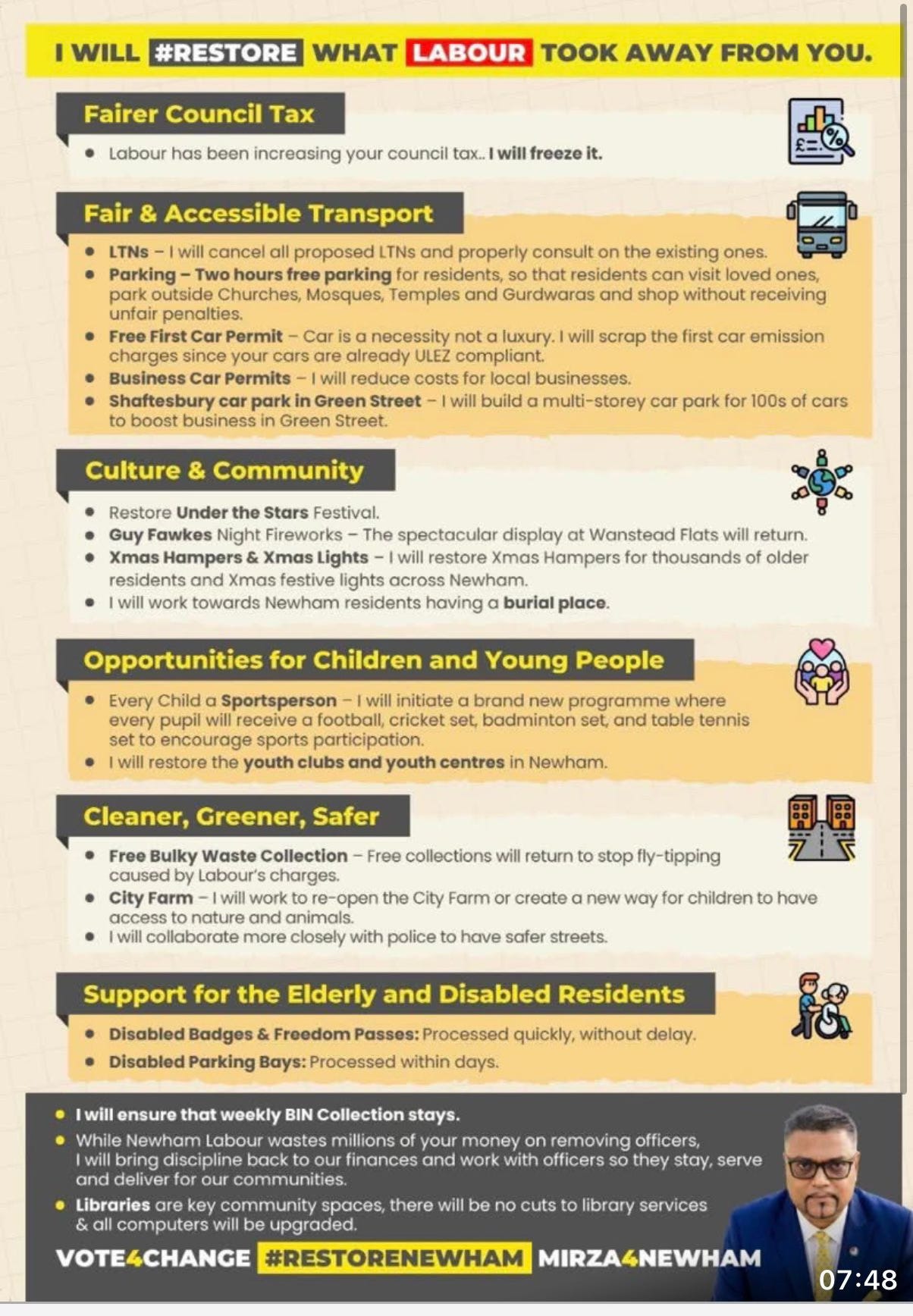
He’s promised to not only scrap the first car charges, but offer two hours free parking for residents, cancel all proposed LTNs and “properly consult” on the existing ones, and build a multi-storey car park for 100s of cars.
“Car is a necessity not a luxury,” he said in his leaflets.
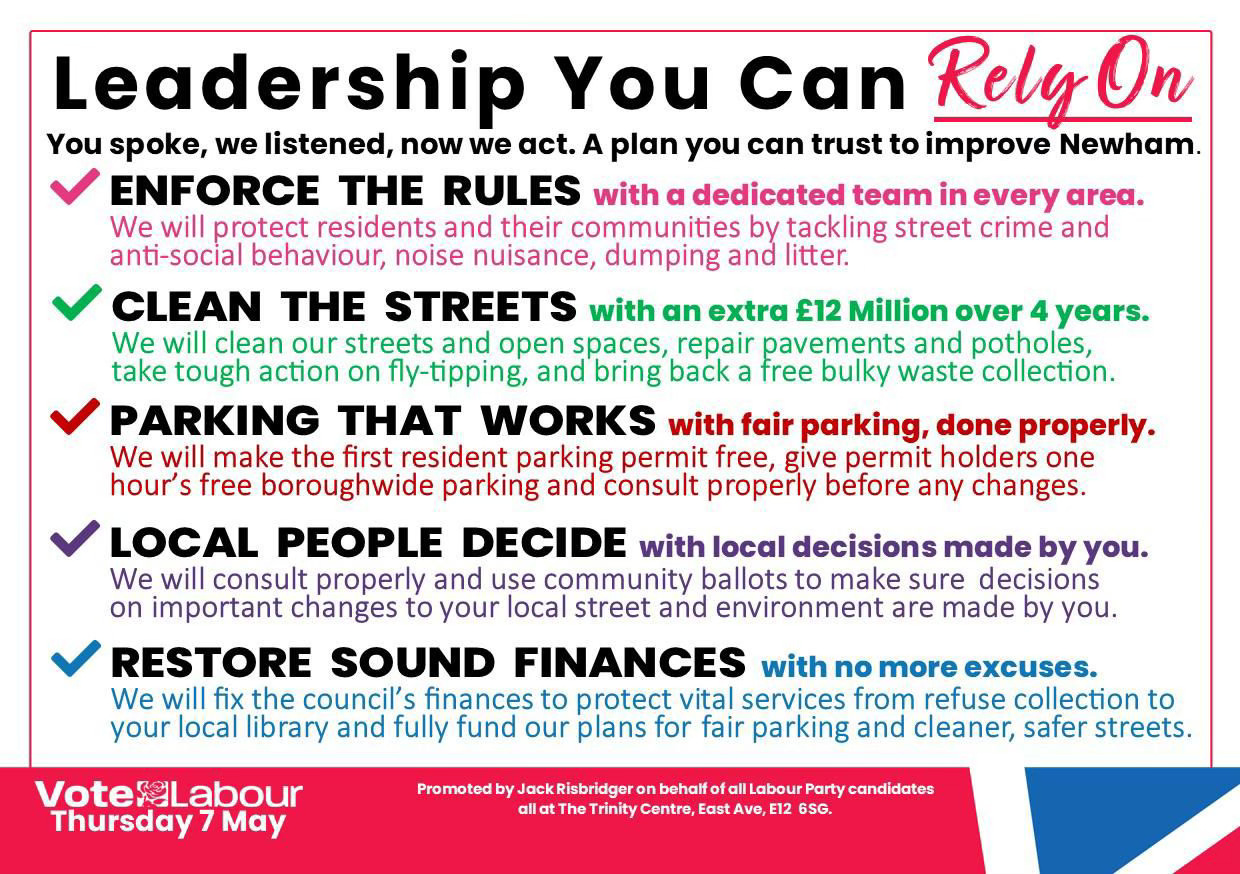
In response, Labour’s mayoral candidate Forhad Hussain has now also pledged to reverse his own party’s emissions-based permit system if he wins election. This means giving the first car permit for free, as well as providing one hour of free parking across the borough.
Newham’s Green Party mayoral candidate Areeq Chowdhury, who defected from Labour, told London Centric that “abolishing car parking charges will cost the council millions of pounds” and take away funding from services such as youth centres and housing repairs. Yet even the Greens have pledged to review emissions-based permits, with the possibility of instead moving to a weight-based car parking system.
Labour has dominated Newham for years and during the 2010s held every seat on the council under former leader Robin Wales. Now the party’s support is fragmenting, with Wales joining Nigel Farage’s Reform UK and the Newham Independents and Greens picking up votes. If control of the council does switch in May, there’ll be a lot written about the big factors at play – but parking charges might be just as important.
Big scoops elsewhere
Sometimes in journalism you get scooped and miss out on an exclusive story. And sometimes you get scooped on a story about ice cream. Which is why we’ve got to give a nod to Andy Silvester at The Times for being first to highlight the toxic Magnum odour pumped into the pedestrian tunnels at King’s Cross St Pancras tube station.
We also have to recognise the valiant work of Robert Smith of the Financial Times, who has attempted to explain a wildly complicated British business scandal that is costing Wall Street banks billions of pounds by tracking down its connection to a greasy spoon cafe in Edgware.
Want to get in touch with London Centric? Click here to send an email or WhatsApp.
“Car is a necessity not a luxury,” says the Independent candidate for mayor of Newham. Given half of all residents in the borough don’t own or have access to a car, I wonder how he thinks they survive. Does he imagine they are all sat at home, unemployed and starving because they can’t get out to find a job or go to the shops?
Last week Sam Freedman suggested in his politics newsletter that Labour should do a better job of picking fights to help their popular policies get more attention, with an example:
“One technique they could use much more effectively is to go after individuals or companies whose behaviour justify their policies. For instance, they could use the mass evictions by Asif Aziz’s Criterion Capital (brilliantly uncovered by London Centric) to highlight policies to protect renters.”
From the PMQs exchange you discuss at the top, it seems like Labour have been paying attention.
Very glad you are keeping up the scrutiny on these slimeballs, looking forward to your next report on what’s going on inside Criterion Capital.