

Predicting every London election result
Plus: What's the tube strike ACTUALLY about?


Today we’ve got a very exciting collaboration with Sam Freedman, who co-writes the influential Comment is Freed newsletter. He’s analysed the polling and local trends across the capital, put his money where his mouth is, and has predicted the outcome of every single election in London next month.
Scroll right down to the end of this post to find out who Sam believes will be running your local council after the capital’s voters go to the polls…
But first we’ve been reporting on what’s really behind this week’s tube strike, in a bid to cut through the political bluster and media pontificating. At its heart there is a knotty row about trade union rivalries and different visions of what it means to work a four-day week.
There was a massive reaction to Saturday’s piece reporting the reality of shoplifting at branches of Greggs – do check out the comments section for a fascinating and considered discussion.
Your definitive guide to what’s really going on with the tube strike
By Polly Smythe
Why are some tube drivers going on strike this week?
London’s tube drivers currently work 38.5 hours a week, plus unpaid lunch breaks, spread over five days. Last year Transport for London bosses offered to reduce this to a 35-hour working week across four days – and include lunch breaks in the paid hours.
To understand why this would lead to strike action, you have to understand trade union politics.
London’s tube drivers are represented by two separate unions, the RMT and Aslef.
Aslef, which represents just over half of the capital’s tube drivers, welcomed TfL’s proposal, calling it “exactly the sort of deal every trade union should be trying to achieve.”
But the RMT has opposed TfL’s proposal, arguing that the new arrangement amounts to five days’ work crammed into four rather than a meaningful reduction in hours worked. Its members are going on strike to demand a maximum of 32 hours work spread across four days.
Is the shift to four days optional or not?
TfL has said it will begin to implement the Aslef-backed 35-hour week proposal on a voluntary basis.
This is soon to be tested among drivers on the Bakerloo line, with new rotas being drawn up and other reforms such as tablet computers being issued to drivers as part of a move away from paper-based systems.
The RMT says that it has had no guarantee that members can stay on the old five-day week rota without accepting other changes to terms and conditions, and that the four-day week was not “designed to fit alongside the old shift patterns, but is designed to replace it”.
Essentially, the fear at the RMT is that the Aslef-backed version of a four-day working week will quickly become the default, without the support of RMT members who want to hold out for a shorter version of the four-day working week.
Inter-union rivalry
While Aslef represents only drivers, the RMT represents many different kinds of transport workers on the underground. The two compete for tube drivers who are willing to pay membership fees.
There are lots of reasons why drivers might choose one union over the other, including the popularity of different unions in different depots, and the RMT having a reputation for being more radical.
Aslef told London Centric it was “surprised that the RMT has decided to take this action” and strike this week.
Finn Brennan, an Aslef organiser on the London Underground, said that drivers won’t be forced to work a four-day week if they don’t want to: “Anyone who wants to keep working a five-day week will be able to. Most people will regard that as a pretty good deal!”
Will tube drivers cross a picket line?
Even when the two rival unions have adopted different approaches in the past they’ve usually refrained from making direct public criticisms of each other. This time it’s different. Aslef previously dismissed the RMT strike action as “the first strike in the history of the trade union movement designed to stop people having a shorter working week and more time off”.
Because Aslef members aren’t on strike, they’ll be rostered to drive trains as normal, raising the difficult question of what will happen if Aslef members encounter an RMT picket line – and whether some tube drivers turning up for work will walk past striking colleagues.
Although the two unions have disagreed before, this is a severe and unusually public split. It’s been a long time since one union has taken strike action and the other has not.
Hang on, how long do tube drivers actually spend working?
This is often summarised vaguely by media outlets, TfL, and the unions themselves. After countless phone calls London Centric thinks we’ve finally got the answer.
At the moment, TfL schedules tube drivers to work 36 hours a week and pays them for 35. They’re not expected to actually work that extra hour, and instead are allowed to bank it and take it as leave. Their shifts last seven hours and 42 minutes per day, including an unpaid 30-minute lunch break.
The new proposal is that TfL schedules drivers to work 34 hours a week but pays them for 35 hours. The new shifts will last eight hours and 30 minutes every day and include a paid lunch break. At some point, TfL will claim back the missing hours and will instruct the driver to use them for non-driving tasks, such as attending a safety course.
Correction: This article originally said shifts currently last seven hours and 42 minutes per day, excluding an unpaid 30-minute lunch break. They actually last that long including an unpaid 30-minute lunch break.
How bad will this week’s disruption be?
The 24-hour strikes have been arranged to run from midday-to-midday in order to maximise disruption over two days, as the system takes time to recover.
But travel chaos won’t be as bad as last September, when almost the entire underground came to a halt, as that action saw both Aslef and the RMT strike at the same time. The Elizabeth line, DLR, London Overground and Trams will be running although they will be busier than normal. The lines that will be worst affected are ones where the RMT is stronger, such as the Central, Piccadilly, Metropolitan and Circle lines.
The political response is largely as expected, with Conservatives condemning the unions, the Lib Dems bemoaning the impact of the strikes, Reform calling for driverless trains, Labour’s Sadiq Khan staying out of the fray while briefing that he is disappointed that a deal could not be reached, and the Greens’ Zack Polanski backing the RMT.
A modest Lime proposal
The days when London Underground unions had a stranglehold on London’s transport system have been undermined by the Elizabeth line and the strike-busting rental e-bike. Lime, Forest, and Voi are gearing up for some of their busiest days ever during the strike, with the potential to win thousands of new customers who need an alternative way to get to work. One London Centric reader has pre-emptively been in touch with a proposal that the operators reserve e-bikes for existing regular customers, in the hope that Lime’s bosses read this. “I can’t be the only regular user getting pissed off at daytrippers on strike days,” they said, complaining about being overtaken by a “fat besuited banker looking like he’s riding a bucking bronco while you have to walk two miles to get a bike.”
Elsewhere in the in the news
London Centric was this week quoted on Radio 4’s News Quiz, a French media outlet, and — most intriguingly — east London’s ReviveFM. Following our reporting on the purchase of a council house by Newham’s Labour mayoral candidate Farhad Hussain, the issue was raised in Revive’s online leadership hustings. Hussain said the coverage is “libellous” and “gutter politics”. You can watch his response here. One of the obstacles to Hussain clarifying the record about his transaction is that the solicitors he used for the purchase are no longer trading.
London election predictions: Who will win in your area?
Sam Freedman is the co-author of the Comment is Freed newsletter, which covers everything from UK politics to the war in Iran. He’s a former government adviser whose work is read widely by Westminster politicians and the civil service. Sam’s been a supporter of London Centric since the start – so we asked if he’d be willing to collaborate on his predictions for London’s elections.
For those who aren’t in the weeds on London local politics, this is what’s happening: every council seat in the capital’s 32 local boroughs is up for election at the same time on Thursday 7 May.
The last time this happened was in 2022, when Labour was surging in the polls and Boris Johnson’s government was reeling from a series of self-inflicted scandals. Back then Labour dominated the capital and won every seat on some inner London councils. The Tories and Lib Dems clung on to their strongholds, the Greens made a tiny number of strategic gains, and Reform UK barely stood any candidates.
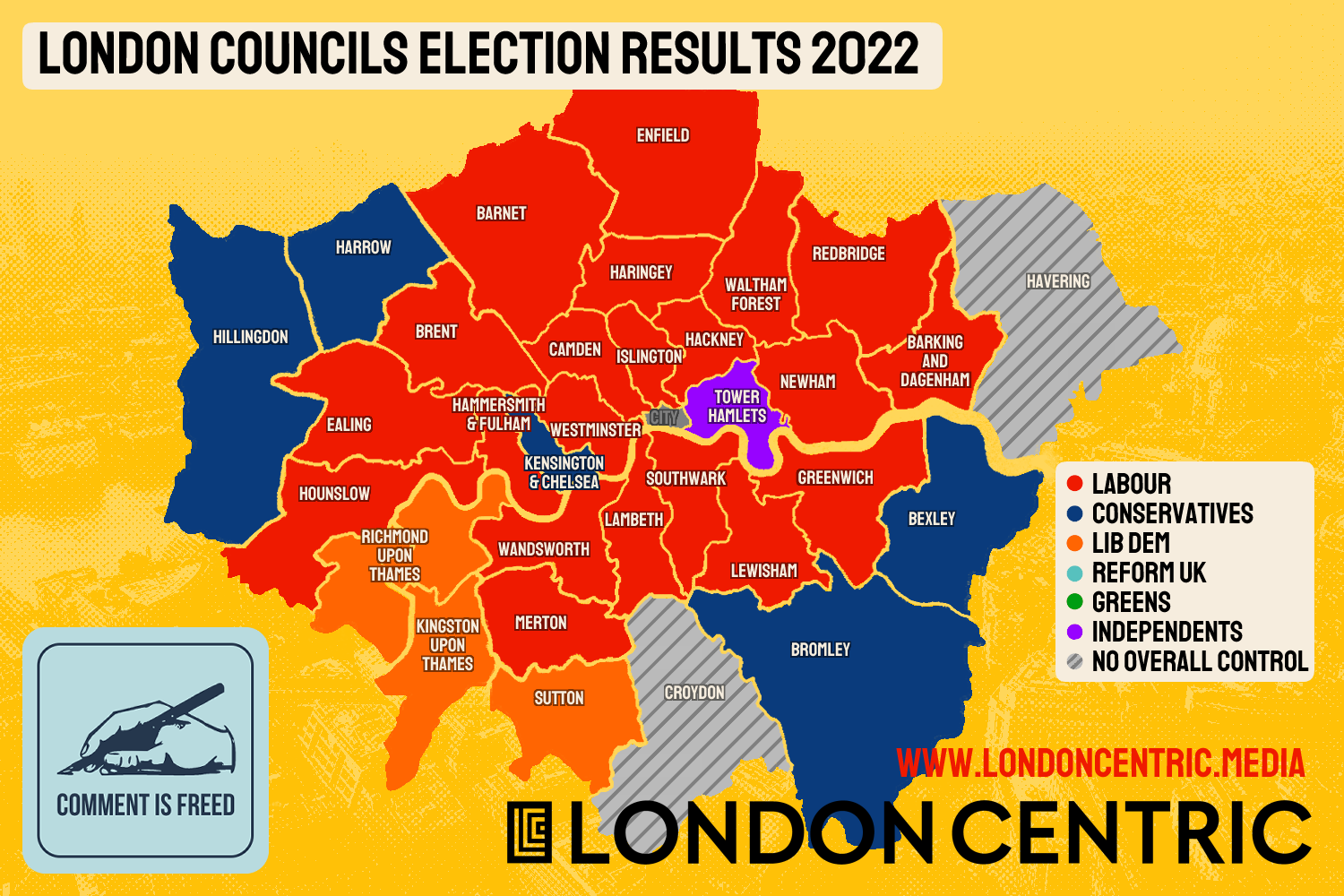
This time around, those five parties are standing in almost every ward and will be competitive in many of them. Due to the first-past-the-post voting system, this means voters on the left and right of politics are struggling to work out which party is best placed to win in their particular local area. Polls suggest there’s going to be a great deal of change. The Greens and Reform UK are hoping to take their first London councils (London Centric readers can learn about Reform’s leaked campaign tactics here) but there could also be a large number of local boroughs with “no overall control”. This is where rival parties have to form coalition deals with each other in order to secure enough councillors to form a working administration – or try to govern as a minority.
What follows are not London Centric’s predictions – they’re the work of Sam, an informed analyst who is willing to put his money where his mouth is. Do get stuck into the comments and let us know if you agree, or not.
This is how he predicts every corner of London will vote next month:
Keep reading with a 7-day free trial
Subscribe to London Centric to keep reading this post and get 7 days of free access to the full post archives.