

London's rental scammers have infiltrated the schemes meant to stop them
London's scammers find a new tactic • "I felt sick... They’re doing everything except for actually having a flat." • What happens when the scammers get inside the systems?


When Callum turned up to collect the keys for his new flat in Stoke Newington he was excited to move in.
He’d viewed it a few weeks previously, when he was shown around by a chatty young woman from Islington’s Anchor Gate lettings agency. Aware of the risk of London’s increasingly infamous rental scams, he’d first checked the letting agent was a member of a government-approved scheme, carrying the royal coat of arms, to ensure he was dealing with a legitimate operator.
Anchor Gate passed every test. Suitably reassured, he paid the agency £3,500 to cover his deposit and first month’s rent for the east London property.
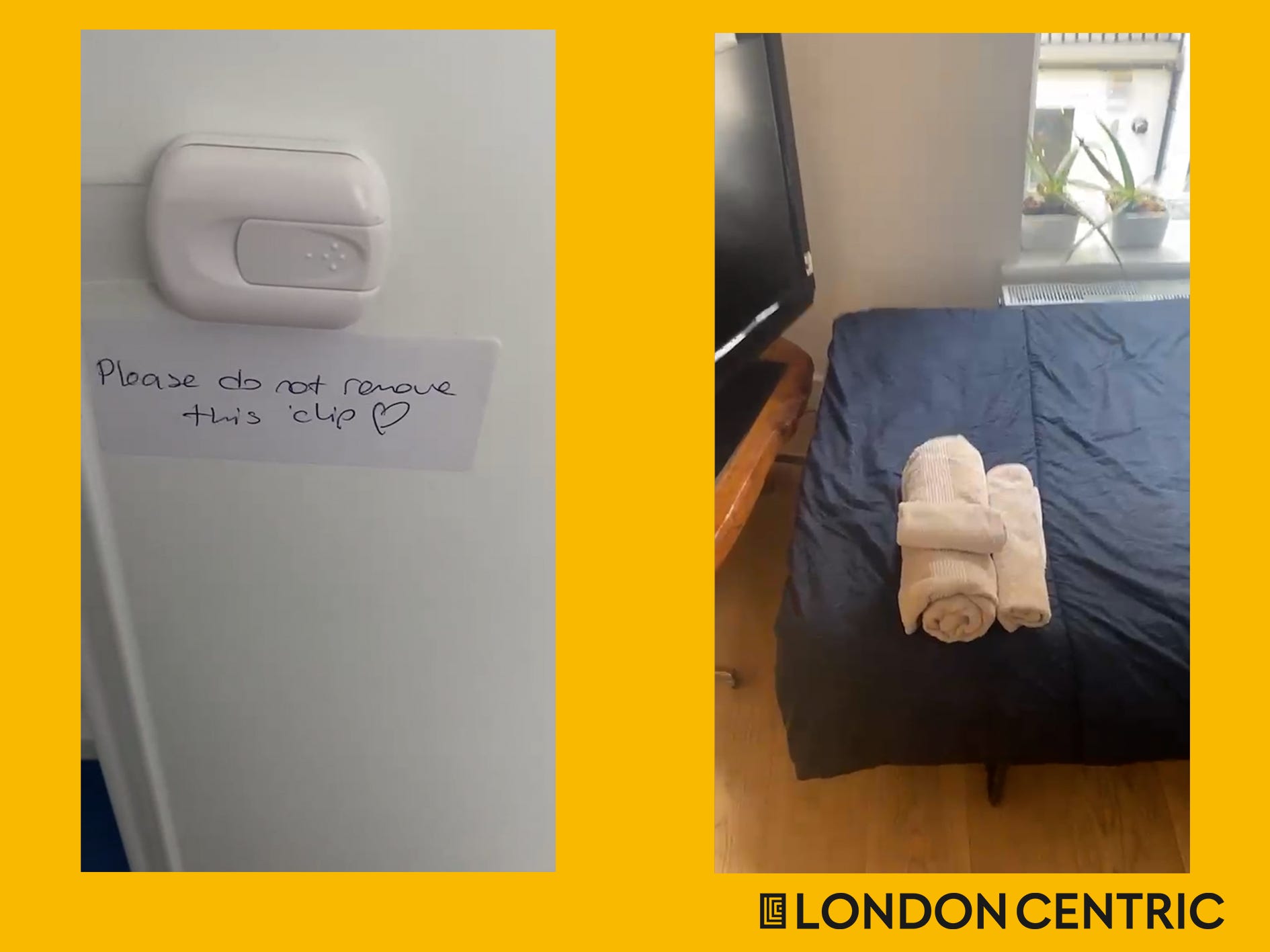
Yet when he arrived to move in he discovered his new flat’s door was open. Inside was a group of baffled tourists who had rented the Hackney property for a lads’ holiday to the capital.
The young woman who had shown him around the flat was unreachable. The email for Anchor Gate had gone dead.

Rather than being a flat available for a long-term tenancy, he had actually been shown around a property rented from Booking.com by scammers for a weekend and used to dupe people looking for a place to live into paying deposits.
Callum realised he had been robbed of thousands of pounds: “Immediately I felt sick, I knew then this was a scam. While I was still in the flat I called the police and called the bank.”
What baffled him was this: how had a fraudulent estate agent been able to gain real membership of government-approved schemes designed to protect renters from dodgy estate agents?
After weeks of reporting across the capital in a bid to hunt down those responsible, London Centric can reveal just how sophisticated the capital’s rental scam industry has become – and how official systems designed to protect renters have instead been infiltrated by scammers.
Like many of our best stories, this one came from our WhatsApp inbox. Callum is a London Centric subscriber who wanted us to track down who was responsible. Please do drop us a line if you have something you want investigating.
Callum shared many personal documents, including his passport and address, with these criminals during the scam. To protect his identity he asked that his name be changed.
How the scam plays out
Callum found the property, a one-bedroom flat, in March on listings website OpenRent. The young woman who met him at the property handed over a business card featuring two contact numbers and a company number, the unique code a business gets when it’s incorporated at Companies House.

In a classic estate agent trick to drive up competition in London’s overheated private rental market, Callum was shown around at the same time as another couple who were also prospective tenants.
Worried the other couple would put in an offer, he messaged Anchor Gate’s head office immediately following the viewing. An agent called Grayson Elliot-Reed replied to say it was Callum’s flat if he wanted it. Callum now wonders how many other would-be tenants were told the same thing about the same flat that weekend and whether the couple were also duped.
Ironically, Callum told London Centric that the only remarkable thing about Anchor Gate Lettings was just how professional, thorough, and responsive they were for a London estate agency. Anchor Gate head office asked for Callum’s work references, his current landlord’s contact details, bank statements, and a copy of his passport. They even sent him legitimate-looking gas certificates and electrical safety paperwork.
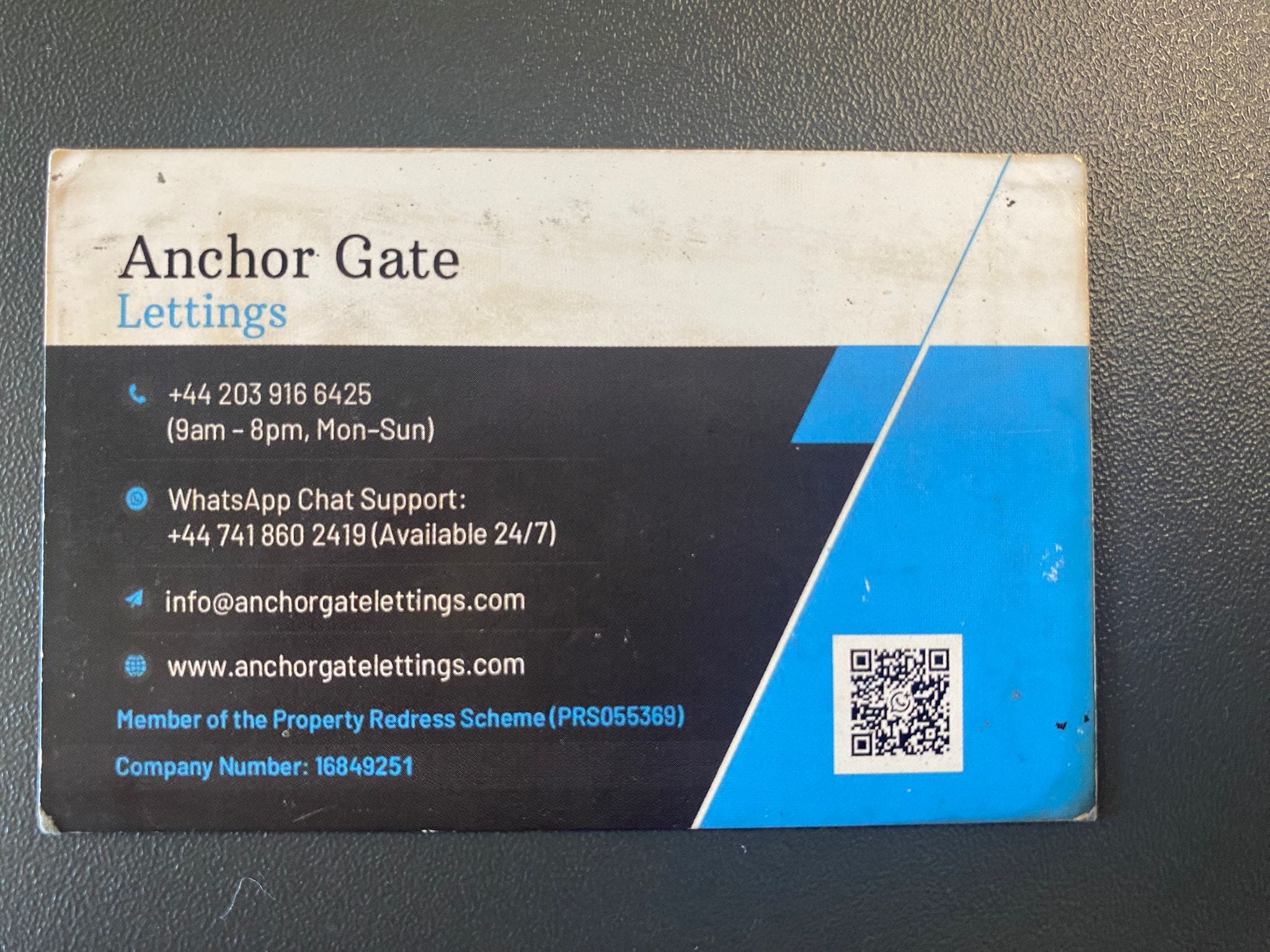
He was mildly confused when Anchor Gate asked to take the discussion off OpenRent’s in-house platform and onto email. But there was one thing that gave him complete confidence. For the last decade, all letting agencies have had to join a government-sanctioned scheme to deal with complaints about their behaviour.
The government authorises private companies to operate these registers under licence, which can then carry the logos of the Ministry of Housing, Communities and Local Government and National Trading Standards.
One of these companies is called the Property Redress Scheme. It makes millions of pounds a year in profit by charging an annual fee to letting agents, who are effectively paying for the government stamp of approval. The more agents the Property Redress Scheme signs up, the more money it makes for its owner, major US insurance company Brown & Brown.
As rental scams become more commonly reported across the capital, London tenants have become more savvy. In response, it seems the scammers have now realised that, for a few hundred pounds, you can repeatedly set up fake lettings agencies with all the hallmarks of a legitimate business and stamps of approval from the British state.
Last November the scammers who targeted Callum paid £50 to register Anchor Gate Lettings Ltd at Companies House.
Then they paid £190 to join the Property Redress Scheme’s public register of letting agents. The scammers also paid £27 to insure a deposit with the separate government-backed protection scheme MyDeposits. For less than £250 they were able to repeatedly highlight their legitimate use of government-endorsed registers as evidence that people could trust them with thousands of pounds.
Tracking down the scammers
The paperwork Callum was sent was fake but the money he transferred was very real – to a Revolut bank account in the name “Gemma Gascoine”, his supposed new landlord.
He was also given an address for Gascoine in Chigwell, at the Essex end of the Central Line, which London Centric visited in May. On the doorstep we were greeted by a confused man. He said we weren’t the first visitors who had turned up asking for their money back from the mysterious Gascoine, who didn’t live there.
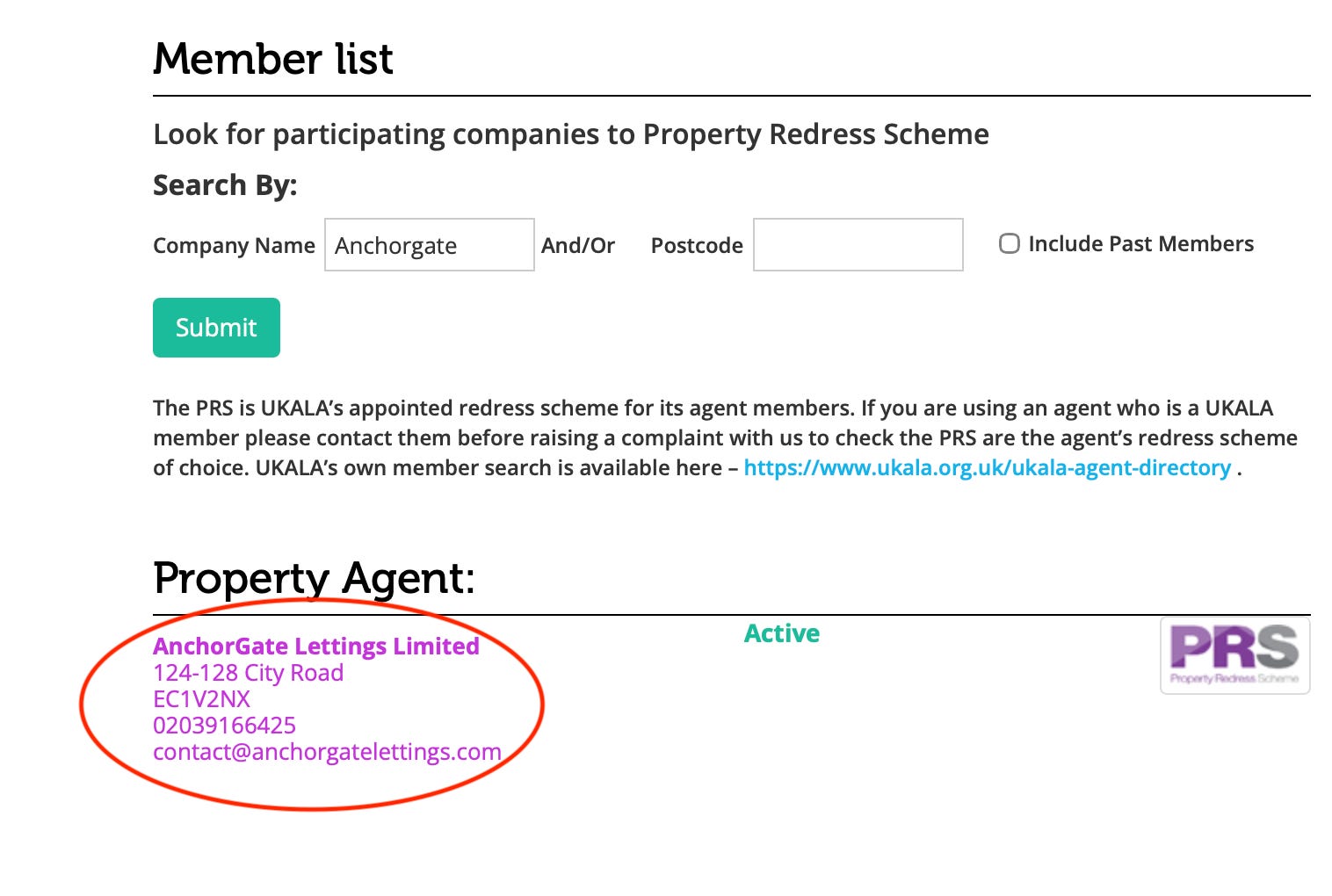
We asked the Property Redress Scheme what checks it carried out to verify that Anchor Gate, a newly formed company, registered to a shared office address on City Road in London, was a legitimate lettings company before putting it on a government-approved register. Neither they nor the government responded to multiple requests for comment.
The Anchor Gate website is no longer live after scamming Londoners out of thousands of pounds. Despite this, the company still appears on the Property Redress Scheme’s public register. That’s despite London Centric repeatedly telling the Property Redress Scheme more than a month ago that it is still endorsing a scam estate agency.
The final clue
We attempted to put all of our findings to the scammers behind Anchor Gate but failed. Everything bounced back and its registered office on City Road refused to take our physical right of reply. Anchor Gate’s sole registered director, a British national called Vladimir Kuzmin, could not be traced.
But there was one final clue.
A copy-and-paste error in the emails sent by the scammers suggested the same group had, a few months earlier, pulled the same trick using a different fake estate agency name.
Just like with Anchor Gate, this second fake estate agency is still registered with the same government-backed scheme. It also has a single named director, who we tracked to an address in Bushey, a Hertfordshire town just inside the M25.
After some consideration, we’re choosing not to name this individual. He didn’t answer his door and his social media posts reveal a string of recent misfortunes including briefly being made homeless and suffering severe health challenges that led to him desperately appealing for money on GoFundMe. We also don’t have any evidence he was involved in running the actual rental scam.
Instead, he fits the pattern we’ve seen with other dodgy London businesses, where a struggling individual is paid a token sum to sign the legal paperwork and take the blame on behalf of the scam’s real operators.
“They’re doing everything except for actually having a flat”
We contacted MyDeposits, which said that rather than handing over Callum’s full deposit, the scammers had posed as a private landlord and paid just £27 for an insurance product, which was enough to produce an authentic link they could send to victims. The company said private landlords “are able to register deposits directly with the scheme in accordance with tenancy deposit legislation”.
Proof that the deposit was protected in a government-approved scheme was used by the scammers in emails to convince Callum that they were legitimate and should be sent more money. While MyDeposits stresses that the existence of a deposit registration is “not designed to operate as property ownership or tenancy verification” it was enough to silence any of Callum’s doubts.
Callum was lucky. In the end he was able to get his rent and deposit back through his bank after it accepted he had been a victim of fraud. But many other victims across London may still be out of pocket. He remains frustrated that London scammers have gained access to the systems meant to protect renters and wants the government to take action.
He’s also now wary of lettings agents that seem professional, given the slickness of the Anchor Gate operation: “When I called their number they even had a message which said the call would be recorded for training and monitoring. They’re doing everything except for actually having a flat. That’s the one bit they don’t have.”
In its emails to scam victims, Anchor Gate stated “we are proud members of the Property Redress Scheme (membership PRS055369)”. Even though their entire business was a fraud, they were telling the truth on this point. It’s just that the guardrails put in place by the authorities to protect tenants are now aiding the criminals in duping the public.
PS…. We’ll be back next week. In the meantime, word reaches London Centric that one person who might have to deal with London estate agents soon is media baron Lord Lebedev, the owner of the London Standard, longevity podcaster, and a big supporter of London Centric.
We’ve spotted that he’s put his eight-bedroom Stud House in the grounds of Hampton Court Palace up for sale with Knight Frank at a cool £25m. The property has been owned by the Lebedev family for almost two decades and is known for being the site of garden parties featuring everyone from Boris Johnson to Rupert Murdoch and Tracey Emin to Joan Collins. Property records show that in 2020, at the height of the Covid pandemic, a loan was secured against the property by Lebedev, who has reduced the scope of his London media interests in recent years.
PPS… FIFA has U-turned on its plans to move England’s World Cup match against Mexico earlier in the day and will stick with a 1am BST kick-off. Expect to see a lot of bleary-eyed and/or teary-eyed people on the streets of the capital on Monday morning. One east London primary school has pre-emptively announced it won’t open until 10.15am on Monday. The headteacher told parents: “To support our students, families and staff following what is likely to be a late night for many, we have decided to take the decision to introduce a late start to the school day on Monday 6th July.” As one parent told us, the school didn’t adjust its hours during the heatwave and battled through. But the football is too much.
Obviously as boring old-fashioned journalists we repeatedly asked the Property Redress Scheme for comment over many weeks. No word and we still don't know what went wrong with their checks and what those checks involve.
I was able to get quite far with registering London Centric as an estate agent on their system (I didn't want to check if our application would be approved because I didn't want to waste the fee).
If you want to check their live register, you can search it here. It's still got the scam company at the heart of this story listed as a full active member despite our repeated warnings: https://www.propertyredress.co.uk/agent-finder
The Property Redress Scheme company accounts are here, showing a good profit from collecting these fees: https://find-and-update.company-information.service.gov.uk/company/08994516/filing-history
Note without comment this quote given to the trade press in 2023 that "we pride ourselves on having a simple joining process". https://thenegotiator.co.uk/news/buying-agent-slams-tpo-as-fat-and-lazy-and-signs-up-to-competitor/
The quality of this report is outstanding.