

Can Reform win Outer London?
Nigel Farage hopes to take control of councils across outer London this week. What's happening in the suburbs?


London Centric will be back to its usual mix of investigations, exposés on dubious scams, and reporting on life in the capital from next week. But in election week it only seems right to keep you regularly updated on what could be one of the most seismic shifts in the capital’s politics in recent years.
Exactly a decade ago I chaired a local election hustings on how to fix London’s rental housing crisis. The Liberal Democrats – then polling around historic lows – were represented by a confident new party activist. He told the audience about the devastating impact that dodgy private landlords had had on his life.
Still, he had little time for Green Party mayoral candidate Sian Berry and her proposals to introduce caps on the rent paid by private renters. Rent controls, the Lib Dem explained, were worth looking at but had failed in San Francisco and Berlin where they led to evictions and caused “pure gentrification”. The solution to the capital’s housing crisis, he said, would instead come through constructing hundreds of thousands of new homes across the capital. “This is really a problem of supply,” he explained.
That Liberal Democrat activist was called Zack Polanski. He later left the party after an unsuccessful attempt to be selected as the Lib Dem candidate for the Richmond Park by-election, found a new home in the Greens, and as many people do over the course of a decade, developed different political views.
I’d forgotten about that debate until I stumbled across a recording on YouTube last week, uploaded by campaign group Generation Rent. It’s not exactly the most fascinating watch. The chair could definitely have done with asking better, more precise questions. But it is interesting to hear the voice of Polanski, who has gone from unknown to nationally famous over the last year, making different arguments for solving the capital’s housing crisis. This week will decide whether he can lead the Greens to an unprecedented breakthrough in London – this time running on a policy platform that promises to campaign for rent controls and radical curbs on the profits of private developers.
This election in London is one of the most open ever – with the big story being whether two breakout radical parties can win entire councils. Polanski’s Greens are looking to advance at the expense of Labour in inner London.
But today we’re looking at whether Nigel Farage’s Reform UK can win the outer suburbs from the Conservatives.
Reminder: London Centric partnered with Comment is Freed to host Sam Freedman’s London election predictions. Do have a look and see if you agree. Still, remember, you can read all the predictions and journalism you like but it really comes down to how – and whether – people choose to vote on Thursday.
The Reform doughnut: On the road in the capital’s outer boroughs
By Polly Smythe and Jim Waterson
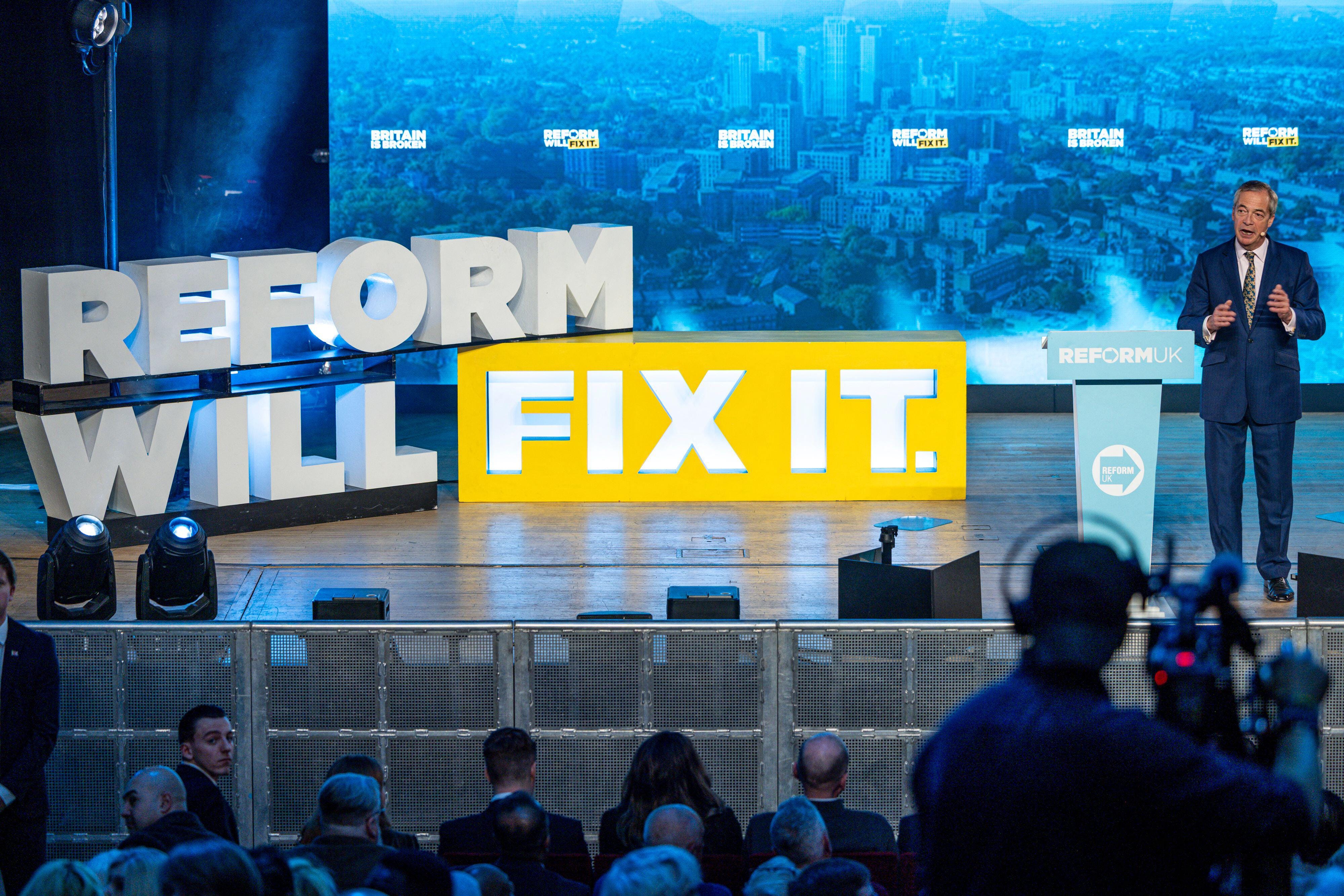
There were a lot of intriguing things about Reform UK’s London local election launch. There was Pete, half of mega-viral septuagenarian rap duo Pete & Bas, who told London Centric he was there out of exasperation with illegal e-bike riders outside his home. There was the woman who told us she was backing Reform to stop migrants “defecating in the streets”. Then there was the man originally from Ghana who said he was voting for Nigel Farage’s party because he’s still on the council housing waiting list after thirty years and objects to asylum seekers being housed ahead of him.
But probably the most telling aspect was that the sold-out rally didn’t take place in a central London venue. Instead, the big pitch to the capital’s voters took place in Croydon’s Fairfield Halls, deep in Zone 5.
In a recent BBC interview, Farage cheerfully explained why he felt his party was struggling to connect with voters in inner London: “Because we’re patriotic, we believe in the country, we’re very, very proud of British history, we respect the Judeo-Christian culture upon which literally the entirety of our civilisation was based. And somehow there are many in metropolitan London who just don’t take that view.”
If you recognise yourself in Farage’s depiction of “metropolitan London”, then you might be surprised by the talk of Reform making big gains in the capital this week.
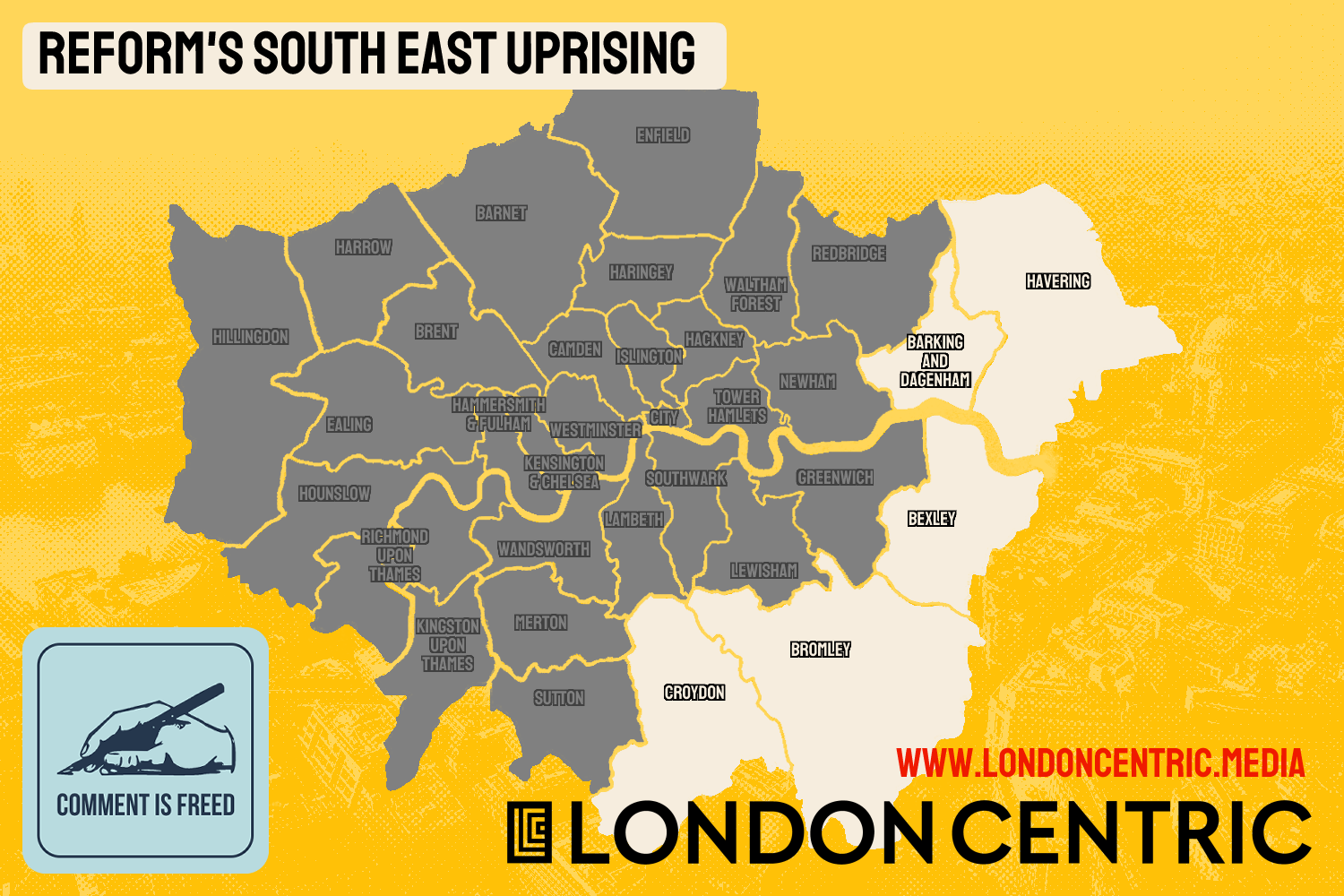
But it’s the outer boroughs – places such as Hillingdon, Havering, Bromley, and Bexley – where Reform is focusing its efforts. These are the local councils that will decide whether Nigel Farage has a good night in the capital on 7 May – and whether Reform can build a political base that will give it a realistic chance of winning the 2028 mayoral election.
In or Out?
Sometimes it feels like there are two Londons. There is the one that strongly identifies as ‘London’: the dense, diverse, often (but not exclusively) politically progressive core inside the North and South Circular roads. Then there is the other London, consisting of suburbs that only became part of the city in 1965. Here the car is still king, the population is often whiter, and wealthy streets sit alongside pockets of real deprivation.
Reform has bet its London campaign, along with hundreds of thousands of pounds in election spending, on taking control of councils in this second part of London.

Reform is, in other words, running a partial doughnut strategy, similar to the one Boris Johnson used to become mayor in 2008, when he courted outer-London commuters who had more in common demographically with the wider south east of England than with Hackney or Lambeth.
Part of this involves rejecting the narrative of London as a multicultural melting pot being a positive thing. For many of the older voters Reform is chasing, the 1965 expansion of Greater London remains a historic mistake that yoked them to a city they might visit but don’t feel like they belong to. And if you want to understand Nigel Farage, you have to understand the Reform UK leader’s links to one village that became part of the capital during his lifetime.
Keep reading with a 7-day free trial
Subscribe to London Centric to keep reading this post and get 7 days of free access to the full post archives.