

The London viral video crisis
Plus: "Gulf Candy" on Oxford Street, a £4m converted chapel in north London, and we finally get answers from Asif Aziz's Criterion Capital.


Last month I was sitting in a pub in Fleet Street with a group of Norwegian local journalists who were visiting. We were talking about the tension between London Centric’s ongoing reporting of pervasive low-level crime in the capital and our exposes of fake viral videos about the city being in a state of collapse. London, I argued, had serious problems but was in a much better place than your average YouTuber is incentivised to claim.
Unhelpfully, at this point a woman walked into the pub and, using a well-established distraction technique, placed a piece of paper over some of the phones on the table and used it as cover to steal the visitors’ devices.
In this instance, we grabbed the thief, who immediately surrendered the phones and headed off to find other victims. The pub manager said she was a regular visitor but there was no point in reporting her to the Met police. It wasn’t the best introduction to London for the Nordic visitors – and another reminder of how such experiences damage the capital’s reputation around the world.
Today we’ve got details about how the government is treating negative viral videos of London as a threat to Britain – with the acknowledgment by Sadiq Khan that the capital’s global reputation as a theft hotspot could damage the city’s economy.
We’re also bringing you some updates on our investigation into the dubious electricity certificates handed to residents of Asif Aziz’s Criterion Capital, the shift to Gulf Candy Stores on Oxford Street, and a chance to live in a £4m chapel.
Sadiq Khan asks British diplomats to fight back against “London Has Fallen” viral videos

Sadiq Khan joined the UK’s leading diplomats at the foreign office on Tuesday afternoon to discuss an issue that the government believes poses a real threat to the UK’s economy: viral videos showing London in a state of decline.
There is a concern in both City Hall and at the top levels of government that the massive popularity of such clips is putting off overseas investors and tourists from coming to the capital. As such, the UK’s leading diplomats – including Christian Turner, the newly-appointed ambassador to Washington DC – were briefed for an hour by both the mayor and Met Police commissioner Mark Rowley on how to fight back against the viral tide.
“There is a perception around the globe about London being unsafe,” Khan told the assembled diplomats, acknowledging the seriousness of the situation and arguing it didn’t reflect the progress made on reducing the murder rate and knife crime.
The issue is that in a global information marketplace, the days of the BBC defining global perceptions of London are fading. Instead, people tasked with attracting investment to the capital are more concerned about what an Indian businessman or a potential Singaporean tourist is seeing on their algorithmically-driven social media feeds.
It’s often not pretty.
Very real clips of disorder and theft on London’s streets are mixed with mislabelled footage of unrelated events elsewhere in the world, alongside completely fabricated stories about the capital. One major driving force has been the shift by platforms such as Elon Musk’s X, formerly Twitter, towards paying users who upload videos that go viral depending on how many views their content receives. In recent years creators have realised that so-called “London Has Fallen” content reliably gets huge numbers of shares, increasing the money they earn and incentivising the creation of more material.
Often it’s business executives’ personal fears about safety that drive wider business investment decisions. It’s unlikely that someone will want to relocate their company to London if they or their other half have spent hours watching videos about the theft of expensive watches or handbags.
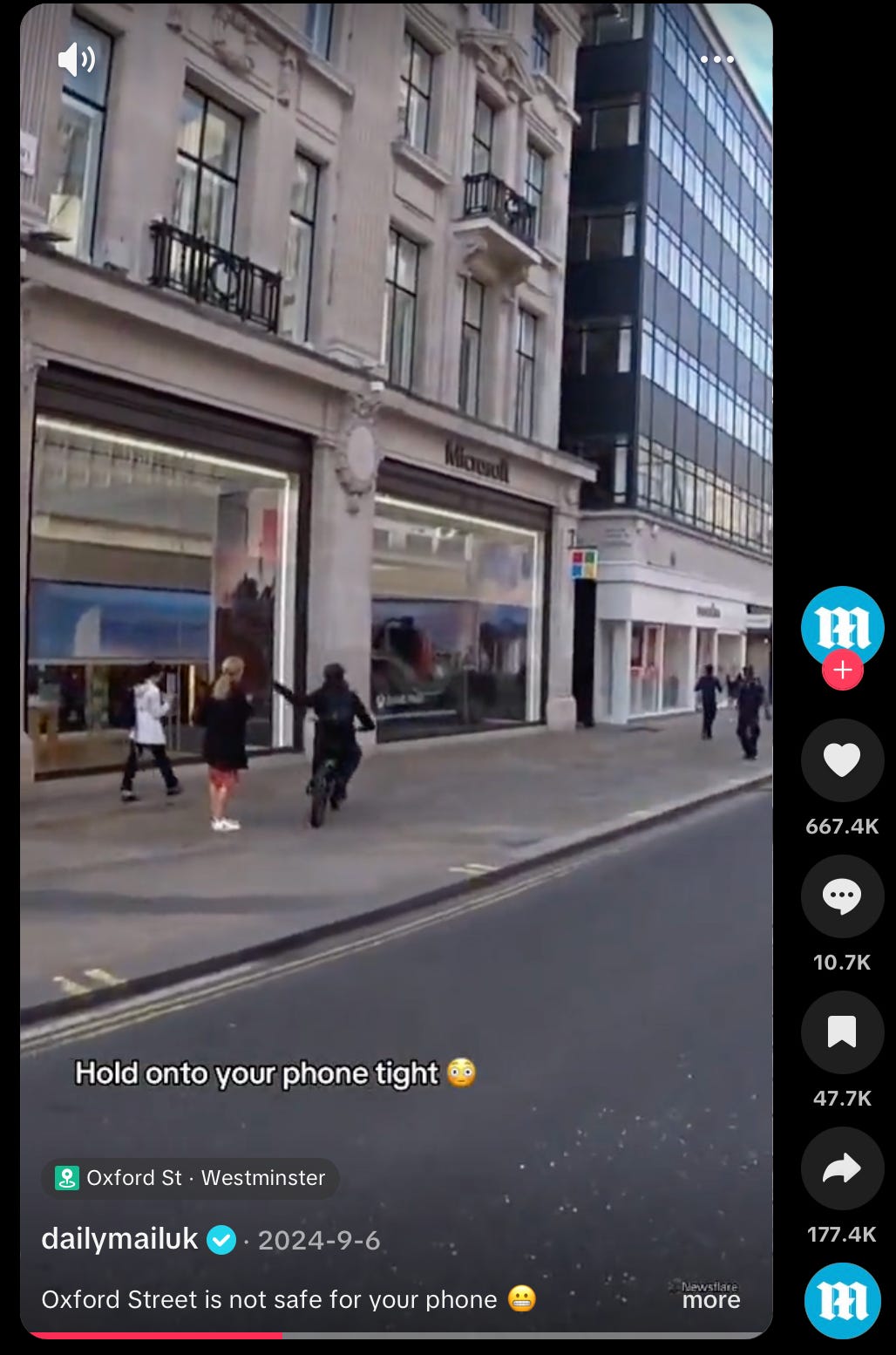
While many of the most viral clips about London are real, such as video of a recent daytime smash-and-grab raid at a jewellery shop in south west London, other clips are faked for cash.
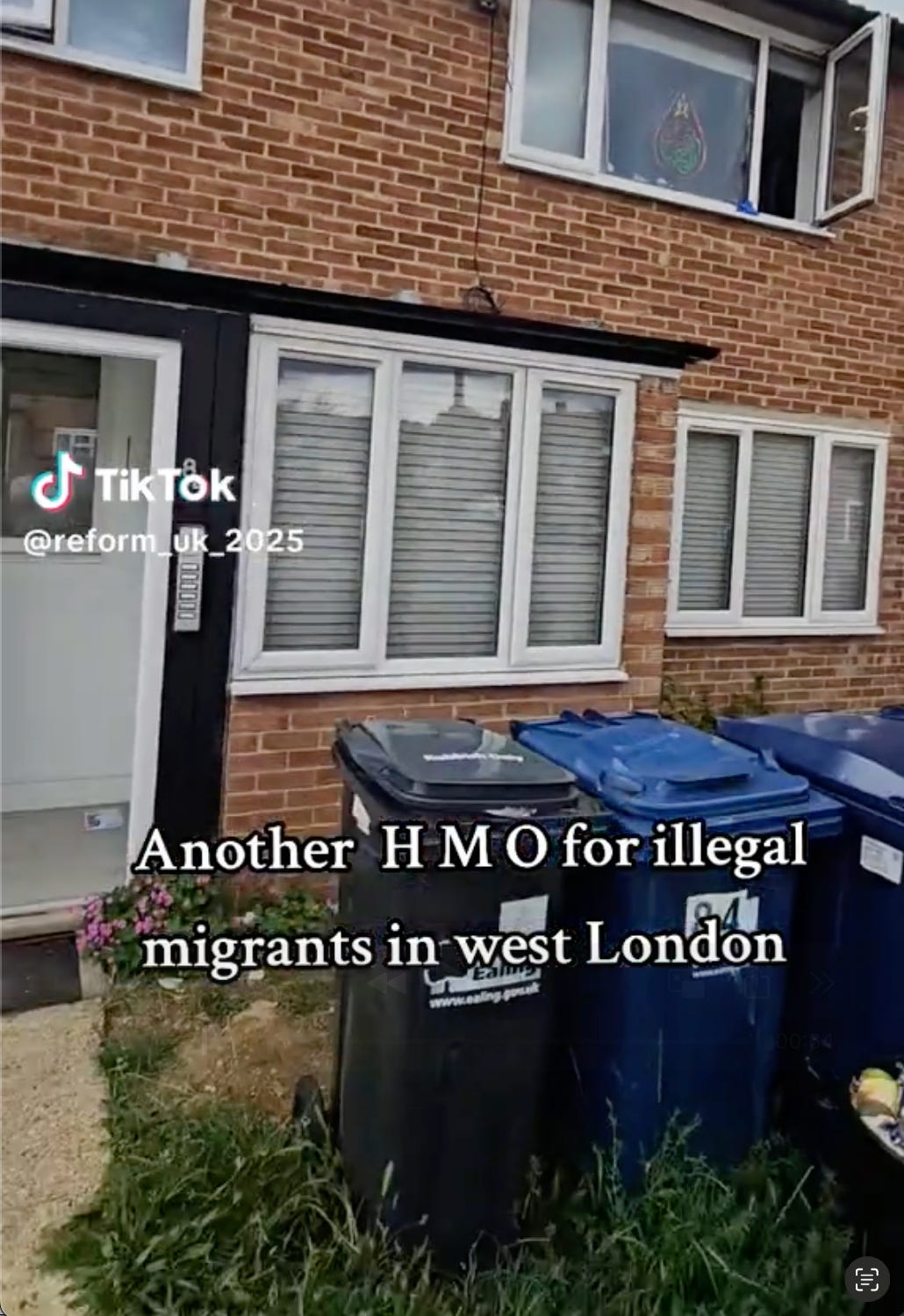
Some of the more extreme videos play on the false idea that London has become a Muslim-dominated city under Sadiq Khan’s leadership or are virulently racist, even if they’re produced by content farms based overseas. As one TikTok creator exposed by London Centric for creating fake content about the capital put it: “Hate brings views”.
There’s even an entire genre of YouTube travelogue dedicated to showing the apparent decline of the capital. On the QAA podcast, presenter Annie Kelly dubbed this “London Has Fallen” content, after a phrase that often pops up in descriptions of the videos.
The prevalence of these videos has led to Londoners having baffling conversations with people around the world who are convinced the capital isn’t just a gritty or flawed city but is instead the most unsafe place on the planet. On a Spectator podcast last year, the commentator Tim Stanley suggested a driving force for some of these discussions might be the cultural transatlantic “marrying of Trump and Brexiteers” which has left American politicians “just more conscious of what’s going on” in the UK.
The objective of Monday’s meeting, according to Khan’s spokesperson, was to give British ambassadors around the world arguments to convince a Dubai investor to ignore such material on their Instagram or TikTok feeds and still come to the UK’s capital.
Ambassadors and high commissioners to countries including Singapore, Japan, and the United Arab Emirates were presented with “evidence to counter false perceptions of crime in the capital” as Rowley set out what the police are doing to counter issues such as phone snatching.
“The aim was to brief international representatives and ensure they and their teams are equipped to support London’s efforts to counter these false narratives,” Khan’s spokesperson said. “They agreed to do more to share information and deploy joint tactics and ideas to disseminate the facts about London to a global audience.”
Meanwhile, Khan pointed out that London’s murder rate is now the lowest since records began and is below other major cities such as Paris, Berlin, New York, and Milan: “Of course, one crime is one crime too many, but people are spreading false propaganda about city because it serves their interests. So we all need to challenge the disinformation, misinformation and lies.”
He told the ambassadors they had to fight back and make a positive case for the capital as a hub for tech and financial jobs: “When you hear news about London being unsafe that’s just not true.”
Whether the ambassadors will be able to be heard over the sound of the next viral video is another matter.
Criterion Capital admits issues with safety checks on its tenants’ properties
One of London’s biggest landlords has acknowledged problems with the electrical safety certificates it issued to its residential tenants… but only after Sadiq Khan, government ministers, and London councils called on them to answer questions first posed by London Centric a month ago.
Some residents in blocks owned by Asif Aziz’s Criterion Capital were recently handed safety-critical electrical checks on their properties even though they had no recollection of an electrician ever visiting. We later discovered the company that supposedly signed the paperwork went out of business three years ago and was not registered with the required trade body at the time of the test.
Landlords are responsible for ensuring valid safety checks have been carried out and can be fined up to £40,000 per property, plus costs, if the local council chooses to pursue the case.
The apparently non-existent electrician who signed the safety checks gave their address on the paperwork as an empty shop unit in Greenwich. That supposed headquarters is located directly opposite the constituency office of housing minister Matthew Pennycook – the same man tasked by Keir Starmer with getting answers from Criterion about how it has been treating tenants.
London Centric first noticed the issue while touring flats with local councillor Stuart Neaverson, as Criterion tenants facing a “mass eviction” repeatedly raised questions about the legitimacy of the safety checks on their buildings. As we pieced it together, we realised that flat after flat, in different Criterion-owned buildings across London, had all been issued with identical safety paperwork that bore no relation to their actual home.

After four weeks of asking questions, Criterion has responded to us. The company says it has fallen victim to a rogue electrician: “We take the safety of our residents extremely seriously and have robust processes in place to ensure compliance with all electrical safety requirements. Criterion contracted a third-party contractor to carry out electrical inspections and issue EICRs across a number of properties, in accordance with its obligations as a landlord. However, we recently became aware that in a small number of cases, the certificates were not issued in accordance with the standards we demand and expect.
“As a result, we acted immediately to terminate our relationship with the third party contractor, and commenced a programme of re-inspections across the relevant properties using a new firm of independently verified and accredited contractors. This process is complete, and all affected properties have valid EICRs, with no electrical safety issues identified.
“At no point would we ever compromise on resident safety. We expect the highest standards from our third party suppliers and will act swiftly and decisively when services are not up to standard, as any responsible landlord should.”
Enforcing whether landlords actually carry out checks is up to local councils who, in many cases, seem to take a hands-off approach following years of funding cuts. But following our questions both Merton and Croydon councils, as well as the operators of the relevant electricians’ professional register, have taken an interest. Merton council told us: “We are deeply concerned about allegations around the Electrical Safety Installation Certificates (EICR) at Criterion Capital properties. We have been investigating the allegations, including contacting partner organisations to review all information available to us.”
London Centric asked Criterion whether its statement means it acknowledges issuing fake safety paperwork to its tenants – and whether it would therefore be self-reporting itself to Merton and Croydon council for a possible breach of its legal obligations as a landlord.
The company responded: “As you know, that is not at all what we have written and is patently untrue and misleading. Any attempt to characterise the matter in this way, despite the facts we have presented to you, would be a very clear breach of your journalistic and legal obligations.”
Last week London Centric linked to an article in Vittles about a number of restaurant operators in Brixton who are set to be evicted from a shop facing redevelopment. We summarised the publication’s findings and stated that while it was hard to trace the ownership of the building, the landlord “appears to have links to… the family of Asif Aziz, the boss of Criterion Capital”.
Criterion Capital has since confirmed to us that the family member linked to the Brixton property’s owner is a “very distant cousin” of Asif Aziz. The company said that therefore it would be wrong to imply either Aziz or Criterion Capital had a financial interest in the building or responsibility for its management. We’re happy to make that clear.
Preposterous property of the week
Ever wanted to eat, relax, and watch TV in the nave of a chapel? Well, you too could luxuriate in the cavernous surroundings of “The Chapel at Rosary Manor” in Mill Hill on the northern edge of London… as long as you’re happy to wait for a 12-month reconstruction job to complete.

The former convent school was run by the Sisters of Charity St Vincent between 1887 and 2007 and most of the site has already been converted into apartments. But the chapel remains unfinished, with it now being marketed as a four-bed work-in-progress complete with a cinema room and gym. Yours for £3.95m.
Goodbye American Candy Store, Hello Gulf Candy Store
Since the pandemic, central London has seen a vast influx of garish “American candy shops” selling overpriced sweets to passing tourists, with shops decked out in replicas of the Statue of Liberty and other US-branded tat.
But is there a new global hegemon in town? One sweet shop on Oxford Street, close to Marble Arch, has rebranded to carry a “Gulf Candy” sign in its window.
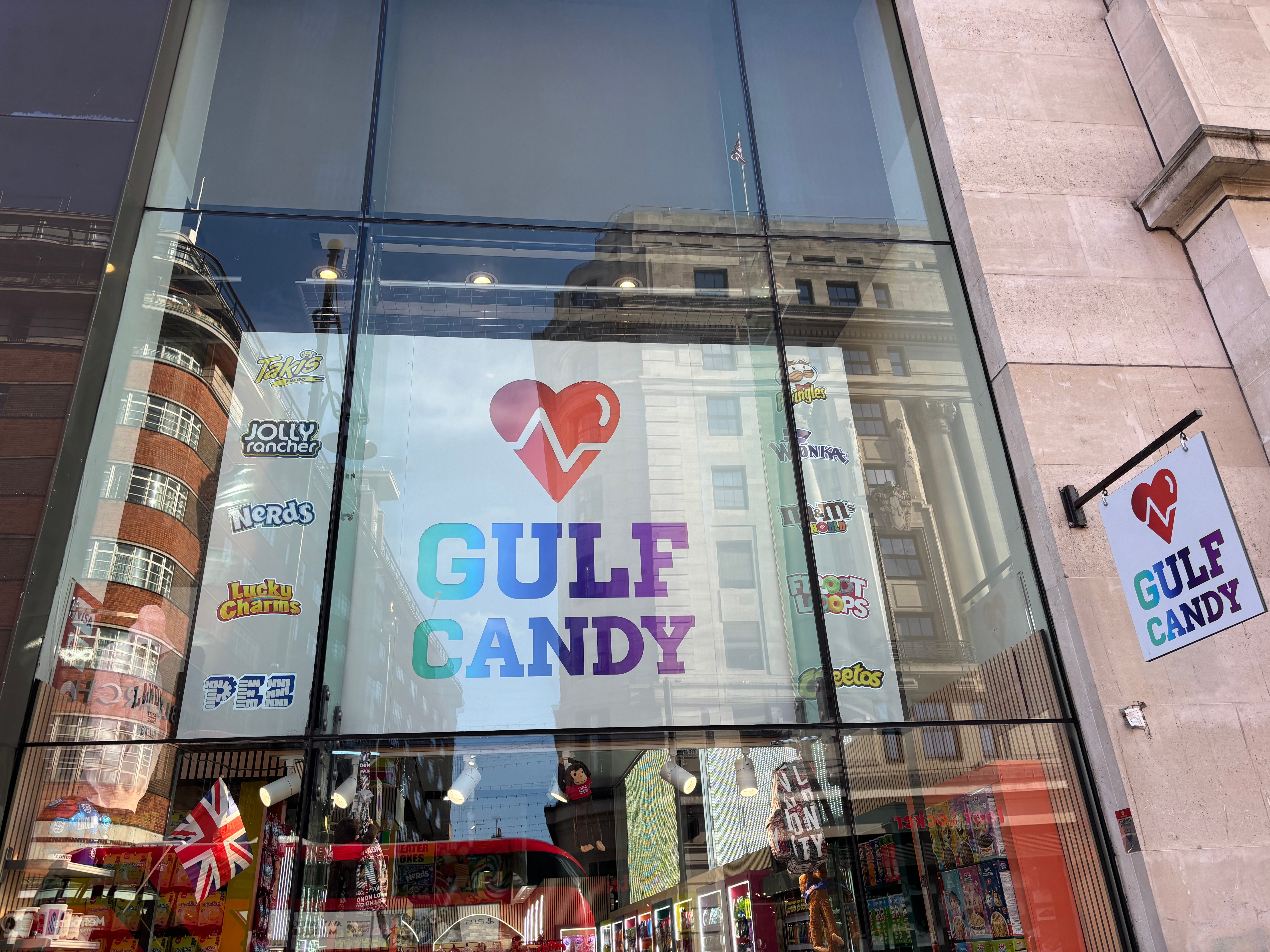
Dr Nayana Prakash, a tech and geopolitical researcher who first alerted London Centric to the name change, said: “I think it’s very funny to see how American soft power might be shifting and associations with American candy may not be as glamorous as they once were.”
When London Centric visited the shop to find out if the sign was a reflection of shifting tourist demographics, the ongoing realignment of global power, or a reflection of the West’s growing interest in Middle Eastern flavours after the Dubai chocolate viral phenomenon, management refused to give us a comment. The stock, with brands like Cheetos, Oreos, and Hershey’s, was distinctly American. After we attempted to obtain details of the store’s parent company and registered operator, our reporter was asked to leave the shop.
On Criterion's replacement EICRs:
"and all affected properties have valid EICRs, with no electrical safety issues identified."
Whilst I'm more senior now, I've been an Electrician for 15 years, most of which ive been doing or involved with EICR works. If no issues have been identified, especially following a lack of maintenance, either the testing regime is poor or the statement is a lie. It wouldn't surprise me if these were again fake or poor quality.
There is an enormous issue with fake and poor quality EICRs in all buildings as there is a race to the bottom in price. A 'drive by' EICR was part of the cause of the Grenfell Tower fire IIRC.
I'm low-key horrified that with a host of witnesses, and caught red handed a pub manager was of the opinion that there was "no point" reporting a thief to the police when they were preying on the pub's customers. I get that the Met don't want spend resources to investigate if a robber has made off with your device and you have no better description than "some guy on a bike" but when the thief has actually been caught in the act?