

London council deploys speed cameras to catch cyclists
Plus: Rowans bowling alley is a profit-making machine, the most cursed Tesco Express in London, and the real impact of the tube fare rises.


In the run-up to Christmas, I want to feature some easy ways for readers to make a big difference to their fellow Londoners. Last week generous London Centric readers donated more than £4,000 to a south London youth club, which was then matched by a third party donor.
This week I’m asking readers to consider giving blood, following an urgent appeal from the NHS in the capital. The health service is particularly worried about a blood shortage due to Christmas Day falling on a weekday, when donor sessions are usually held. If you’ve never given blood before, it really is far easier than you think and you can be done within an hour. What’s more, they’ll give you lots of packs of Seabrook Crisps and Club chocolate bars.
I’ll be giving blood in Brixton early on Friday morning (19th December) and then hanging around for most of the day if you want to say hello. Why Brixton? It’s a recently-launched full-time donor centre, next to a station on the Victoria line that makes it accessible from most of London, and it currently has 50 spare donation slots on Friday that would be amazing to fill with London Centric readers. Just click here to sign up.
Alternatively, book in your local area over the Christmas period at a time that suits and then WhatsApp over your experience. I know not everyone is able to give blood — but I’d love to hear from you if you’re able to do this one simple act for the first time.
Scroll down for stories about the most cursed Tesco Express in London, the curious finances of Rowans bowling alley in Finsbury Park, and how much your tube fare is really going up.
Speed gunning cyclists in the park
Exclusive: A London council has started issuing speeding fines to cyclists, after deploying staff with a speed gun to monitor a popular commuter route from south west London.
Park police employed by Wandsworth council have been handing out £50 penalty notices to cyclists who break a 12mph speed limit in Tooting Bec Common, in what is an incredibly unusual deployment of technology normally reserved for cars.
Local resident Ed Owen was riding his Brompton bicycle to work last week when he was pulled over by Wandsworth’s in-house park police force, which is separate to the Metropolitan police. They informed him their speed camera had clocked him travelling at 16mph in a 12mph zone and issued him with a fine.
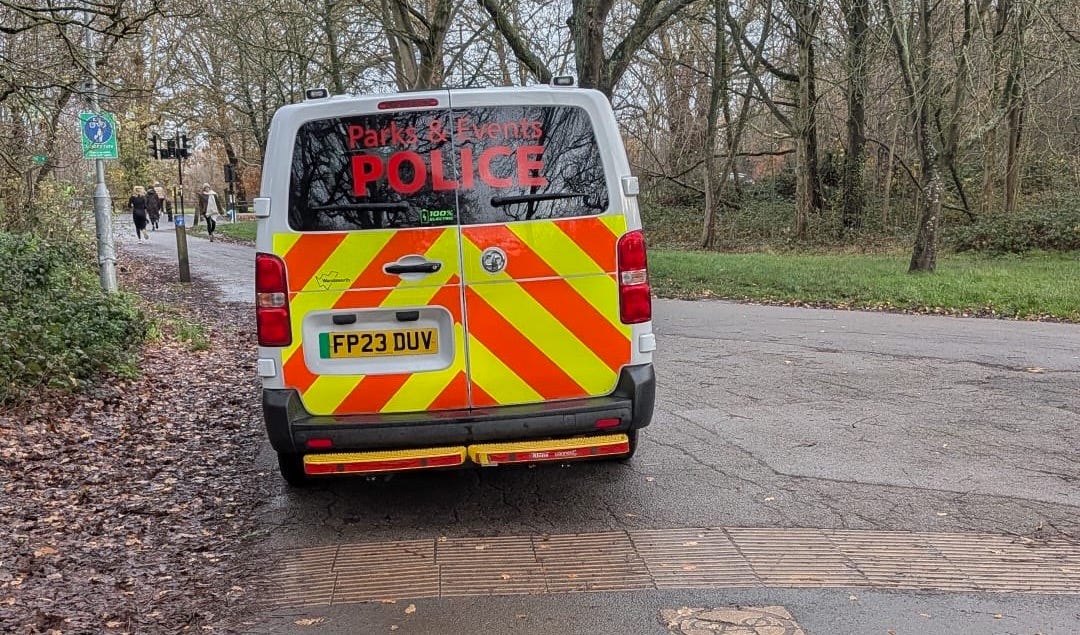
“They said they’d had complaints from dog walkers that people had been going too quickly,” he said, insisting he was always careful to avoid conflicts with other path users. “I hope I’m a considerate cyclist.”
Owen said he’d been cycling on the route for 15 years. While the route used to have separate lanes for cyclists and pedestrians, a few years ago it was turned into a shared path. He said some cyclists do ride dangerously but the big problem with issuing fines for speeding is that very few cyclists have a speedometer so have no way of knowing precisely how fast they are going.
His fine was rescinded after he raised concerns: “It struck me that this was a very confrontational way to do this. Maybe they should cycle around and show people what 12mph looks like.”
There is no legal limit on how fast bicycles can travel on public roads in the UK because speed limits only apply to motorised vehicles. But some local authorities retain historic and often forgotten byelaws relating to bicycle speeds.
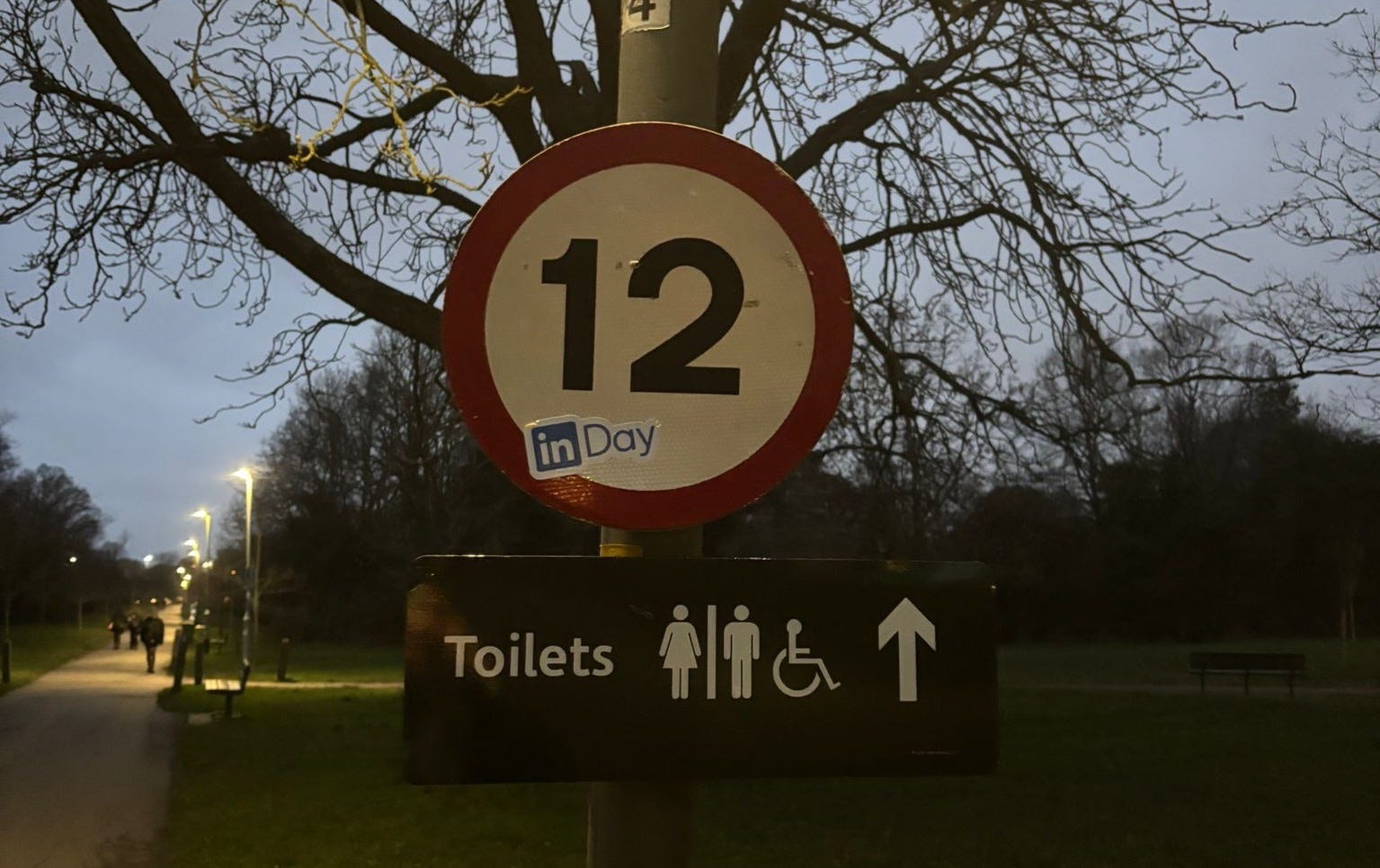
In the case of the capital these often date back to the days of the old Greater London Council. London Centric has discovered the same 12mph cycle speed limit also theoretically applies in Battersea Park and Wandsworth Common, as well as in north London’s Finsbury Park, with potentially many other public places affected if councils chose to enforce the law.
Wandsworth’s parks police said they were responding to complaints from the Friends of Tooting Common. The volunteer group recently published an open letter saying there is a “particular problem with delivery riders” and urged the council to increase speed checks and build barriers to slow down cyclists, warning the status quo is a “serious accident or fatality waiting to happen”.
“We stress that we are, of course, not anti-cycling,” they wrote to the local council. “Traffic calming measures do not deter considerate cyclists – on the contrary.”
Legal e-bikes have their electric assist cut out at 15.5mph in the UK but delivery drivers often use illegally-modified vehicles that go faster. Some phone thieves also use off-the-shelf e-bikes designed for off-road usage that can go at 30mph. Cycle speeds have also been an issue in the Royal Parks, which has asked cyclists to voluntarily keep below 20mph after an incident in Regent’s Park which killed an 81-year-old woman.
When we visited Tooting Bec Common Monday evening, there didn’t seem to be any signs of dangerous cycling. One local resident, Hugh, said he wanted the council to focus “on the cars and not the bikes” but raised concerns about illegal e-bikes that are “more like electric mopeds.”
The speed of cyclists in London has increasingly become a topic of media fascination, especially with the rapidly-growing number of people on bikes stretching existing infrastructure to the limit. Last year the Daily Telegraph had to retract an article based on Strava fitness tracking data that claimed cyclists were travelling at 52mph along the Chelsea Embankment after accepting this was not physically possible.
Give award-nominated journalism this Christmas!
London Centric was this week nominated in eight different categories at this year’s Regional Press Awards for categories including investigative reporting, feature writing, and even website of the year. Thanks to all the paying subscribers who make it possible for this tiny outlet to compete with some of the biggest regional newspapers in the country!
If you’re still looking for a Christmas gift, why not consider giving original journalism about the capital with a London Centric subscription? If you’re interested just follow the instructions here and we’ll have a gift card in the post today.
I’m sending out gift cards all this week and will be able to hand deliver extra gift cards within Zones 1-3 right up until Christmas Eve!
What’s going on with Rowans?
WhatsApp group chats have been buzzing with speculation about the future of iconic north London bowling alley Rowans after Haringey council’s draft local plan suggested it could be a potential mixed-used development site including 190 homes.
On the surface it looks like a straightforward story of a council seeking to bulldoze the local cultural institution next to Finsbury Park station. Haringey is required to identify potential opportunities for housing development and this one, right on the southern tip of the borough, could be an easy win.
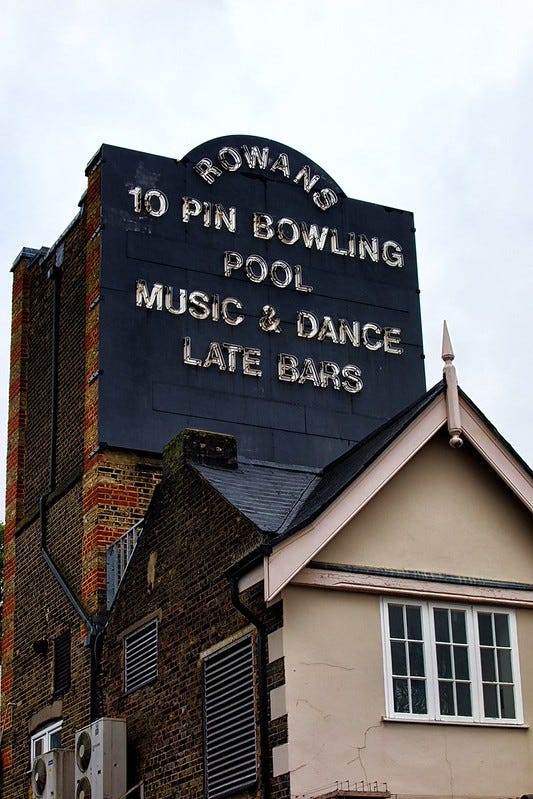
Yet the new local plan isn’t a document saying that something will definitely happen. Instead, it’s a document that Haringey is legally obliged to produce indicating where things could be built — in this case at some point before the year 2041. Rowans has had a similar public status as a potential development site for the last decade under the existing local plan.
The council insists it’s really restating its prior commitment to preserve a bowling alley on the site in a theoretical development. Haringey deputy leader Sarah Williams said: “We know that Rowans is a much-loved local space for our community and there are no proposals to replace it. Should the owner of Rowans come forward at a future date with plans to redevelop the site, the local plan safeguards provision of community, culture and leisure facilities, including a bowling alley.”
Bowling for scoops
Rowans is also, according to London Centric’s analysis of its financial records, still a fantastically profitable business. The freehold on the building has been owned since the 1980s by the Nagle family, former north London bookmakers who bought the former cinema and bingo hall from the Rank Corporation. They turned it first into a snooker hall, then installed 24 ten-pin bowling lanes. After struggling for a few years in the 2010s, business boomed following a publicity boost prompted by the previous threat of redevelopment.
Although its shabby look is part of its appeal, accounts show the bowling alley now generates vast amounts of cash. Londoners spent £6.8m at Rowans during the 2023/24 financial year, producing a very healthy profit. This allowed the company’s directors and shareholders, all members of the Nagle family, to pay themselves a combined £3.65m in salaries and dividends.
Ownership of the bowling alley’s parent company is largely split between 84-year-old Alan Nagle and 83-year-old Pauline Nagle. Whether there could be any attempt to build housing on one of London’s best-connected potential development sites will rest largely on the intentions of those two Nagles and their heirs, rather than the council.
Has your tube fare actually gone up by 5.8%?
Last week Sadiq Khan announced that as part of a funding deal with the central government, Transport for London tube and rail fares will be rising above-inflation next March — by an average of 5.8%.
Yet any average hides the real changes below the surface. We’ve taken the fare rises and highlighted the substantially-below-average fare increases in green, and the substantially-above-average increases in red. Peak time commuters to central London get off comparatively lightly.
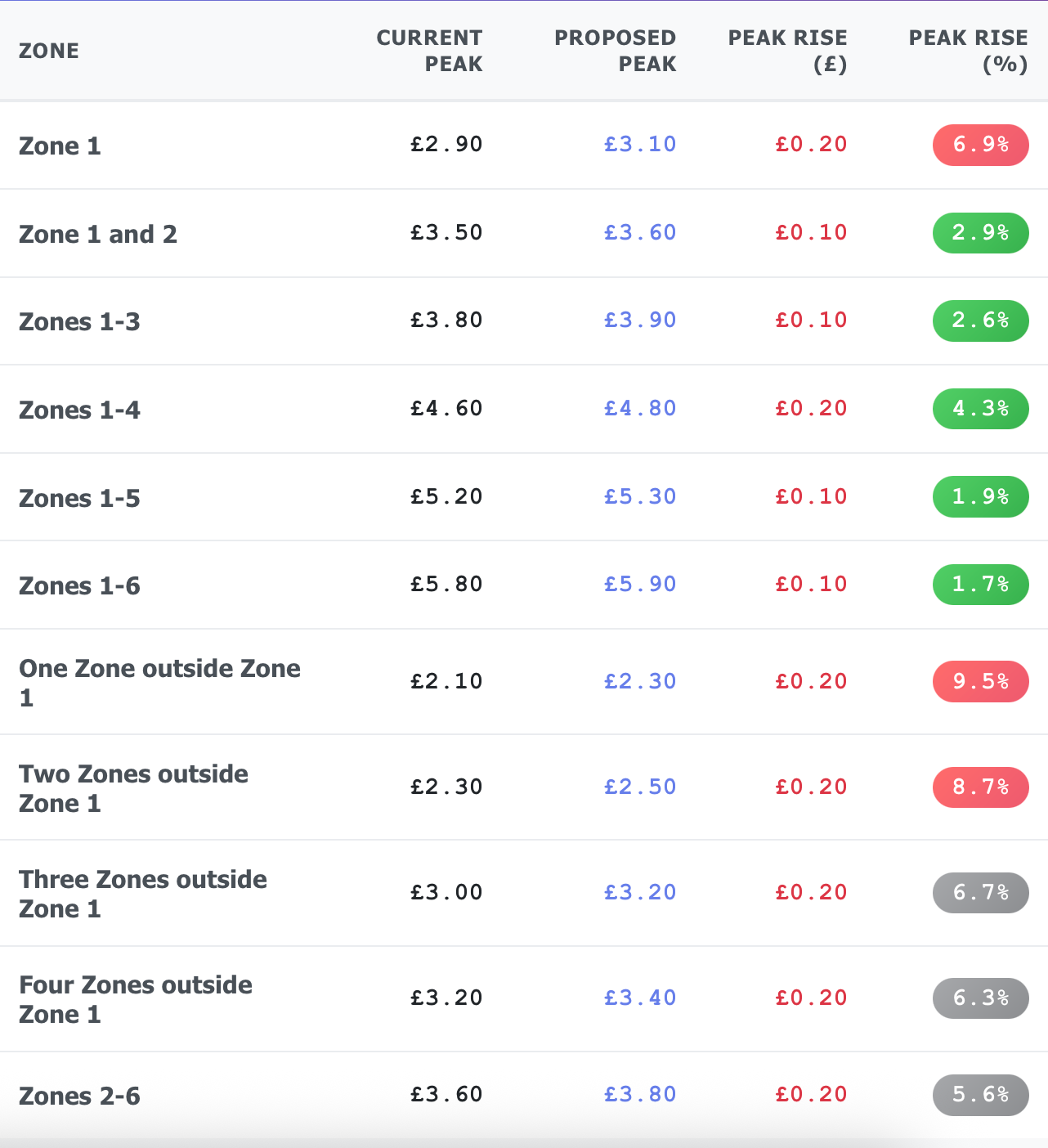
Instead, the big percentage rises are going to people who travel off-peak, especially if your journey takes places entirely outside Zone 1.
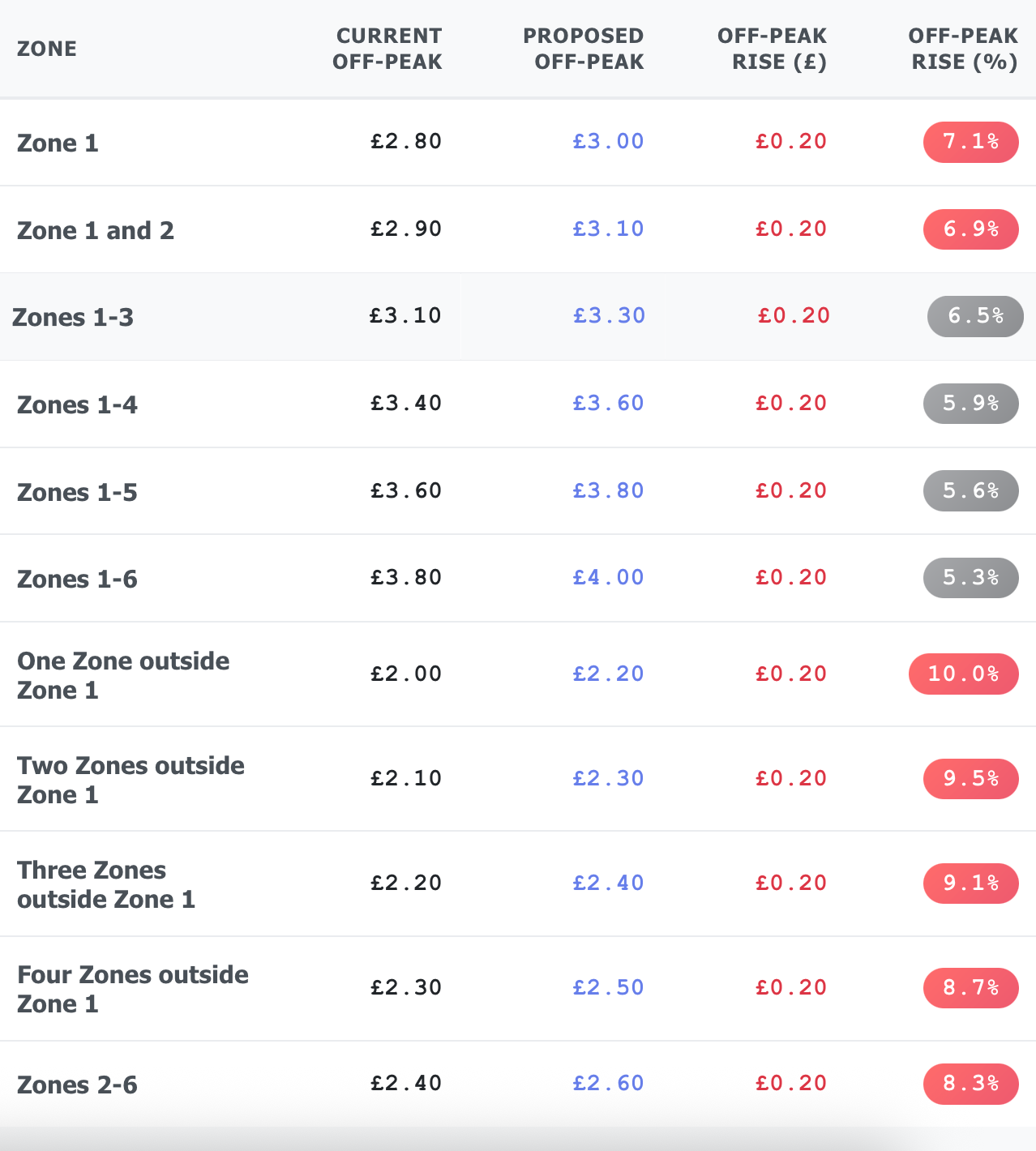
Bus fares are temporarily remaining at £1.75 until the summer, although the price of travelcards and the daily/weekly fare caps won’t rise as part of the national government’s rail fare freeze.
For the long term picture over the rising cost of London travel we defer to Diamond Geezer, the Samuel Pepys of modern London blogging, who has been collating historic fare data for seventeen years.
London’s most cursed Tesco Express closes again… after residents who live above it are told to evacuate their structurally unsafe block just before Christmas
By Polly Smythe
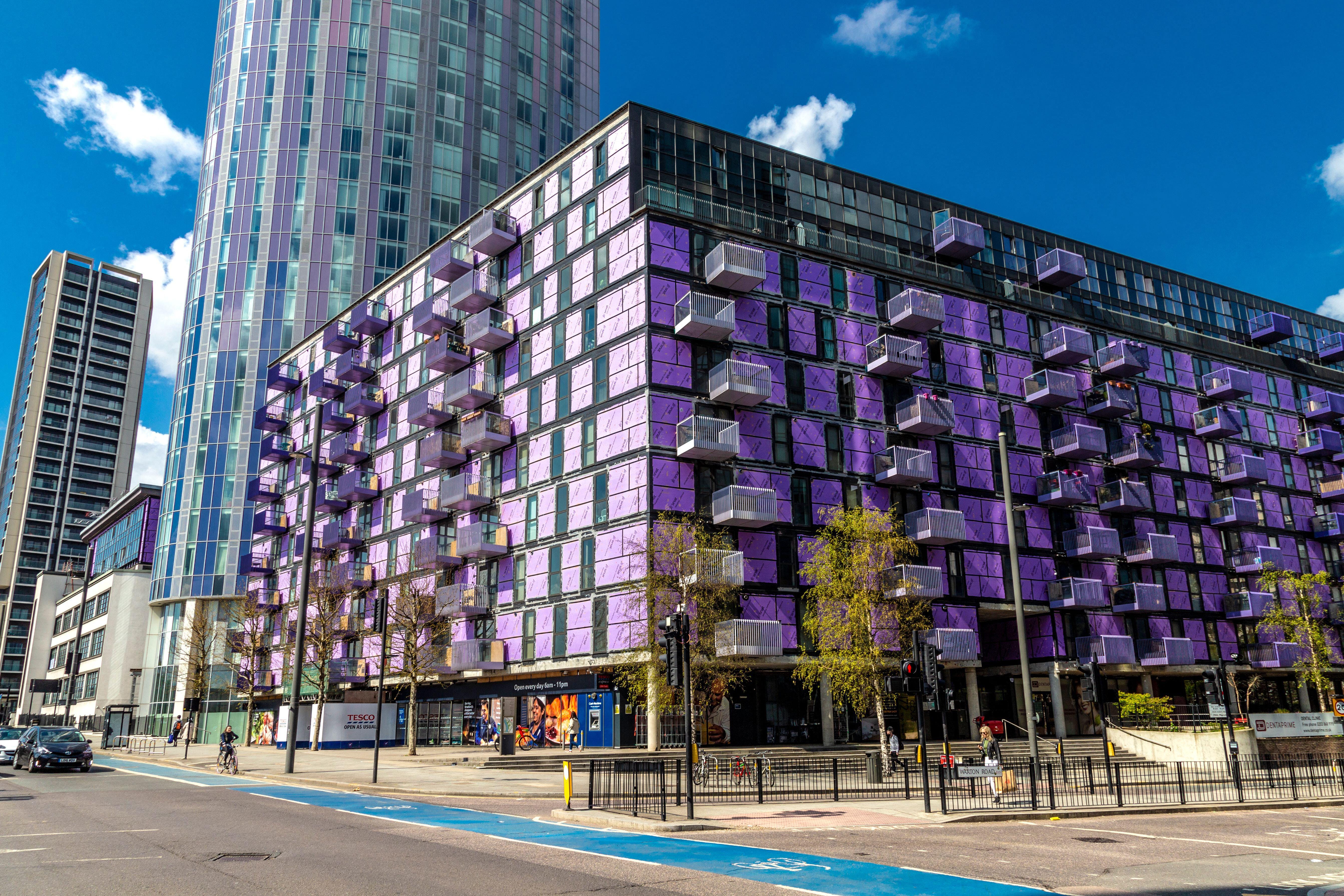
Longtime London Centric readers will remember our reporting on the mysterious person who spent the summer repeatedly crashing cars into a specific Tesco Express in Stratford.
Now the east London shop has been closed for a fourth time because the building it occupies has been declared structurally unsafe, revealing a far bigger story about the poor quality of some recently-built housing in the capital.
Hundreds of residents occupying 239 flats in the Halo development were evacuated last week after their properties were deemed no longer “safe to occupy”. Building owner Notting Hill Genesis, a housing association, told residents that it will be “months, rather than weeks” before they can return to their homes, due to cracks in the building’s structural columns.
When London Centric visited the Halo development last week, we found people panic-cooking their festive food and bidding farewell to decorated Christmas trees they won’t see again until the spring.
As we spoke to residents stuffing their belongings into bags, they kept asking one question: How have things gone so spectacularly wrong with a development that’s only just over a decade old?
“Rain blew in through the wall”
Sebastian Coe, chair of the London Organising Committee of the 2012 Olympic Games, said that its legacy would be tens of thousands of “new, quality” homes in the area. As developers swarmed to East London to capitalise on the Olympics gold rush, the Stratford Halo estate began to spring up in 2008, with work finishing in 2013.
It consists of a mix of private and social housing across four residential blocks, as well as the 43-floor Halo tower.

“I was one of the first people to move in,” said one resident, who bought a flat up on the seventh floor. With a view of London’s skyline, overlooking the theatre hosting Abba Voyage, it’s been his home for 12 years.
With his plan to host a Christmas party for 15 children and their parents in disarray, the resident told London Centric he was stuck contemplating what to do with a freezer of Chicken Kyivs.
Following the Grenfell Tower fire the Halo estate was discovered to be covered in cladding that fell “below expected standards of fire safety”. Yet works to remove it were interrupted by Covid-19.
Without adequate structural protection during the pandemic, the flats were exposed to the elements.
“Rain blew in through the wall,” the resident said. “The water would come in through the carpet.” Soon, damp started to seep through the ceilings and floors, attracting insects known as silverfish.
Despite the mess, the already-high service charge crept up year on year. Due to a legal dispute between a building contractor and the site owner over damages to a lift that happened during renovation works, the housing association asked residents to bear the full cost of a replacement lift.
Then windows in the Halo tower started cracking due to exposure to sunlight. On 31 March, two giant window panels fell out of the 133m building, crashing onto the ground. In response to what it dubbed a “glass incident,” Notting Hill Genesis constructed a “protective crash deck.” While supposed to be a temporary safety measure lasting until the summer, the deck is still in place.
“Jacks propping things up”
One block in the Halo development was evacuated earlier this year but alarm bells rang for remaining residents when the housing association said it would be installing steel beams and columns in the basement car park.
“You’d go down there and there’d be closed off bits where there’d be jacks propping things up,” said one resident. “But the headline kept being ‘everything’s fine.’”
Genesis initially told residents that the flats were safe to live in, as long as “temporary propping” was installed. But “given the time that has elapsed without the remediation work being completed” they no longer consider the buildings to be safe.
A man who bought his first home in the complex in May told London Centric he was “trying to be rational”. As he attempted to make one final batch of bread from his sourdough starter, he said he was tempted to take up Notting Hill Genesis on their offer to buy back all the privately-owned flats at full market value.
Genesis said it was “deeply sympathetic to the impact this decision will have... This is a significant undertaking and is a decision we have not taken lightly: however, we hope our residents will understand why we have taken this very difficult decision to ensure their safety.”
In a follow-up email Genesis asked residents to be “as flexible as possible when it comes to alternative accommodation” given the “pressures of Christmas coming up”.
“Mould on the sofa”
We encountered another evacuated 27-year-old resident waiting for an Uber while clutching bags of her belongings. She told London Centric she had been renting in the block for 18 months. “When I moved in, there was mould on the sofa, cracks on the bedroom walls, water damage, and silverfish.”
Despite this litany of complaints she said her rent at £1,725 a month was a “steal” compared to other flats in the area. “I’ve been told my rental contract will be terminated on 1 March. So I’ve got to find somewhere else now, but they’re all £300 or £400 more a month.”
While Genesis will pay for her AirBnb for the next three weeks, she said that the housing association still expects her to pay rent on her empty property, as her temporary accommodation was “incurring them a cost”. She said residents had not been informed if they would also have to keep paying service charges while living in temporary accommodation.
“My plans for Christmas this year?” she said. “Coping.”
If you want to support London Centric’s work please help us by spreading the word that we’re trying to do journalism the right way. Forward our emails, share links to our stories in your WhatsApp groups and on social media, and encourage your friends to join our mailing list. Paying subscribers fund all of our journalism.
If you’re willing, why not buy a Christmas gift subscription for a friend who might appreciate it?
I can understand the concerns of the pedestrians, I've seen electric bikes fly through the common dangerously before. But, not 4 days ago on the road around the common an 11 year old was left fighting for her life after being hit by a car, and I don't hear calls for a speed camera, red light camera or traffic calming measure on that road. The same area of road where a car completely destroyed a bus stop a few weeks ago. Can we stop pretending bikes are the problem here?
Last Friday an 11 year old girl went to hospital following a collision on Tooting Bec Road (which runs alongside the common).
TfL consulted on proposed changes with cycle tracks in 2017, but AM Leonie Cooper opposed the proposals as elderly people could have been run over by cyclists at the crossing next to the athletics track. Sadly the parks police are different to the road police so this crazy allocation of resources allows danger on our roads to be ignored, whilst anti social cycling is tackled like this. Also how are people cycling without a speedometer supposed to know what speed they are cycling at...