

Is London ready for robotaxis?
We found the best place to spot a Waymo in the wild. Plus: New London Overground lines edge closer, the end of the night czar, and an underground swimming pool in East Dulwich.


There was a huge reaction to Saturday’s investigation into the person secretly filming Londoners in their homes to create fake anti-immigrant TikToks.
Thanks to everyone who joined as a paying supporter to help cover the costs of reporting it. London Centric barely has any overheads, meaning your money is already heading straight back out of the door to employ extra reporters to dig deeper on this story.
LBC’s James O’Brien invited me on his show to discuss the piece (watch here) and if you want to send the story to your friends then do check out and share the video version which is available on London Centric’s Instagram.
Labour MP Siobhain McDonagh, whose Mitcham and Morden constituency includes one of the houses in the videos, told us that it was a deep “violation of privacy – and all to support a dishonest political argument”.
Rob Blackie, the Liberal Democrats’ mayoral candidate in 2024, has reported the TikTok account to the police for the potential criminal offence of inciting racial hatred.
We traced the TikTok account back to estate agency Smart Let Estates, who confirmed they know the identity of the person secretly filming their tenants inside their properties.
The estate agency has now issued a new statement saying they would be willing to meet the police: “The agency has cut all ties with the individual involved and we are prepared to speak to the authorities should they be interested in speaking with us."
There’s much more to come on this story – and the wider issue of the substantial damage that is being done to the capital by fake viral videos designed to stir up anger and suspicion. Right now, it’s over to the police if they want to act.
Today we’ve got a story revealing new details about the impending rollout of self-driving Waymo robotaxis in the capital – scroll to the end to read that.
Want to get in touch with London Centric? You can send an email or a WhatsApp.
No more Night Czar
London definitely won’t be getting a new Night Czar following the departure of Amy Lamé, after the mayor’s Nightlife Taskforce published its final report this week.
Chaired by Fabric boss Cameron Leslie, the taskforce is a 12-strong group made up of venue owners, industry representatives, and promoters — including Michael Kill, chief executive of the Night Time Industries Association, whose credentials London Centric explored back in June.
The report makes 23 recommendations, while acknowledging that none of them alone will act as a “magic bullet” to save clubbing in the capital. They include:
Permanently drop the individual “Night Czar” role and replace it instead by a permanent commission of experts
Lobby central government to introduce a law that pubs and clubs need to receive a minimum of ten unrelated noise complaints before a licence review is triggered – stopping a single persistent neighbour from getting a venue shut down.
Create a London-wide licensing standard to create simpler and more consistent standards across the capital, overriding individual boroughs.
Re-establish a night-time transport working group to ensure people can get home.
Create a register of vacant and under-used properties that could become nightclubs, to help operators to find new venues.
Among the problems identified by operators was a tension over the Met police’s zero-tolerance approach to drugs, which includes opposition to offering on-site tests of illegal drugs for purity. London’s biggest nightclub, Drumsheds, managed to hold on to its licence last January, following two drug-related deaths.
“Some nightlife businesses fear that taking harm reduction approaches will result in police scrutiny and legal consequences,” said the report. They said club operators can be reluctant to engage in “drug-related harm reduction, for fear of inviting involvement from the police.”
Preposterous property of the week
Externally, this three-bedroom house in south London’s East Dulwich isn’t much to look at, with the property accessed from a tiny entrance on a normal row of Victorian houses. But peep inside and you’ll find an underground indoor swimming pool, a wine cellar, and a cinema room.

According to Land Registry documents, the site was bought back in 2012 for £575,000 and is now on the market, as a three bedroom house, for £2.75m.
Anyone got any spare London Overground line names?
Transport for London this morning set out what it wants to achieve in the next five years. The capital has been relatively starved of new projects in recent years but with the Docklands Light Railway extension to Thamesmead given outline funding, it’s possible to start dreaming again. The Bakerloo line extension to Lewisham remains, optimistically, one of the potential projects.
More likely to happen in the coming years are two new London Overground lines. One would be a new West London Orbital line from Hounslow to Hendon and West Hampstead, using existing underused routes. The other involves TfL taking over the existing Great Northern Route from Moorgate to Welwyn Garden City and Stevenage via Hertford North. It hopes this will be approved by central government within a matter of months, with train frequency ultimately increased to support a new town on the edge of London.
Both of them would become London Overground-branded lines and need a new name. (Previously rejected line names are available here.)
Still, Transport for London is in a strange place — trying to expand while also facing declining passenger numbers. So far this year TfL has carried 79m fewer passengers than it had budgeted, due to factors such as tube strikes and slow bus speeds putting people off travel.
Lime’s street warfare
Relations between Lime and local councils are becoming increasingly sour, especially with local politicians facing re-election in May and e-bikes are one of the top topics brought up on the doorstep. In December, Islington council leader Una O’Halloran told both Lime and Forest e-bike providers that they were on their “last warning” following months of complaints about haphazardly discarded bikes and dangerous parking.
Last week, Lime suddenly introduced “red zones” throughout large parts of the borough, preventing riders from parking their bikes close to popular stations such as Highbury and Islington and Canonbury, infuriating many users who got in touch with London Centric. But rather than smooth things over with the council, the move has made matters worse.
An Islington Council spokesperson said that at a meeting with Lime, it had “set out the urgent need for the company to rebuild trust by becoming significantly more transparent, responsive and proactive. The council made clear that operational noise at night, dangerous and inconsiderate parking, unsafe rider behaviour are all unacceptable and must be addressed immediately.”
The restrictions now appear to have been lifted — but with the regulatory net closing on Lime and other e-bike operators, the street-by-street battles with local councils over restrictions are only set to intensify.
Self-driving robot taxis will be picking up passengers on London’s streets this year. Is the capital ready?
The security team at Chiswick Business Park had been dispatched to intercept a potential security risk prowling around their car park: me.
I was trying to track down London’s first self-driving robotaxis, following a tip sent in by a London Centric reader. The reader said that Waymo, which is preparing to launch on the streets of the capital, was using the car park of Chiswick’s Virgin Active gym as a temporary base ahead of its launch.
The friendly but bemused security guard had bad news: “The cars moved to Park Royal ten days ago.”
For the uninitiated, Park Royal is one of the strangest parts of London, sandwiched between the West Coast Main Line and the A40 Western Avenue road. It’s an unwelcoming teardrop of industrial sites, car showrooms, and distribution centres between Acton and Harlesden.
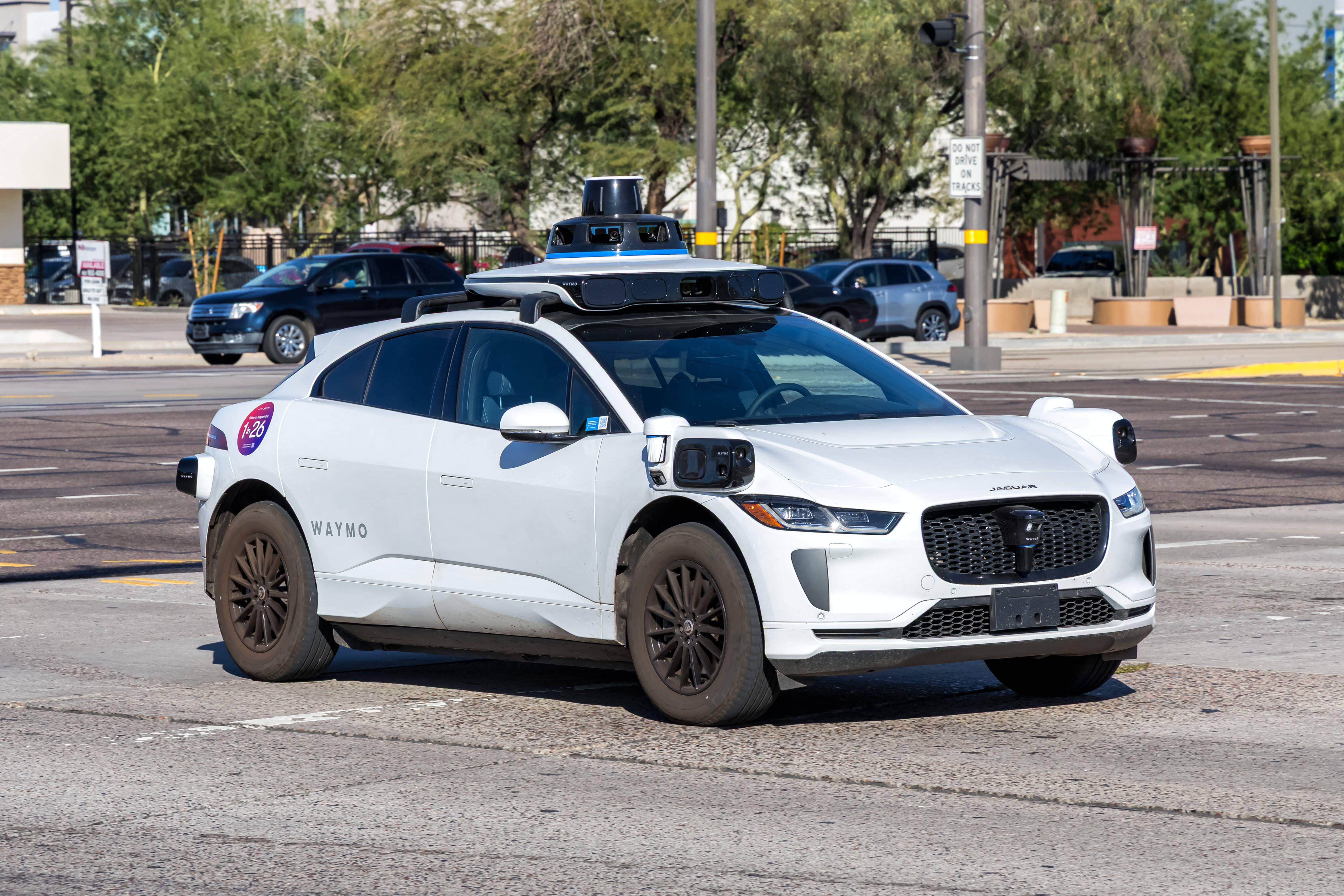
It’s also, right now, the best place in London to go if you want to spot Waymo’s automated cars, all heavily modified left-hand-drive electric Jaguar I-Paces, as they head out on their trial shifts. The cars are driven by artificial intelligence but still have a human on board in case of an incident. At the moment they are using their sensors to build a map of the city as they get ready to accept paying customers later this year.
Over the last few weeks London Centric has been looking into Waymo’s impending launch in the capital. We found the business, owned by Google’s parent company Alphabet, is:
Running its vehicle charging, maintenance, inspections, and technician training out of a site in west London, which is why its cars have been most frequently spotted on that side of the capital.
Conducting market research on which London airports customers would like to be picked up at, as it targets one of the most lucrative taxi markets in the country.
Hiring London-based staff to deal with serious and “graphic” incidents, given the inevitability that accidents will happen – while pointing to its US data that suggests AI-controlled cars have a vastly better safety record than human drivers.
Dealing with protests from Uber drivers who fear for their incomes and want Sadiq Khan to acknowledge them as part of his warnings on AI taking jobs.
Facing a distinctly British challenge: zebra crossings that feature Belisha beacons which often rely on eye contact between drivers and pedestrians.
“I could deny / But I’ll never realise / I’ve been chasing Waymos / All my life”
Waymo’s intention is that by the end of the year it will be carrying fare-paying passengers on the streets of London.
One scenario is that Waymo rapidly revolutionises the way Londoners get around. Another is it becomes the latest attempt by a private operator to conduct transport shock therapy on London’s streets, creating the sort of controversy that followed the launch of Uber in 2012 and Lime e-bikes in 2019. It’s possible that it achieves both.
On Wednesday night Waymo is hosting its first major press event, with government ministers in attendance – meaning the news will soon be full of coverage of the cars.
In the course of reporting this piece, two things became apparent:
Self-driving taxis really are on track to carry paying customers in London this year.
Most ordinary Londoners haven’t the faintest clue that this is happening — still treating it as something that is in the realm of science fiction, despite the widespread use of Waymo and rival services in cities such as San Francisco.
Jack Stilgoe, professor of technology policy at University College London, who sits on a committee advising the government on rules for self-driving vehicles, said there would be cynicism in the capital: “I think most people will still think: what problem do these cars solve?”
“In London, we’ve rightly celebrated reducing car use, and getting people onto shared modes of transport that reduce congestion and improve safety. If people are using [self-driving cars], have they stopped using their own cars, or stopped using public transport?”
But can it cope with a rainy Tuesday night away on Kingsland Road?
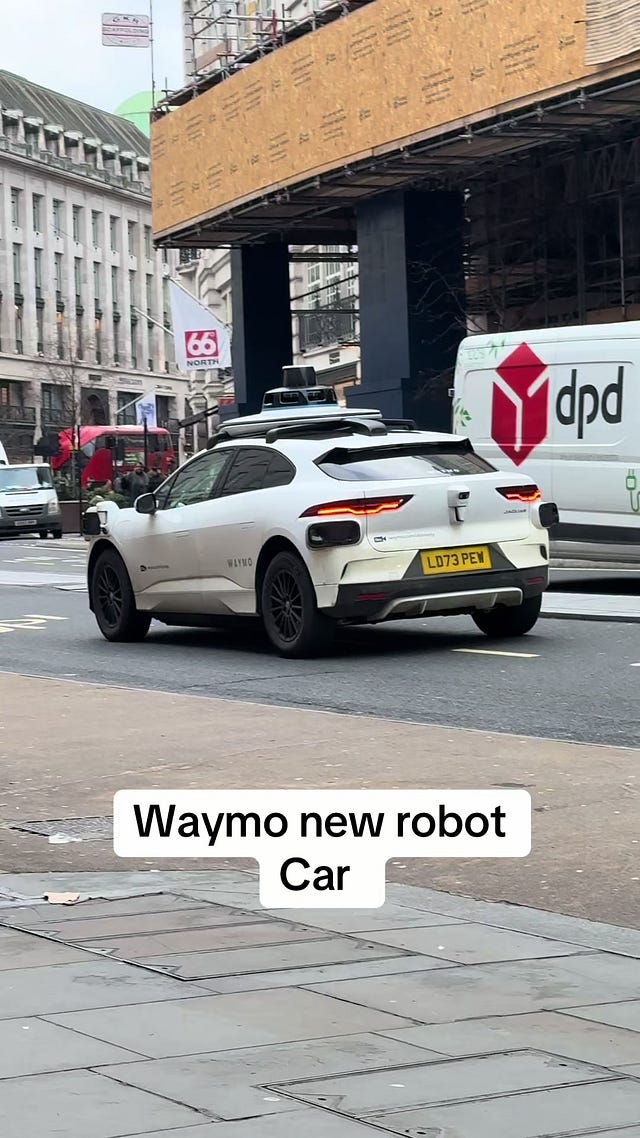
While I finally located a Waymo in Park Royal and chased it on a practice run, it’s clear that they drive in a very different manner from humans. Rather than hitting the accelerator when there’s open road and braking sharply when there’s a red light, the self-driving car seemed to gently glide around.
(Update: After the publication of this piece, Waymo got in touch to say that the car I saw would have had a human operating the vehicle in order to train it, rather than relying on artificial intelligence. What I observed turns out to have been a triumph of social engineering that showed how differently humans would drive if they were being constantly monitored — and how Waymos will be expected to drive in future. We have a “Mechanical Turk” situation.)
 Tiktok failed to load.
Enable 3rd party cookies or use another browser
But what happens when an AI driver that thrives on predictability and the rules of the road faces the chaos of inner London’s roads?
If an Uber driver is heading down a narrow lane designed for a horse-drawn cart that’s temporarily blocked by an unloading van, they might conduct a swift illegal u-turn to stop the whole of central London snarling up. Will Waymo be willing to do the same?
“Moving around London is not the same as moving around Phoenix in Arizona,” said Stilgoe, the academic. “If the police put tape across a road and ask vehicles to turn around, what happens if that vehicle doesn’t have anybody in it?”
He also raised the prospect of Zebra crossing without red stop lights, a largely British road feature that often involves making eye contact between a pedestrian and a driver to indicate intent: “I still don’t know what Waymo’s approach to a zebra crossing is. Negotiating with a robot, where you can’t read the robot’s intentions, becomes really complicated.”
“High-severity, cross-functional incidents”
There will also inevitably be viral videos of Waymos getting things wrong which will get far more publicity than if a human driver did the same. In San Francisco Waymo has killed both a beloved neighbourhood cat and a dog, awoken residents with a car park full of nighttime honking, rolled into a fire scene and run over a fire hose, and avoided being ticketed for an illegal u-turn because the form had no category for robot drivers. Just before Christmas a power outage in San Francisco led to Waymo shutting down its systems, leaving cars blocking streets.
Inevitably, the question is what happens when things go very wrong and cause injuries – as they inevitably will at some point, as with all road vehicles. Waymo has already hired “incident response managers” in London who can handle “high-severity, cross-functional incidents” and might potentially be exposed to “graphic” content. The company’s case is that data from the US shows that its cars are ten times less likely to be involved in a serious injury crash than human drivers.
Waymo spokesperson Ethan Teicher said: “We’ve demonstrated our technology is scalable and adaptable to new environments, backed by a safety record that shows we’re making communities safer where we operate. We’ll continue to introduce Waymo’s technology to the city over the coming months, to ensure it performs safely in this new environment and provides riders with the same magical experience we offer in six major US cities. With well over 127m fully autonomous miles on public roads in the US and more than 20m fully autonomous rides provided, we’re thrilled to soon offer our ride-hailing service to Londoners.”
The rivals joining Waymo on London’s streets
Waymo isn’t the only robotaxi firm preparing to launch in London. The Alphabet-backed company has dominated press coverage and has established itself as the market leader in other Western cities around the world but faces competition from two main competitors for dominance on the streets of London.
One is Wayve, the confusingly-similarly-named British company that has been testing its vehicles from a base near the Egg nightclub in King’s Cross for several years. You’ve probably passed its vehicles travelling around inner London on training missions for the last year, long before Waymo arrived on the scene, except Wayve’s sensors are substantially more subtle – meaning you’re less likely to see viral clips of them.
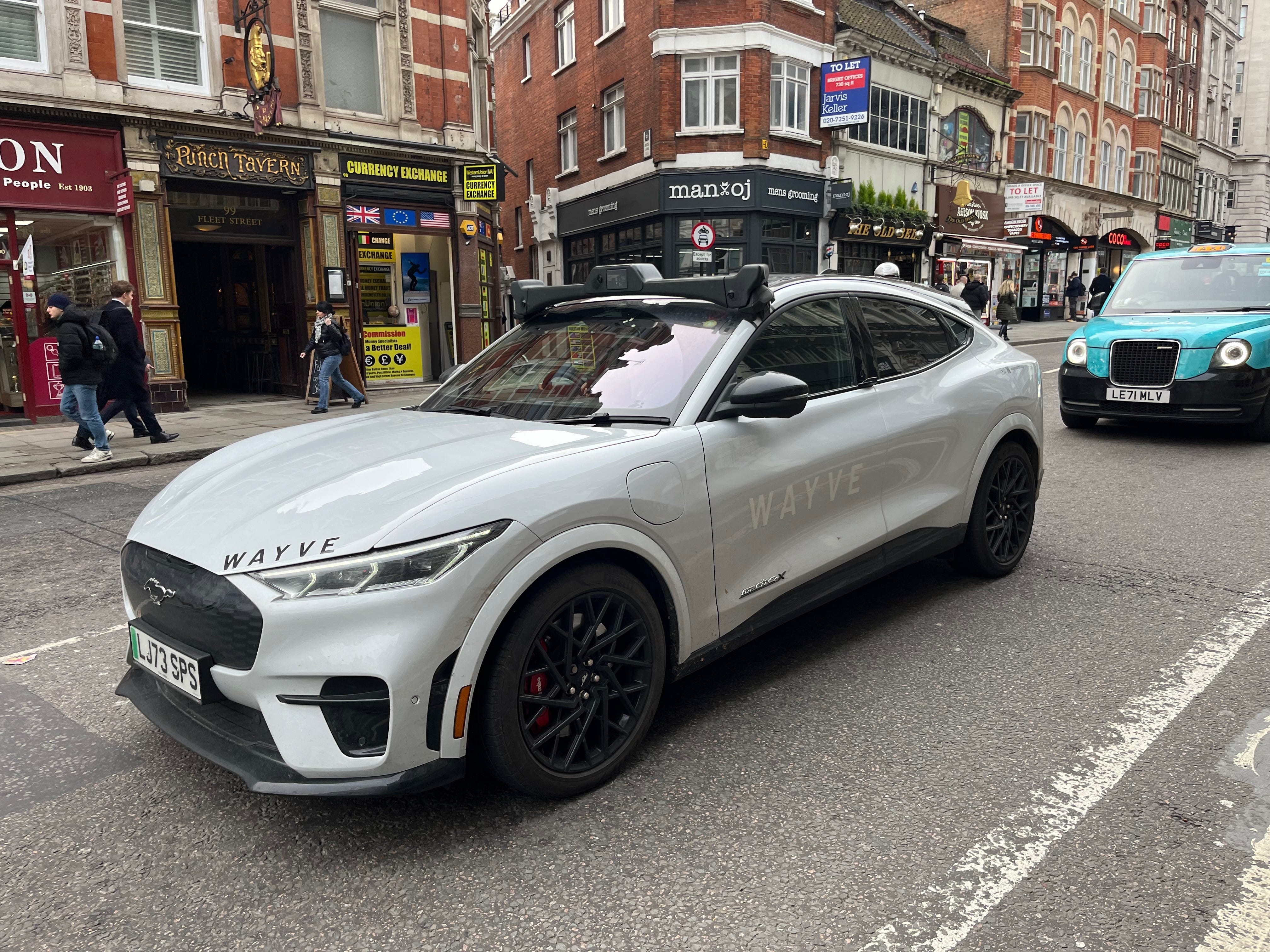
Wayve is taking a different approach to Waymo and rather than mapping the capital with sensors, claims to be able to respond to street situations in real time. It publicly signed a deal with Uber last year to be integrated into the taxi app but the challenge will be getting up and running for passenger service, with no launch date pencilled in.
Uber (along with rival Lyft) has now signed a parallel deal to launch vehicles from established Chinese operator Baidu on London’s streets in the coming months, meaning there will soon be at least three different brands of robotaxis on the streets of the capital.
The Uber drivers fight back
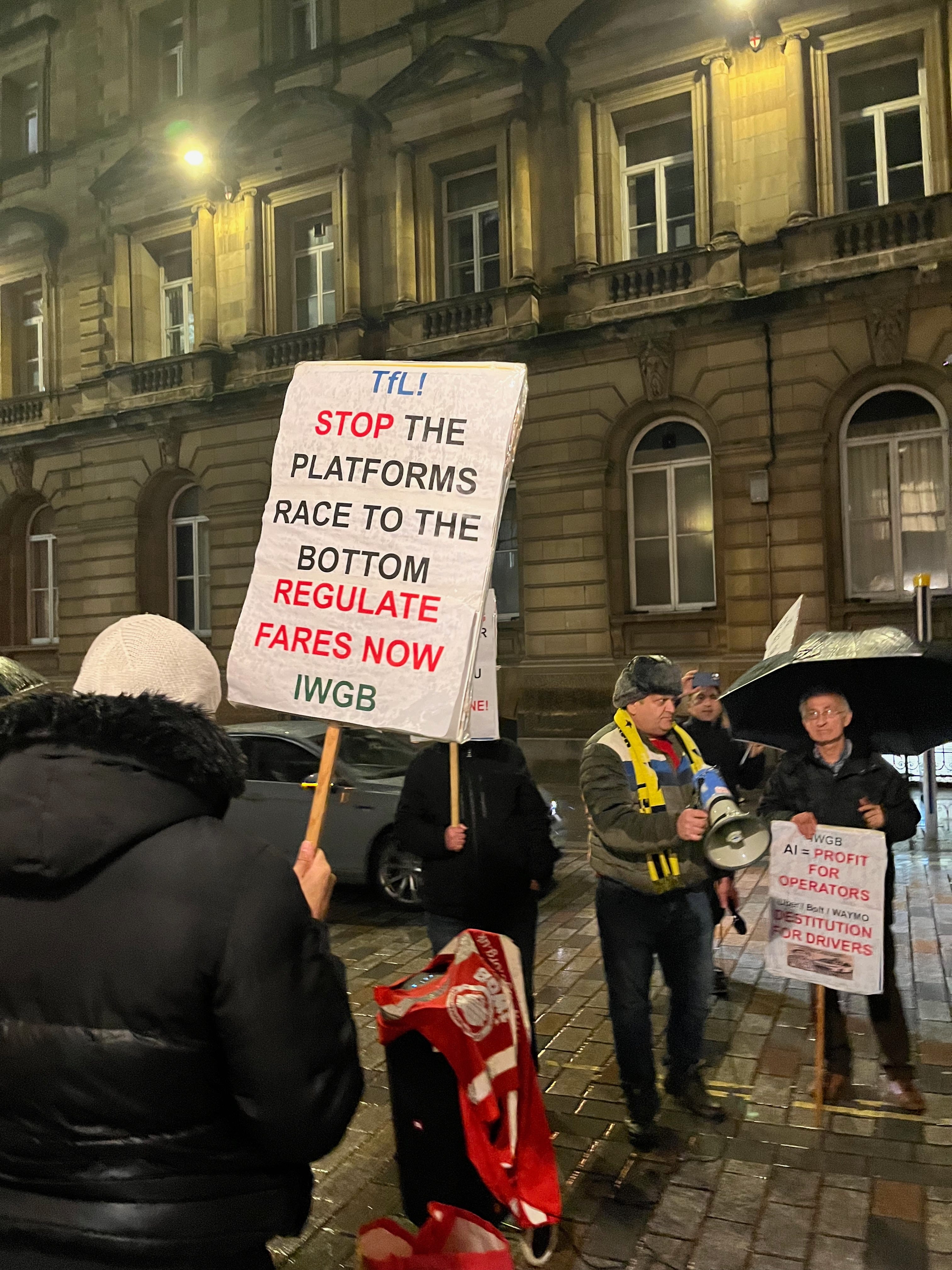
Earlier this month, the Independent Workers’ Union of Great Britain picketed the City of London’s annual London government dinner at the Mansion House. As London’s political elite arrived in black tie, the protesters demanded that Sadiq Khan and Transport for London intervene to protect Uber drivers’ income once self-driving vehicles such as Waymo start to arrive in the capital.
Banners included “AI = Profit for operators, Destitution for drivers.”
Ed, an Uber driver in his late 50s, told London Centric that self-driving cars pose a “very serious” threat to drivers: “Why would Uber employ a driver when they can employ a robot?”
While he worried that in the long term, driverless cars would replace human drivers, he feared that at first they’d be used by companies to drive fares down even further.
Having spent the last decade as a driver, he said: “TfL says it supports drivers. But when self-driving cars come along, it’s inevitable the workforce will diminish. There won’t be enough work for them. There are 100,000 private hire drivers in London. Each one of those cars feeds a family.”
What the protesting Uber drivers didn’t know was that, inside the Mansion House, Sadiq Khan was delivering a speech that described AI as "a weapon of mass destruction of jobs" that could create an “era of mass unemployment” in the capital – implicitly echoing their message.
Airport runs and non-stop workers
The fear among taxi drivers is that their lucrative airport market will be eaten into by the new vehicles, with Uber drivers sharing speculation that secret deals have already been struck to create holding pens for hundreds of driverless cars at the capital’s airports. Heathrow, Gatwick and Waymo all deny that any such deals are in place. Yet in recent days Waymo has been sending out market research surveys to Londoners asking which airports they would like to get a ride to, suggesting this is an ultimate aspiration.
Rapid growth is not a given, especially given the need to find sufficient suitable vehicles to replace the discontinued Jaguar I-Pace. Despite fanfare around the presence of driverless cars in San Francisco, the size of Waymo’s fleet remains comparatively small. And while Waymos can work almost around the clock, unlike humans who require breaks for rest and sleep, that’s still not enough taxis to meet demand for the city’s residents.
There’s one other curious aspect: even with massive subsidies from its owners, a Waymo fare in San Francisco is often more expensive than taking an Uber with a driver. But that doesn’t stop people from choosing the self-driving vehicles — with one of the key attractions apparently being the removal of the need to talk or interact with a human driver.
On top of everything else, could this be the beginning of the end of the famous London cabbie’s chat about who they had in the back of their cab?
Want to get in touch with London Centric? You can send an email or a WhatsApp.
A thing I noticed earlier, when the Wayve CEO was boasting of his trip through Central London in a massive, single-occupant, automated vehicle, is that they leave a generous amount of space to the car in front. Multiply this out to a large fleet and they surely increase congestion significantly compared to the bumper-to-bumper practices favoured by cars trying to navigate vehicle-choked streets. Just another way these companies plan to take up public space, potentially to the detriment of everyone else.
This Stilgoe professor sounds like a bit of an ****. Looking at his quotes:
“Moving around London isn’t the same as moving around Phoenix, Arizona - what happens if police put tape across the road and ask vehicles to turn around?”
Well, while there definitely are many differences between the two places, that surely isn’t one of them. I’m confident that happens in Phoenix as well.
“Zebra crossings often involve eye contact between pedestrian and driver.”
They often do, but they don’t need to. The Highway Code says that the car must stop if the pedestrian is on the crossing, and that will be straightforward for Waymo to cope with. It might take a little while for people to get used to not being able to make eye contact any more, but it won’t be a showstopper, especially as most pedestrians in London seem to step out into the road without looking or even bothering to find a crossing first.
“Most people will think what problems do these cars solve?”
Well there’s the opportunity to massively reduce the accident rate, and to increase capacity in an under-served market, for starters. But in any case, this objection reminds me of every Luddite anywhere ever. “What problem does email solve anyway? We have a perfectly good postal system!”
Go to the bottom of the class, professor.