

Another fundraiser outside London stations is under investigation
Plus: More festivals in parks hit by planning rows, TfL's bird-killing nets at a tube depot, and how much is Lime making from Londoners?


London Centric is entirely funded by paying subscribers. So I’m really delighted that we’ve been nominated in two categories at this year’s Orwell Prizes, which are awarded in memory of the author. It’s all thanks to the people who put their faith in this project and are generous enough to back it financially, enabling us to carry out ambitious local journalism about London.
Our reporting on Asif Aziz’s Criterion Capital and the company’s “mass evictions” has been nominated in the ‘Reporting Homelessness’ category. Judge Mel Young said: “London Centric’s entry was very well researched, the product of a great deal of work, but it was also extremely engaging: as a reader, you wanted to find out what was going on. It illustrated what is clearly a major problem in the rental sector, and how vulnerable people can be.”
Katherine Denkinson’s story on the TikToker filming inside Londoners’ homes to produce fake viral content was nominated in the ‘Exposing Britain’s Social Evils’ category. Judge Abby Jitendra said: “A fascinating look into the strange dynamics social media platforms give rise to, with fake stories gaining huge attention and worsening public trust – thoroughly investigated and novel.”
The full Orwell Prize shortlist can be seen here, where there are loads of links to incredible pieces of journalism. London Centric only launched in September 2024, so it’s amazing to be competing alongside some of the biggest and best-funded news organisations in the world.
Homeless In Need under investigation over its fundraising activities

If you step outside a central London tube station, you’re likely to encounter fundraisers representing a “community interest company”, standing in front of a banner and asking for money for causes from veterans to the homeless. These groups look like charities and have similar messaging to charities – but they’re often run as for-profit companies with limited oversight on how they spend their money.
London Centric has learned that yet another of these organisations, Homeless In Need UK, which is regularly operating outside Green Park tube station and at other locations, is the subject of an ongoing investigation by the Fundraising Regulator into its tactics.

Homeless In Need says it is collecting money to support individuals experiencing homelessness, particularly those suffering from PTSD. Taking donations from commuters in cash or with card machines, they might appear to many Londoners to be a registered charity.
The company’s most recent accounts suggest that little of the money it raised during its first year of operation ended up with the homeless. Instead, filings show the company spent almost half of its £41,000 income on “directors’ fees”, with founder James Gordon Adams the only named director.
It also spent £12,847 on “materials for fundraising” as well as around £6,000 on wages and expenses.
This left little money to fund actual direct help to the homeless. The only explicit spending in the accounts was £980 providing food to the homeless in Gillingham, Kent, and £880 on “PTSD support”.
A previous iteration of the company’s website claimed that this money had gone a long way: “So far we have helped thousands with food donations, accommodation needs as well as PTSD treatment.”
Legal grey area
Like other groups spotted soliciting money outside London stations, such as Inside Success and We R Blighty, Homeless In Need is not a charity – although this distinction might not be immediately apparent to anyone rushing by on their way to work.
Amid mounting concern from well-meaning donors, the Fundraising Regulator – which is run and funded by registered charities – has attempted to crack down on the growing number of these non-charitable organisations. The body previously found both We R Blighty and Inside Success in breach of the fundraising code of practice. The City of London also successfully prosecuted We R Blighty for carrying out illegal street collections in the square mile.
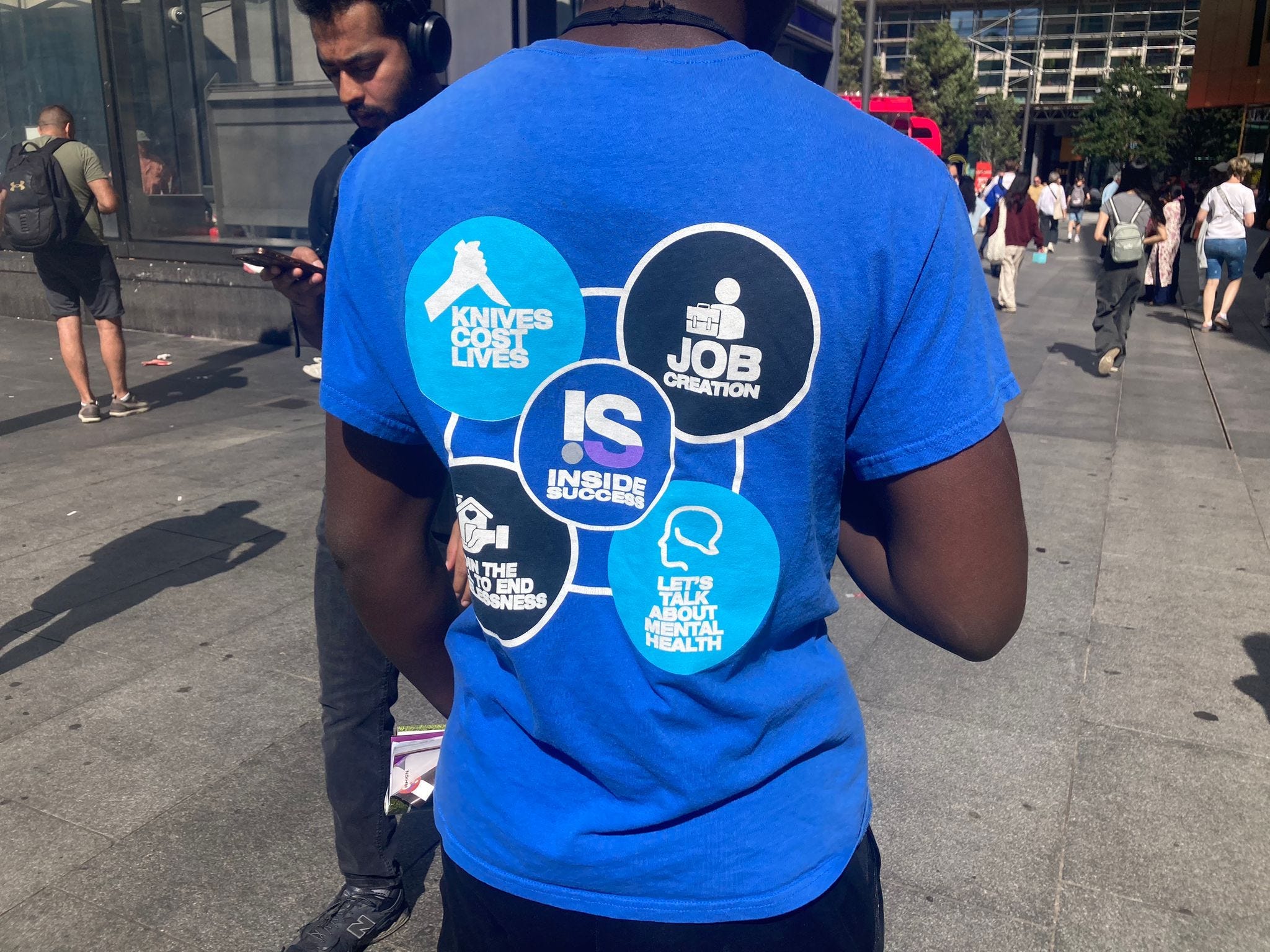
London Centric reader Florence Batchelor told us that when she walked past Homeless In Need on her way to work she was pleased to see someone other than We R Blighty collecting. “I saw a couple of guys with buckets, and since they were different I thought I’d put a tenner in the bucket,” she said. “Afterwards I got a feeling that there was something strange about them…It’s so easy to get caught out by these groups.”
If you want to sell goods on the streets of London, you need a street trading licence from the local council. Alternatively, if you want to fundraise for a registered charity, you need a licence from the Met police. These groups operate in the grey area, sometimes claiming to use an exemption that was originally meant for newspaper sellers.
Legitimate charities argue it is relatively simple to bring prosecutions against community interest companies (CICs) but say there is little desire on the part of the police or councils to dedicate any resources to dealing with the issue. In some cases London Centric has had to inform local London councils and councillors that they have the authority to prosecute them.
“Highlight the good things”
When we called James Gordon Adams, the director of Homeless in Need, he said the figures in the accounts “are from two years ago… our real accounts which will be out in a month. If you just talk about two years ago, you’re going to muddy the waters.”
Like many of the community interest companies that solicit money outside central London stations, Homeless In Need is based in Kent.
Adams said “there was a slight error between fundraised materials that should have gone onto fundraising,” but asked London Centric to “highlight the good things” about his organisation’s work, claiming that negative coverage would affect income.
The Homeless in Need YouTube channels show videos of several individuals who appear to have genuinely received help from the group. One man called Matthew states: “Homeless in Need have been more helpful to me than all other charities. Not only have they been able to support me from time-to-time with accommodation, they have now managed to get me the support and stability where I’m able to propose myself towards getting jobs again.”
Want to get in touch with London Centric? Send us an email or WhatsApp.
I Ran (So Far From Ealing)
An attempt by Transport for London to reduce flooding caused by falling leaves at one of its tube depots appears to have resulted in a massacre of birds. Netting was installed at its Northfields depot last month. But locals told London Centric a flock of seagulls instead became ensnared in the mesh, leaving them dying slow deaths while their shrieks tormented people living near the depot.
Locals claimed TfL staff at the depot refused to intervene, while the Royal Society for the Protection of Birds reportedly said it was unable to act as the distressed avians were on TfL property.
Adrenne Read, Head of Built Environment, Maintenance and Renewals at Transport for London, said: “Unfortunately, some damage to part of the netting has allowed a small number of birds to become trapped.
“We take animal welfare very seriously. We are removing the birds and will urgently repair the netting to prevent this happening again.”
The festivals in parks backlash is causing events to be cancelled
The Battle for Brockwell Park was temporarily paused last week, after a judge refused residents’ latest legal bid to overturn the approval given to music festivals such as Mighty Hoopla.
But the precedent set in south London, which means many outdoor gigs now require full planning permission, is continuing to cause problems for promoters across the capital.
Two music events set to take place in west London’s Gunnersbury Park have both had to relocate in recent days, with electronic dance music festival Waterworks moving to The Cause nightclub, and a Lenny Kravitz concert being held instead at the Crystal Palace Bowl.
The change in location is a result of a row over planning permission, following a review in March by Hounslow Council into the park’s licence to operate events.
The review was triggered by the Gunnersbury Park Garden Estate residents committee, which has long raised concerns over drug use and antisocial behaviour at the festival, as well as unsafe noise levels and reduced public access.
While Hounslow Council chose not to revoke the park’s premises licence, in April it announced a new set of conditions for future events held there, including a capacity cap and mandatory community engagement plan with local residents.
Last week Waterworks announced that a delay in planning permission being granted for the event left it with no option but to relocate, or risk committing to spending “hundreds of thousands of pounds worth of infrastructure orders, supplier and crew commissioning, with no certainty of permission in place.”
The statement by Waterworks said that plans are “underway” for the festival to return to the park in 2027. London Centric has contacted Waterworks and Hounslow Council for comment.
Why won’t YOU take the bus?
Londoners taking the bus at the weekend this summer will be able to take unlimited journeys for the price of a single fare, after mayor Sadiq Khan announcing a new fare cap in a bid to encourage people back on to London’s buses
The offer will run from 25 July and until 31 August on Saturdays and Sundays, as well as during the late August bank holiday. That means that if you tap in once, you can take unlimited bus journeys at no extra cost for the rest of the day. The offer also applies to tram journeys for those in the south of London.
The mayor has also indicated his intention to delay a planned increase to the £1.75 bus fare, which was expected to come in this summer.
The real issue the experiment is trying to solve is the stubbornly falling passenger numbers on TfL’s buses. This is partly due to the general decline in Londoners moving around the city but also due to bus speeds slowing down to 9.2 miles per hour – which, on top of the lack of air conditioning in hot London summers, can make the bus an unappealing option. In February, TfL announced it was putting aside £20m in funding for “fares innovation” to try and find new ways to boost passenger numbers.
How much does London need Lime – and how much does Lime need London?
One of the challenges to the bus in London is the growth of the rental e-bike market, led by the growing popularity of Lime, which has done more than almost anything else to encourage cycling in the city.
Last week Lime confirmed its long-awaited plans to list on the stock market, with the FT saying it is aiming for a $2bn (£1.5bn) valuation.
As part of this process, the lossmaking company has to publish a warts-and-all financial document setting out the financial state of the company and telling investors about any risks it may face in the future.
London Centric’s reporting on Lime bike leg and lost kidneys gets a reference in the reputational risks section:
Claims of accidents involving our vehicles or other causes of injury, particularly injuries involving serious injury or death, including negative publicity surrounding such events, have occurred and are likely to continue to occur. Additionally, the perception that our offerings are unsafe could harm our reputation and may make it less likely that riders would be willing to try or continue using our platform. For example, in the United Kingdom we are subject to claims that our vehicles increase the risk of leg injuries.
The legal documents also show the enormous importance of the London market to Lime’s financial performance, with a quarter of global revenue coming from the UK market during the first three months of this year, most of it in the capital.
These figures suggest Londoners are spending almost £10m a month on Lime e-bikes and scooters.
Another London bridge crumbles…
London Bridge might remain intact, but the same can’t be said for the other bridges along the Thames. In 2019, Hammersmith Bridge closed to cars, with Albert Bridge becoming pedestrian and bike-only in March this year.
Now, Transport for London has introduced a weight restriction on Vauxhall Bridge, after an assessment found signs of deterioration. The 18-tonne restriction will be introduced from 1 July and won’t apply to emergency vehicles and buses. As long ago as 2020 the transport authority was warning major investment was needed to secure the future of the Edwardian structure.
TfL said that the bridge doesn’t currently pose any risk to users, with the measures instead aimed at avoiding further damage while it resolves the issue.
While 39,500 vehicles cross the bridge each day, TfL said currently only around 200 of these exceed the 18-tonne weight limit. But it’s another indicator that much of the capital’s physical infrastructure is ageing and might soon need a lot of money spending on it. Who’s going to pick up the bill is the question no one wants to answer.
…and the tube strikes are still going ahead next week
Lime bikes at the ready, as some of London’s tube drivers head back out on strike, with the action likely to cause disruption for much of the week.
Members of the Rail, Maritime and Transport union (RMT) are set to hold two 24-hour strikes, starting at midday on Tuesday 19 May, then again on Thursday 21 May.
The dispute centres on TfL’s proposal for a 35-hour four-day week on the London Underground (full explainer here). While rival union Aslef has welcomed the change, the RMT has rejected it on the basis that the plan crams five days’ work into four, arguing the plans need to be accompanied by a shorter working day.
When London Centric spoke to the RMT last month, it said the interlude between strikes offered a “window of opportunity for TfL to come forward with a decent proposal so we can reach a negotiated settlement.”
But no talks have been forthcoming, meaning there’s still no end in sight for the dispute. How badly your tube journey will be affected depends on whether your line is largely staffed by Aslef or RMT drivers.
An RMT spokesperson told London Centric: “Despite promises about talks, TfL has not made any attempt to engage in negotiation meetings to resolve this dispute. London Underground is still pushing implementation plans through a forum that excludes senior managers and union officials, instead of engaging in proper negotiations.”
Want to get in touch with London Centric? Send us an email or WhatsApp.
Re falling bus passengers, likely to be partly hire bikes, but mostly increased bus journey times. Sometimes when this happens TfL install 24/7 clearway, bus priority, doesn't need bus lanes can be done with signals, and bus journey times improve. Sadly in key locations, junctions, and roadway, maintaining capacity for people to drive takes precedence over bus priority, walking and cycling
Congrats on the nominations!