


Thanks to everyone who signed up to read our deep dive into what actually happened in the Clapham chaos last week. If you missed it, you can catch up here.
Coincidentally, today Sadiq Khan is announcing a £30m investment in 32 new “late-night youth clubs” for every London borough. His team blames past austerity measures and directly links this investment to efforts to do more to tackle “phone theft, shoplifting and antisocial behaviour”.
Today’s main story is on another new phenomenon that has become an accepted facet of London life, that as yet hasn’t received much attention. Is it now normal to work unpaid shifts in order to be considered for a job pulling pints? Are cash-strapped London hospitality venues taking advantage of the capital’s glut of unemployed young people to get them to fill gaps in their rotas?
Scroll down to read that, but first…
You can’t spell Haringey without “Ye”
Wireless Festival has been cancelled after the government blocked Kanye West, who was set to headline all three nights of the event, from entering the country due to his history of antisemitic comments.
Public land use rights in London parks probably aren’t the top thing on the-artist-currently-known-as-Ye’s mind right now. But one of the side effects of his visa refusal is an inadvertent victory for campaigners against private festivals in London’s open spaces, with Finsbury Park now potentially open to the general public for longer in July.
“We’re obviously pleased in the sense that the park and local residents won’t be subjected to another overly enormous, overly loud, overly invasive event,” said Katie Dawson, co-chair of Friends of Finsbury Park, when we gave her a ring on Tuesday. “Haringey don’t own this park. It was bequeathed by an act of parliament, in the 19th century, for the good of people living in an urban environment around the park. It’s not for them to just then milk it, trash it, and abuse it, to get a bit of money.”
Promoter Festival Republic, part of Live Nation, will push ahead with three big gigs the weekend before, featuring Biffy Clyro, Kasabian, and Wolf Alice, meaning there will still be substantial disruption as an arena is built to hold 50,000 people a night. But the site could be cleared earlier than expected.
Curiously, it’s only a couple of weeks since Haringey approved an extension to the promoter’s contract to use Finsbury Park to host Wireless every summer until 2032. Councillors were told events in Finsbury Park, including those put on by other promoters, generate £1.2m a year to cover the cost of maintaining the green space in the face of budget cuts elsewhere.
We tried to contact Haringey council to find out if the local authority would be left out of pocket by the Kanye West cancellation or if the promoter’s insurance would cover payments to the council. The council’s press office phone number hasn’t worked for the last two months and they haven’t replied to our emails – but we’ll let you know if we get through.
Lime-inal space
The first new, smaller – and possibly safer – Lime e-bikes have been spotted on the streets of London. We saw one zooming past London Bridge station on Monday morning, while subscriber Thomas Dawson has been in touch with an early review: “Had a new Lime for the first time today! Pros: Basket is better for storing bigger bags. Cons: seat only goes up to 9, seems less powerful (really struggled on hills).”
He reckoned they felt safer: “Would want to see how they go in the rain and after it’s been bashed about a bit, but you can definitely feel the weight being under/behind you rather than further forward.”
Comment once, comment all
The London Centric comments section continues to be one of the most interesting places on the internet, featuring a group of people whose feedback is sometimes smarter and more nuanced than a lot of London journalism, ours included.
It’s always good to see new voices join in the discussion – such as the cluster of freshly-registered users who spent the bank holiday weekend posting comments in support of landlord Asif Aziz beneath one of our old pieces about his company’s “mass evictions”.

We always welcome frank reader feedback. But it seemed strange to see a group of newly-registered users leaving a string of pro-Criterion comments on an old piece, all within the space of a few minutes. So we contacted Substack’s support team. After investigating, they said the users showed signs of “coordinated and inauthentic” behaviour and deleted their comments.
The following day, another cluster of comments arrived. A spokesperson for Criterion Capital said it had nothing to do with them and we’re none the wiser as to who is behind them.
But to answer one of the questions posed by our new friends:
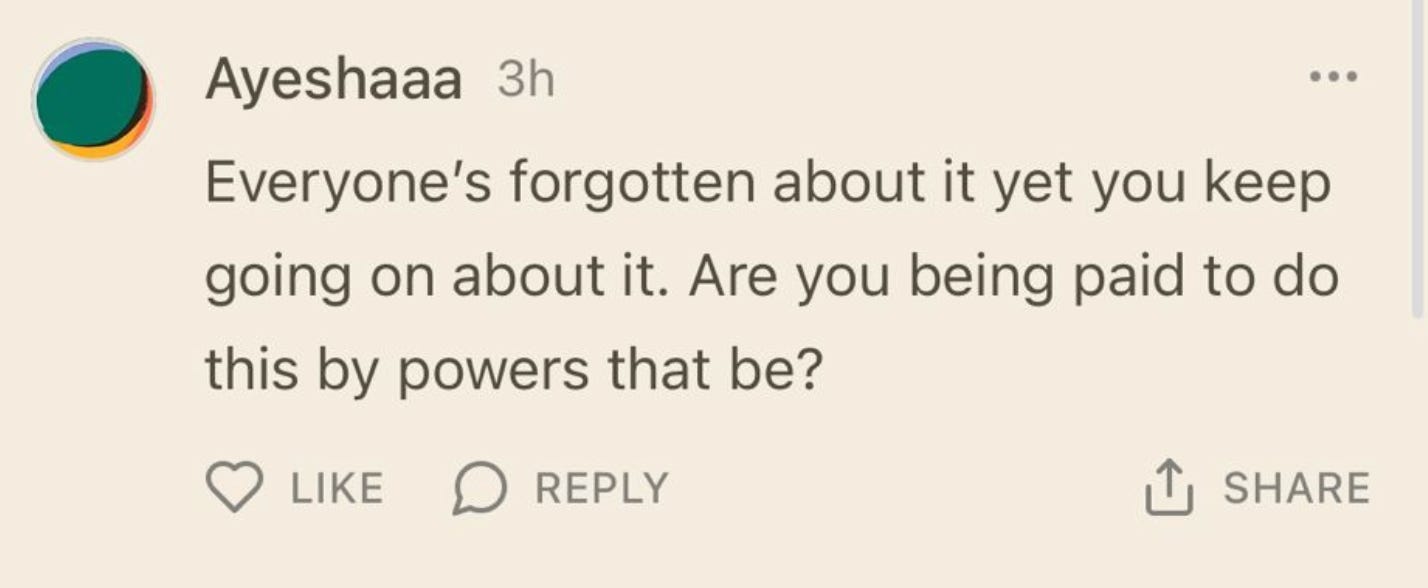
No, the investigation is not funded by “powers that be”. Unless you count our wonderful paying subscribers.
PS: Two quick updates on Asif Aziz and Criterion Capital.
1. Merton Council has been in touch regarding our investigation into seemingly invalid electrical safety certificates issued to Criterion’s residential tenants. The council says the paperwork has now been received and is “being reviewed as a matter of urgency” with the potential to fine the landlord tens of thousands of pounds per breach.
2. Our investigation into the tax-evading central London gift shops that rent their shop units from Criterion Capital has been shortlisted for the best financial journalism of the year at the Wincott Awards.
From the Tate to your local pub: Are London venues turning to unpaid trial shifters to fill rotas?

By Polly Smythe
When Lucy, 24, arrived for an unpaid trial shift at the Peppa Pig afternoon tea bus sightseeing experience, her tasks were simple: for four hours, she had to arrange finger sandwiches on platters, carry trays of macaroons, and pour cups of tea, all while the bus lurched about central London carrying excited families.
The trial seemed to go well: “I was very proud of myself. I didn’t drop a single macaroon.” She wasn’t being paid anything for her time, and the slow traffic meant it lasted an hour longer than planned. But having done a good job, and with a few years of hospitality experience behind her, Lucy felt confident she had a good chance of being hired.
Several weeks later, she finally heard back from the operators, who said there was no work: “In the months since, I’ve felt more and more aggrieved about it. I found it very demoralising.”
Lucy is just one of a growing number of young Londoners expected to work a full hospitality shift for free in order to be considered for a job, in what a leading union has told London Centric is a “growing problem.”
With youth unemployment in the capital at its highest level in a decade, there’s fierce competition for entry-level roles. But employers say that increases in national insurance contributions and the minimum wage have made taking on new staff in hospitality and retail prohibitively expensive.
The suspicion is that squeezed businesses are instead turning to the ranks of young people desperate to find work as a way to plug staffing gaps for free.
“There’s this sense of, ‘what can you do about it?’” said Lucy. “You’re completely at the mercy of the boss. In the back of your mind, you know they’re getting hundreds of CVs handed in all the time.”
The biggest change in recent years, according to staff and managers, is the growing deployment of trial shifters on busy weekend shifts.
One restaurant manager said that trial shifts are increasingly scheduled on Fridays and Saturdays because they are seen as “a good way to get ad hoc shifts.”
The manager, who has supervised unpaid trial shifters in previous jobs, said this is a terrible time to judge whether someone is up to the job: “Management will go, ‘let’s get the trial in on this day because that’s going to be more helpful for us.’ That’s bad because you’re throwing someone in at the deep end.”
Still, they said that the high turnover of staff, aided by short or non-existent notice periods, means that the distinction between hiring for a job that exists and a job that might exist in a few weeks is often blurred: “If a staff member quits with one week’s notice and you suddenly have space to fill, restaurants like to have contacts available for when they have sudden exits.”
Carolina, 25, did a four-hour unpaid trial shift at an Italian restaurant in Clapham. “Nine times out of ten, a job is going to have an unpaid trial shift,” she said. Her shift was scheduled on a Saturday morning, to cover the brunch rush.
“It makes you see yourself as someone whose time isn’t valued,” said Carolina.
It’s not just smaller venues that are using unpaid trial shift workers. Late last November, Michael worked an unpaid trial shift as a barista in the cafe at Tate Britain. The venue was an hour’s travel from his house and the trial lasted for two hours: “It felt like I was just filling in for someone. They’re quite understaffed. It took a week or two for them to get back to me, and then they said on this occasion we’re not selecting you.”
“It was near the Christmas period, which made me think this doesn’t feel right. It was a busy time.”
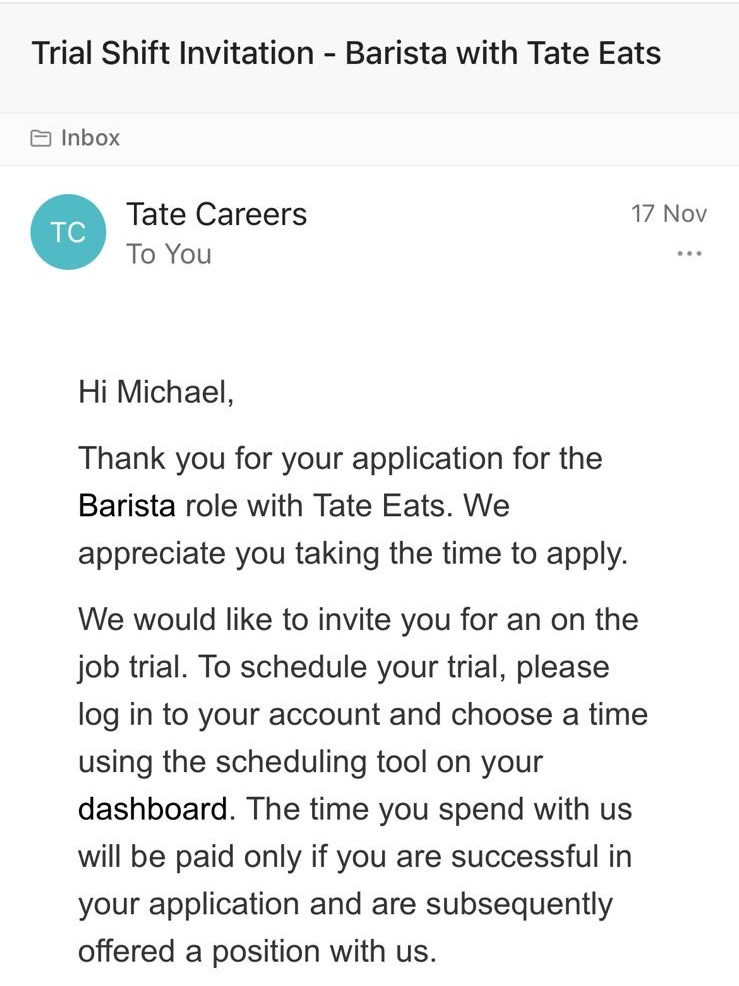
The Tate did not respond to our request for comment on whether its use of trial shifts was widespread.
But others with hospitality jobs said they regularly see them used this way. Charlie, who used to work at a bar on south London’s Bermondsey beer mile, said: “Trials were always in the evening when it was busier.”
Those on a trial weren’t allowed behind the bar and instead were tasked with glass collection, which freed up paid bar staff to focus on serving pints faster and getting more money through the till.
“Without them we would’ve been stretched,” he said. “Pubs have a quick turnover of staff, so there were always vacancies. But the vacancies didn’t correlate with the level of trials I saw coming in.”
Bryan Simpson, who leads on hospitality for Unite, said the union had seen a “clear rise in concerns about unpaid trial shifts coming through, both through direct complaints and anecdotally from workers across the hospitality and service sectors”.
He said: “Increasingly, these aren’t short, skills-based assessments but long, gruelling shifts that look and feel like real work – with no pay at the end of it.” The trial shifts are “being used to plug staffing gaps during busy periods, with no genuine job on offer, which is simply exploitation by another name. Workers are effectively providing free labour in workplaces that are already under pressure to cut costs.”
Job listings are rarely upfront about whether a trial will be paid, or for how long it will last. But once workers have arrived for their trial, often having spent money on travel or suitable clothing for the shift, it can be difficult to ask questions without the fear of jeopardising the chance of getting hired.
Daniel Burke, 22, has done four unpaid trial shifts, the longest of which lasted eight hours. A baker, he’s been tasked with mundane jobs like separating crates of egg yolks and egg whites, or shaping endless piles of dough.
“Unpaid trial shifts are so normalised that a lot of people don’t even think of them as being bad,” he said.
Employment rights minister Kate Dearden told London Centric that the government is “tackling the dodgy use of unpaid work trials, which some employers exploit to secure free labour under the guise of recruitment”.
“Updated guidance will make clear where the law stands and how workers can challenge unfair treatment,” she said.
After her Peppa Pig rejection, Lucy attended a “recruitment day” for a weekend-only bar job at a mini golf venue. There were 50 people in attendance for only a handful of positions, with the day spent performing various tasks. No one was paid for their time spent trying to secure a minimum wage job.
“After each round, they’d read out a list of names of those who’d progressed. It was like the X Factor. And everyone there was more than qualified to do that job.”
Brigit’s Bakery, the company behind the Peppa Pig bus experience, said it only uses trial shifts as a “short, structured, and supervised way to assess a candidate’s suitability” and that they are “proportionate in length and focused on assessing practical skills relevant to the role.”
Lucy has now secured a full-time job in a different sector. “My job hunting period was cursed. People would say, ‘how’s the search going?’ I’d go, ‘Well, I did a four-hour unpaid trial shift on a Peppa Pig-themed afternoon tea bus and I didn’t get the job. How do you think it’s going?’”
I'm not racist. I'm prejudiced against billionaires.
Omg the Azis bots hahaha they really have the nerve to post inauthentic comments instead of actually paying taxes and being a good landlord