

How the elections will change London
Who won, what will they do in your local area, and what does this mean for Sadiq Khan?


There won’t be any talk of what this week’s London election results mean for Keir Starmer, Nigel Farage, or any national politicians in today’s newsletter.
Instead it’s all about what the vote means for London – and, crucially, what the victors actually plan to do to the city.
This is the end of all of London Centric’s election coverage. We’ve got lots of fun non-politics exclusives coming up next week which will probably come as a blessed relief to many readers. See you then! (And don’t forget there’s always the London Centric archive to check out.)
Who actually won on Thursday?
All 32 London boroughs had all of their local councillors up for election, alongside a handful of directly-elected mayors.
Turnout was up, contests were tight, and there was something for (almost) everyone. Many councils ended up as ‘No Overall Control’ – meaning no single party did well enough to govern with a majority.
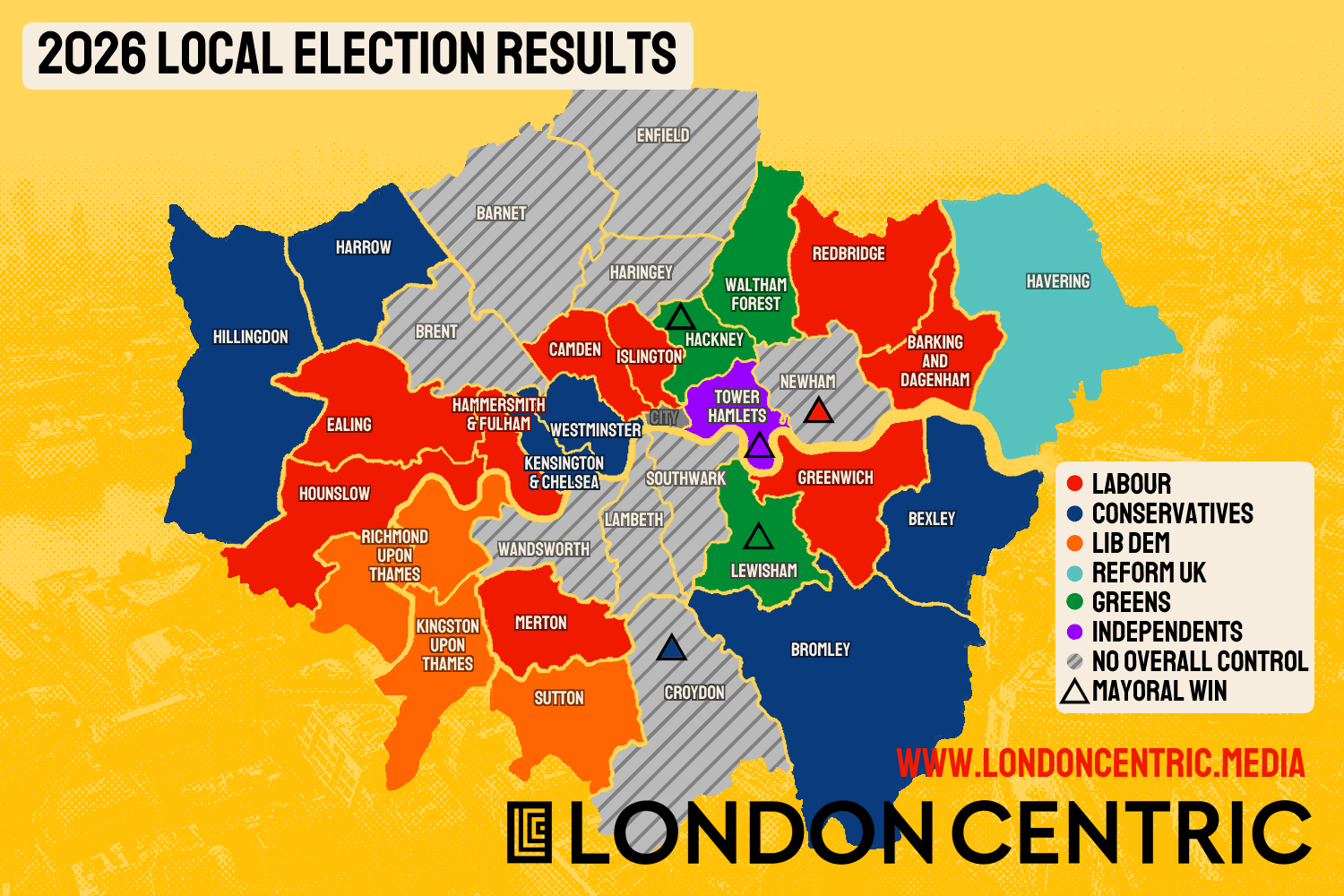
This is what the London results look like, with all results in…
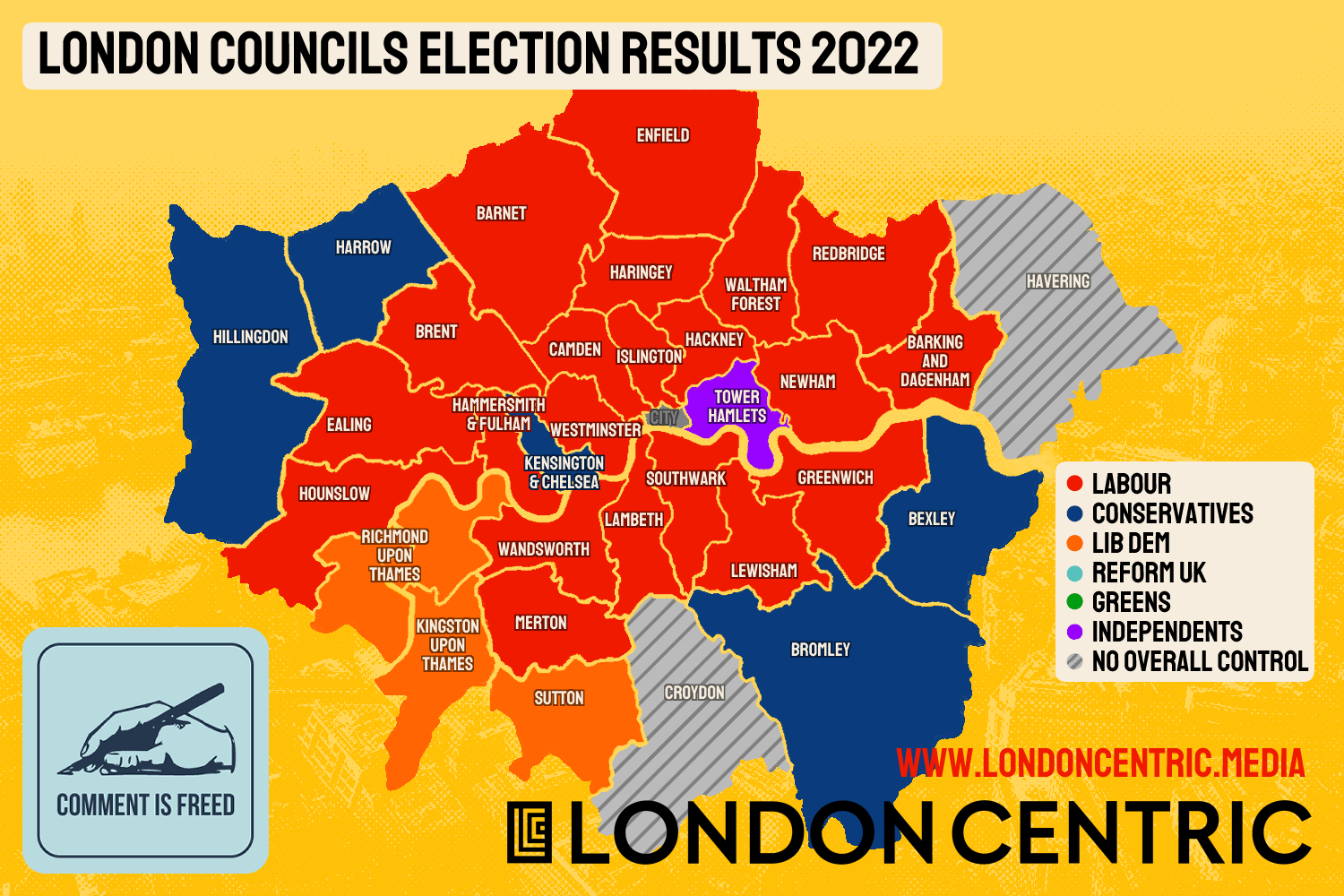
This, for comparison, was the previous election result from 2022, showing how Labour used to dominate.
Until this week the party ran 21 out of 32 London councils….
What happened:
It was a big night for the insurgent Green Party, as Zack Polanski’s party took control of a sweep of formerly Labour-run councils. Greens were elected as the executive mayors of Hackney and Lewisham. They took control of Waltham Forest and also dominated the Hackney councillor results. The Greens helped push Southwark and Haringey into No Overall Control territory and are still making big gains in Lambeth (where the count is so close at the time of publication that the final result has been delayed) while also coming a close second in many wards across London…
Yet despite the enormous success there was a sense among some in the Greens that they could have done even better. Missteps and media criticism in the final week of the campaign – plus a lack of campaign experience compared to Labour’s established get-out-the-vote operation – held them back from turning some of their ultra-close defeats into victories. They’re hoping to learn from this experience and push on even more.
Reform UK spent big on its London campaign, even buying front page wraparound adverts on newspapers such as the Standard. The party took control of Havering, the east London territory which includes Romford and Upminster. Reform celebrated by talking about a fresh push to take the borough out of the capital and move it to Essex.
Yet Reform’s big outer London suburban push largely fell short, with Nigel Farage’s party making some gains but failing to make the gains it had confidently talked about – meaning the capital bucked the national trend.
The Conservatives successfully defended Bexley, Bromley and Hillingdon, sometimes by asking Labour, Lib Dem, and Green voters to lend their votes to keep out Reform. The Tories also celebrated victories such as winning back Westminster and coming very close in Wandsworth. They also held their forever heartland of Kensington and Chelsea and modern heartland of Harrow. The Conservatives also clung onto the Croydon mayoralty by a very narrow margin – a result that would, as the FT’s Stephen Bush pointed out, have probably gone Labour’s way if the central Labour government’s incoming changes to the voting system had been approved a bit earlier.
One of the challenges of political journalism is that so much is about media narratives and expectations management – and when expectations were so low for Labour, it looks like a comparative success to just hold onto councils they used to dominate.
This time around Labour performed strongly in Ealing, Merton, Hammersmith & Fulham, and Barking & Dagenham, while clinging on despite taking blows in Camden, Islington, Hounslow, and Greenwich. They lost control of Enfield and Brent. In Barnet they slipped back but still won an equal number of seats as the Tories, giving the balance of power to a single Green Party councillor.
Labour also won the mayoral contest in Newham after a three-way with a local independent and the Greens, while also seeing off a strong challenge from Jeremy Corbyn-backed independents in Redbridge.
Still, it’s been a brutal set of results for a party that until this week dominated London, has the ruling mayor, and delivered a vast number of Labour MPs at the last election.
As for the Liberal Democrats, they built North Korean-esque levels of total dominance in the south west London boroughs of Kingston upon Thames, Richmond upon Thames, and Sutton, winning almost every seat, while struggling in all but a few other ultra-local pockets of the capital.
Over in Tower Hamlets, Lutfur Rahman from the Aspire Party was re-elected as mayor.
Update: Late council results:.Three boroughs with elected mayors counted their council votes on Saturday. The Greens followed their mayoral victory in Lewisham by taking the council from Labour, while Lutfur Rahman’s Aspire did the same in Tower Hamlets. The Conservatives took the Croydon mayor but the council itself remained in No Overall Control.
Possibly the most dramatic late result was in Lambeth, a former Labour stronghold, where the Greens ended up beating Labour to become the largest party – but not with enough votes to form a majority administration. The power now lies with the small group of Liberal Democrats on the south London council.
What does all this mean for Sadiq Khan – and the next mayoral election?
In less than two years Londoners will vote for the next mayor of Greater London. Sadiq Khan, who has already served three terms, has still yet to indicate whether he’ll stand again. But at some point in the next year he’ll have to make up his mind and either start a campaign or let Labour choose his successor.
Multiple Labour candidates, including Dawn Butler, one of Khan’s closest allies in politics, have been openly running for the Labour nomination under the impression that the mayor will stand down.
Yet Professor Tony Travers, director of LSE London, told London Centric this week’s results strengthen the political case for a fourth Khan term: “He’s a Labour politician, like Andy Burnham, who Labour understands is likely to be able to deal with the Greens. I don’t know what he wants going forward. But, for Labour, the choice between him and a new candidate embeds the risk that a new candidate couldn’t defeat the Greens.”
On Friday night Khan came out and said Labour faces an “existential” threat without a change in direction and warned that “London has been taken for granted for too long”. The mayor said Labour needs a “bold assertion” of progressive values to take on the Greens as the “only party that can unite progressives and close the door to the darkness and division of Reform”.
The real question is whether those are the words of a man limbering up for another election – or just someone able to speak his mind to the party leadership now he won’t face the London electorate again.
What some of the new councils are actually pledging to do
All the parties running pledged change. But, when local budgets are extremely limited, how much scope is there for change on the scale that voters are demanding? Hundreds of new councillors will have to understand the challenges of local politics as they attempt to implement their manifesto pledges. Here are some areas where the results could have an impact.
Westminster’s Conservatives pledge to fight Oxford Street pedestrianisation
Sadiq Khan has pledged to remove traffic from the western half of Oxford Street by the end of this year, a policy that has been unpopular with some residents in the immediate local area.
After the Conservatives won the local council back from Labour on Thursday, the new council leader Paul Swaddle announced plans to mount a legal challenge to Khan’s plans. The party’s manifesto also commits it to challenging any attempt to remove what it calls “accessible bus routes” along Oxford Street. (In response, Khan’s team say they’ll be pushing ahead with the plans, with the street no longer under the control of Westminster council due to a deal with central government.)
Other pledges by the Westminster Conservatives include creating a cabinet member for enforcement, who’ll be tasked with ensuring mobile phone theft and antisocial behaviour is tackled, as well as illegal short-term lets. Their return to power could also spell trouble for Lime rental e-bikes, with the manifesto promising the introduction of fines for badly parked dockless bikes.
Hackney Greens to stop sending bailiffs for council tax debt
What will a Green mayor and council mean for Hackney? To pick a few points from the borough’s lengthy manifesto, they include introducing a roaming community skip collecting bulky waste for free to stop fly-tipping, aiming to respond to housing repair requests within a week, 100% council tax relief for the “lowest-income” residents and ending the use of bailiffs for council tax debt, and using Hackney Council pension funds to buy back council properties.
Mayor Zoë Garbett’s other policies include lobbying Sadiq Khan for local rent control powers and for a free public transport pilot scheme.
Havering’s bid for freedom could be on with Reform UK support
Reform UK won its only London council with a manifesto promising more “visible policing”, 1,000 new trees and urban gardens, housing that’s prioritised for “local residents”, and a focus on clean streets.
Although not formal party policy, Reform MP for Romford Andrew Rosindell floated the idea that a Farage national government would see Havering leave London and join Essex.
Greens pledge e-bikes for Waltham Forest
Whether you’re in Chingford or Walthamstow, the party has pledged to set up a dedicated renters’ support service, expand protected cycle lanes and cycle routes, explore introducing dockless bikes to a borough that has resisted the lure of Lime, push for pension fund divestment in support of Palestine, and refuse housing developments that “don’t meet the borough’s needs”.
What you might have missed…
Dylan Law, Hackney’s new Green deputy mayor, is 20, meaning he was born after Tony Blair last won an election … The husband of former PM Liz Truss, Hugh O’Leary, failed to get elected as a Conservative in Greenwich… the Labour leader of Camden, Richard Olszewski, did a “chicken run” to stop the Lib Dems beating him in Fortune Green. He went to stand in the supposedly safe Labour seat of Holborn and Covent Garden, only to lose to the Greens instead … Bailey Nash-Gardener, founder of the social media news aggregation account Politics UK, was elected for Reform UK in Havering … Green candidate Laurence Williams, standing for his tenth political party, came in seventh in Sidcup … Former Conservative leader of Barnet council Dan Thomas, who left London to become leader of Reform in Wales, is now leading the opposition in the country … Wandsworth councillor Malcolm Grimston, an ex-Conservative kicked out of the party back in 2014, has suddenly become the king-maker of the local area, after the Conservatives won 29 seats and Labour 28 … Darren Manning and Richard Law, both expelled from Reform after London Centric revealed they were former BNP members, stayed on the ballot but failed to get elected in Merton… The sole Reform candidate elected in Greenwich was Paul Banks, who ran on a platform of being “sociable, courteous, and unbiased” … Saiqa Ali, one of the two Green candidates suspended following an arrest over alleged antisemitic social media posts, remained on the ballot and won in Lambeth…Reform UK’s unsuccessful Brixton Windrush candidate Oliver Cromwell Khan has still not been spotted on the campaign trail… Hounslow Labour councillor Farhaan Rehman, who was caught repeatedly parking his Lamborghini in a disabled parking space, underperformed his Labour colleagues and lost his seat to the Conservatives.
Did the alphabet swing key election seats?
It’s nice to think that voting is a logical and considered process. If you think that, read this.
Almost every council ward in London elects multiple councillors. Voters are given a ballot paper with a long list of candidates arranged by their surnames in alphabetical order, rather than by political party. Voters are then offered the chance to vote for multiple individuals.
This means that candidates standing for the same party in the same area can end up with very different numbers of votes. Some of this might be because residents know or like a specific local candidate, so tactically split their vote.
But some of this is because of what’s known as the “ballot order effect” – people voting for people whose surnames begin with ‘A’ or ‘B’ but losing interest or changing their minds by the time they get to candidates whose surname starts with a ‘Y’ or ‘Z’.
London Centric analysed all of Thursday’s results in three councils: Bexley, Westminster, and Hammersmith & Fulham.
In 82% of cases the party candidate whose surname appeared highest on the ballot outperformed their party colleague whose surname appeared lowest.
In some of these cases, where two parties were very close, the difference was enough to swing the election outcome – which could explain some of the areas where candidates from rival parties were elected alongside each other.
Which is why, if you’re thinking of standing at the next election, you should rename yourself Mrs Aardvark immediately.
That’s your lot. Got a story for London Centric? Get in touch here.
PS… Democracy in action can be beautiful. Many local councils use leisure centres to count ballots. Some councils do something different.
If you cast a vote in Barnet, it was tallied up at Hendon’s RAF Museum.

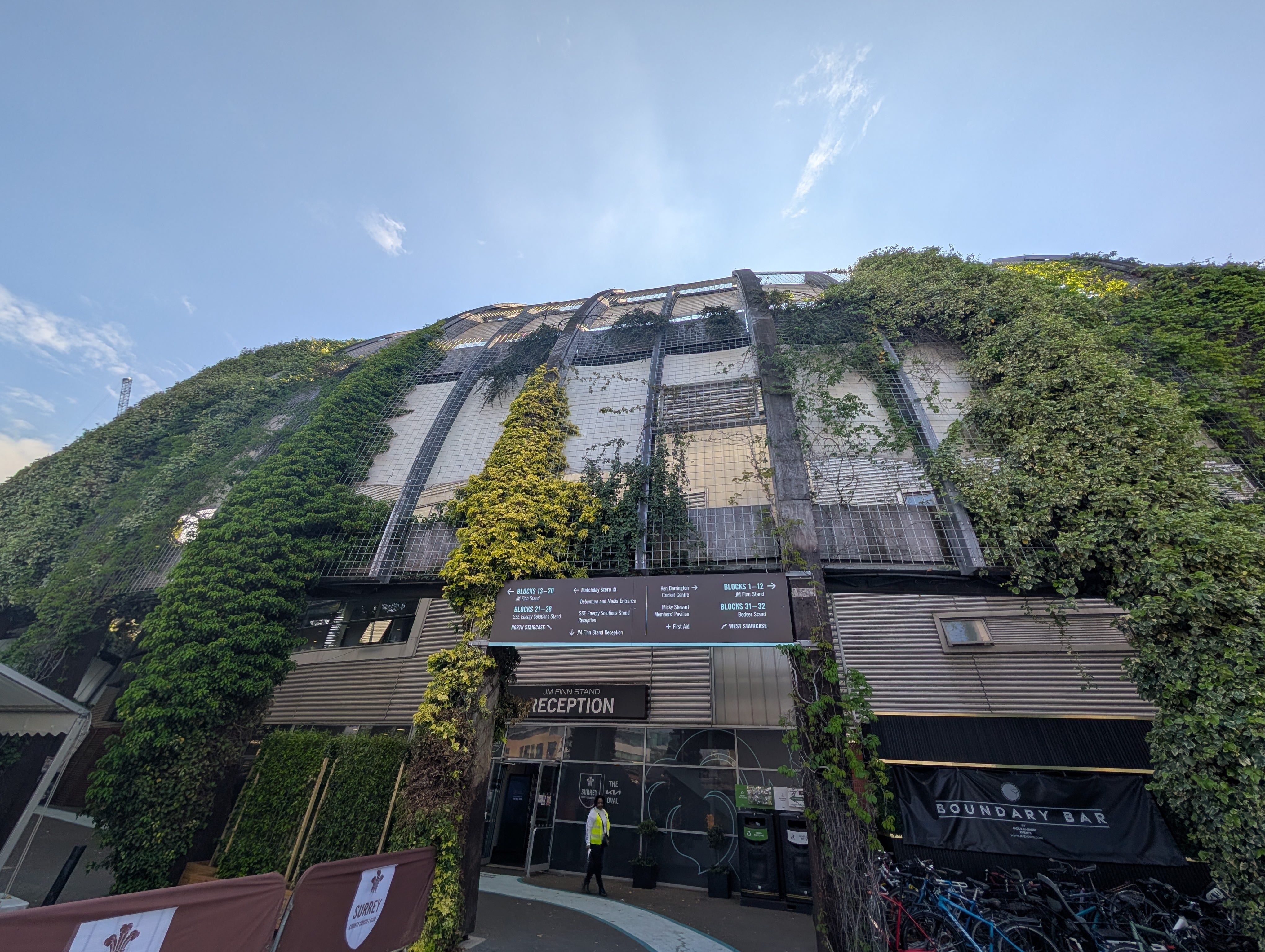
Meanwhile, Lambeth’s votes were totted up at The Oval cricket ground, with anxious candidates able to distract themselves by watching a school sports day taking place.
I find it interesting that whilst there is political turmoil across most of London, the south-west Lib Dem stronghold doesn’t budge.
I think the competent performance of those councils to date is part of it. Whilst across the rest of London the message was ‘change’, the message in the SW was about staying on course.
There may have been some rallying around keeping reform out, but in the end that hardly seemed a threat.
I guess that and it’s the stronghold of the ‘centrist dad’ as Reddit would say!
The Greens were four votes away from a majority in Haringey - with Labour candidate Hasret Bodozgan elected in Woodside ward with 1,337 votes and Green candidate Hayley Jukes on 1,334.