


We’ve spent August working on something very fun, which we should be able to unveil next week. If all goes to plan (and it’s still a massive if, we’re a tiny team, things can and do go very wrong) follow London Centric on Instagram and keep an eye on our stories to see if you can get involved.
Until then we’ve been looking into a new, totally legal tactic that is being used to try to squeeze as much rent as possible from London’s private tenants in the face of the Renters’ Rights Act: the inverse bidding war.
Scroll to the bottom for that story…
Relight my recycling fire
Tuesday night’s enormous fire at a recycling centre in south London, next to the railway line out of London Bridge, shows the strain that such facilities are facing. No one was harmed in the giant blaze which produced smoke that could be seen across the centre of the capital. But it took 100 firefighters working through the night to bring it under control and the depot was severely damaged. The same facility also caught fire in June. Scaffolding next to the already-beleaguered structure was badly scorched this time around.

It’s too early for a definitive answer on what caused the fire in 50 tonnes of household waste, if it’s ever possible to find one. That said, when London Centric visited the site on Wednesday morning, there was no doubt in the minds of the firefighters on the scene about the most likely culprit.
“It’ll be lithium batteries,” said one firefighter, taking a break. “They get crushed and then combust. I think it started in the recycling then spread.”
It’s one thing not to clean out your plastic pots but Londoners can’t stop chucking rechargeable batteries in the recycling. Which are then destroying London’s ability to recycle.
Is this London’s most-shut-down-for-summer street?
We enjoyed the, ahem, “robust” comments under our piece questioning whether London should shut down for August. (For the record, we haven’t taken a day off.)
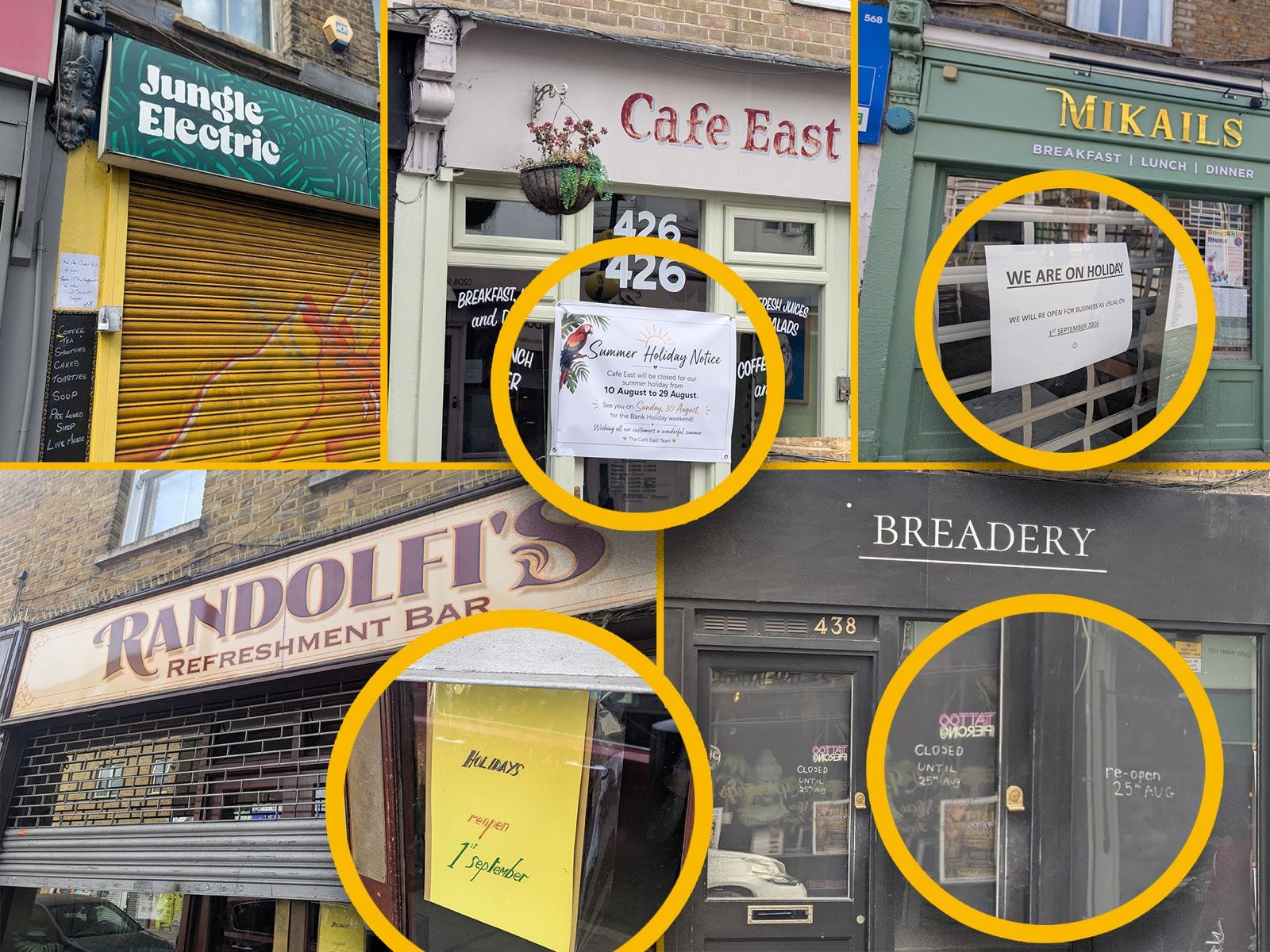
But it’s clear some parts of the capital have already given up. One London Centric reader nominated Roman Road in east London, where at least five shops and cafes are closed for most of August, with signs saying the owners are on holiday.
Any advance on that?
The VAT of the land: More London dodgy shops raids on the way
Treasury minister Dan Tomlinson has responded on X to a piece we wrote for the Financial Times about London Centric’s reporting on dodgy shops. Our reporting has consistently concluded the quickest way to fix the capital’s high streets is for HMRC to conduct spot checks on whether dodgy shops are paying their taxes rather than have politicians fiddle around the edges with planning laws or run around shouting “money laundering”.
Tomlinson wrote that, behind the scenes, things are already changing: “Jim is under-doing the transformation HMRC has been through in the last year. In the year I was minister for [HMRC] we did something radical and stopped only focusing on going after the biggest tax losses, but instead started looking at *where* tax losses were happening - with a laser focus on High Streets. Thanks [to] investment from Rachel Reeves, HMRC had the resources to expand its small business tax evasion work - and I and senior leaders in the department decided that half of that team - something like 350 people - would now be solely focused on High Street tax dodging.”
Referring to the tax raids on central London gift shops we reported on at the start of the summer: “The raids Jim mentions are not one-offs. But the first of, I hope, many in the years to come.”
Sadiq Khan has welcomed the impending launch of a legitimate Harry Potter shop on Oxford Street. One of the great mysteries (and one that Warner Bros has never responded to us on, to the annoyance of law-abiding gift shop retailers in our inbox) is why legitimate Harry Potter merchandise has consistently been supplied to the tax-evading “generic boy wizard with a vintage Ford Anglia in the window” shops across the centre of the capital. Could this end now they’ve got competition from an authentic outlet?
The heat’s over. Is London about to have flash floods?
After weeks of dry weather, the Met Office has finally said that parts of the UK can expect to see the “first meaningful rain for a long time”. Could that mean floods?
Dr Linda Speight, a hydrometeorologist at the University of Oxford, explained that the drier the summer, the greater the risk of flooding once rain finally does arrive.
That’s because the summer’s heat has dried out the ground, leaving it hard and cracked. “What normally happens when it rains is that the water fills all the gaps between the soil,” she said.
“To do that, water needs to be able to get into the soil’s surface. But at the minute, the surface is sealed with dust and is really hard, so there’s no way for the water to get into those gaps to move through the soil. It will just run off the top.”
Traditionally, the city’s vegetation has helped to slow the flow of water by soaking it up. “It’s not going to do that because it’s already dead.”
This means even fairly standard rainfall could trigger flooding, while drains and gutters could be blocked by material that has gathered during the dry period.
Flooding isn’t the only problem that the sudden change from dry weather to wet weather creates, explained Speight. It’s also an issue for London’s water quality: “There’s now two months’ worth of dirt sitting on the streets and in the sewers. As soon as it rains, that first flush of contaminants out of the system is going to cause a real spike in pollutants in the rivers.”
It’s also an issue for a system that’s used to having shoulder seasons, where the emergency services can reset. “Fire brigades are at their wits’ end,” said Speight. “They’ve already used up all their resources dealing with the fires and the hot weather. Now we’re going to have this sudden flip to wet weather, but they haven’t got months to reset and regroup before the floods start happening.”
Just how likely is flooding? “If rain happens slowly over several hours, the ground’s got a chance to soak it up,” said Speight. “If we get a thunderstorm, that’s when we have problems.”
“The problem with London is people don’t realise they’re at risk. They can’t see the water. They assume that the built environment will deal with nature, that there are big sewer systems that will drain the streets. So when it does happen, people are often caught unawares.”
One is a bloody historic epic fought between warring factions for reasons no one can quite decipher. The other is Lambeth local politics. So congratulations to Lambeth’s Green mayor (and actor) Paul Valentine, who has spent recent weeks filming House of the Dragon with Simon Russell Beale.
Our best stories come from our readers. If you’ve got a story you’d like us to look into, send us a WhatsApp or an email.
Welcome to London’s inverse bidding wars

By Polly Smythe
Over the last few months, the London Centric inbox has filled up with readers reporting a new trend for the capital’s private renters: inverse bidding wars.
In May, the Renters’ Rights Act finally came into force, bringing with it the biggest changes to the capital’s rental market in decades.
Among the practices banned by the new law were bidding wars, where landlords and letting agents advertise properties at an unrealistically low rent then, having created interest, encourage prospective tenants to competitively bid up the amount they’re willing to pay each month.
London’s landlords briefly took a bloody nose. But, in their quest to keep rents as high as possible without falling foul of the legislation change, they have found a new way to fight back.
How does it work?
Sick of renting from a landlord who refused to fix the constant issues in her house, Lucy Giles, 23, started looking for a new place to live in May, just after the new act came in.
She told one letting agent she was shocked by the massive increases in advertised prices: “[The agent] said to me that landlords were putting the rent higher, either expecting a lower offer or just taking a stab in the dark and hoping that people would pay.”
How high the advertised rent went depended on the landlord, with the agent telling her some were “going crazy and putting the rent really high, and some were doing it just a little bit higher than what their current tenants were paying”.
Giles had just experienced one of the unintended consequences of the Renters’ Rights Act.
Prior to the passage of the new law, a landlord might publicly list a two-bed London flat for £2,000 a month.
Then, when a prospective tenant put in an offer at that level, they’d be told that someone else was willing to pay £2,100 a month. The estate agent would try to create a bidding war. That left the potential tenants with the option to either up their offer, or risk losing the flat.
These upwards bidding wars are now illegal.
The intention was that renting a flat would instead become like walking into a supermarket — the advertised price would be the price you paid.
What wasn’t made illegal was accepting an offer beneath the advertised price.
As a result landlords and estate agents have responded by enormously increasing the advertised prices for flats.
The landlord’s initial hope is that a potential tenant is panicked enough to pay over the odds.
If not, prospective tenants are encouraged to view a property out of their price range then told to put in a bid below the asking price — creating a inverse blind auction where the objective is to try to work out how low your rival bidders have gone, then bid slightly above that.
London Centric tested this theory this month by ringing up more than a dozen letting agents to inquire about renting. We were repeatedly encouraged to view properties advertised as being well out of our stated price range. Time and time again letting agents told us that the landlord would definitely consider offers under the asking price.
But are people really paying that much?
You might think that landlords would have a hard time finding tenants happy to pay such a high rent. But a mix of desperation to find a property, inexperience in London’s rental market, and a desire to escape the tedium of flat-hunting is proving enough to push renters into paying far more than what a flat is worth.
“They might put the asking price to £4,000, but they don’t really mean £4,000,” said Giles. “But if several people are looking, you’re going to have to put the asking price. You know the way estate agents say, ‘I’ve got viewings all day,’ and you don’t always know whether that’s true or not.”
Plus, if you’re not aware that landlords are hiking the rent with the knowledge that they’ll accept a lower bid, then hundreds of properties that are in your price range look like they’re outside your budget. “I’m very much someone who will only look for what I can afford and won’t look beyond that,” said Giles. “So I just found there was way less on the market.”
Alice Bathurst, 24, is currently looking for a two-bed flat with a friend. She said she worried renters would end up paying more with the new system: “For so long we’ve been in the mindset that to get somewhere good you have to offer above the asking price, and that you wouldn’t even think to drop below. It’s so culturally ingrained that the rent that’s being offered is the starting point for you to then bid upwards.”
“I suppose it’s technically not illegal”
Michelle, 25, started looking for a flat all the way back in February: “I was looking at the market months before the Renters’ Rights Act came in, and I noticed on 1 May [when the act came in] that the properties that were coming up were automatically more expensive.”
Having finally found a flat near her price range, she went to a viewing in June. The flat was advertised at £2,900 a month.
“We offered £2,500, because that’s what the property would have been worth six or seven weeks before.”
That’s when, in her case, the process reversed direction and became an old-fashioned upwards auction, with the condition that every offer had to remain below the £2,900 asking price.
“We went back and forth twice, and eventually maxed out at bidding £2,700.”
She thought she had a deal. But two weeks later the letting agent said somebody had come in and offered more: “I suppose it’s technically not illegal, so there was nothing we could really do about it, though it was disappointing.”
Having worked in housing policy, Michelle was frustrated with how the Renters’ Rights Act is playing out: “When I saw this legislation come in, I thought, this is really good. I just never really thought about the unintended consequences that mean the market is functionally acting the exact same.”
Rather than creating pricing transparency, the act has essentially just put a formal upper limit on the amount that can be charged in an old-fashioned bidding war, she said: “Landlords can list something for much more than it’s worth, hope people are desperate and bid against each other, and keep bidding up, and they’re still doing nothing wrong, legally speaking.”
How else are landlords trying to get around the act?
Several readers also spotted listings that require tenants to make a one-off payment for their bills to cover the “entire tenancy period”.
This immediately raises a problem. The act did away with fixed-term tenancies, instead turning all rental contracts into rolling agreements with only a two-month notice period. So why ask for a flat fee up front?
Just like inverse bidding wars, it’s not specifically prohibited. Landlords are allowed to ask for payment for utilities but they have to be able to prove that the money is actually going towards utilities.
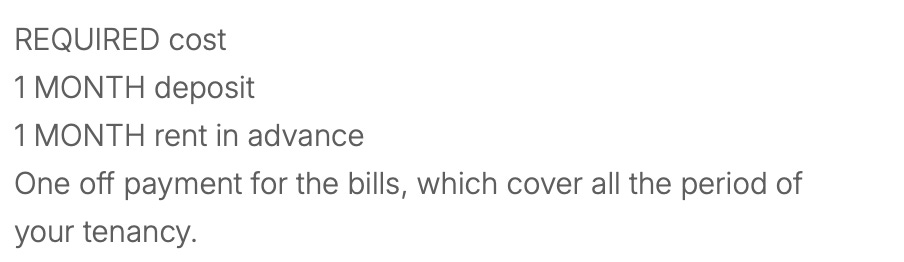
When we called one landlord who’d adopted this policy, he said that he’d been charging fees of this nature before the introduction of the Renters’ Rights Act. He said that they allowed tenants to make a one-off payment that could cover their bills indefinitely, no matter how long the tenancy lasted.
Mairi MacRae, director of policy and campaigns at housing charity Shelter, said: “With the Renters’ Rights Act finally in force, gone are the days when landlords could demand tenants cough up huge sums of rent up front, or hit the road.
“Seeing the back of these ludicrous upfront costs is hugely welcome, but the government cannot leave room for loopholes. Unscrupulous landlords must be prevented from flouting the law or finding cynical workarounds to continue cashing in on tenants’ basic need for a home.”
But one group of tenants are the big winners: students.
Although university courses tend to finish around May, many student housing contracts have historically lasted for 12 months. This leaves students stuck paying rent over the summer months, even if they don’t want to stay in London out of term time. The Renters’ Rights Act abolished fixed-term tenancies, giving students the power to quit early — leaving landlords with empty properties over the summer months and ruining their financial planning.
(University-owned accommodation and purpose-built student accommodation are largely exempt from this rule.)
Last month, the London-focused estate agent Foxtons said that following the introduction of the act, it had seen “elevated levels of tenancy terminations during May and June, particularly in student rentals”. As a result, around £3m in rent that Foxtons would have booked if the contracts had continued to their expected date was lost.
Pre-emptive comment for the economists reading this: “inverse bidding war” was the best description we could think of for this process which is really maybe a sort of “capped Dutch auction that can reverse direction and go back up again”.
Another unintended consequence of landlords inflating the advertised price is rent increases for existing tenancies. Landlords and lettings agents are using the advertised asking price of nearby properties to justify an increase up to that level (despite those properties actually being rented out for less). What makes it worse is if you want to dispute the rent increase, you go to the tribunal system whose primary method of evaluating if your rent is fair is looking at the price of advertised properties in your area…