


On Wednesday morning a nervous 15-year-old boy entered Stratford youth court, where he was due to be sentenced for his part in creating one of London’s most notorious viral videos.
Before this year’s footage of kids on Clapham’s High Street became a worldwide story about the state of London, there was another globally viral video clip involving the capital’s teenagers: the footage from March 2025 of a young boy hurling a heavy chair over a balcony at Westfield shopping centre in Stratford, captured on camera by his friend.
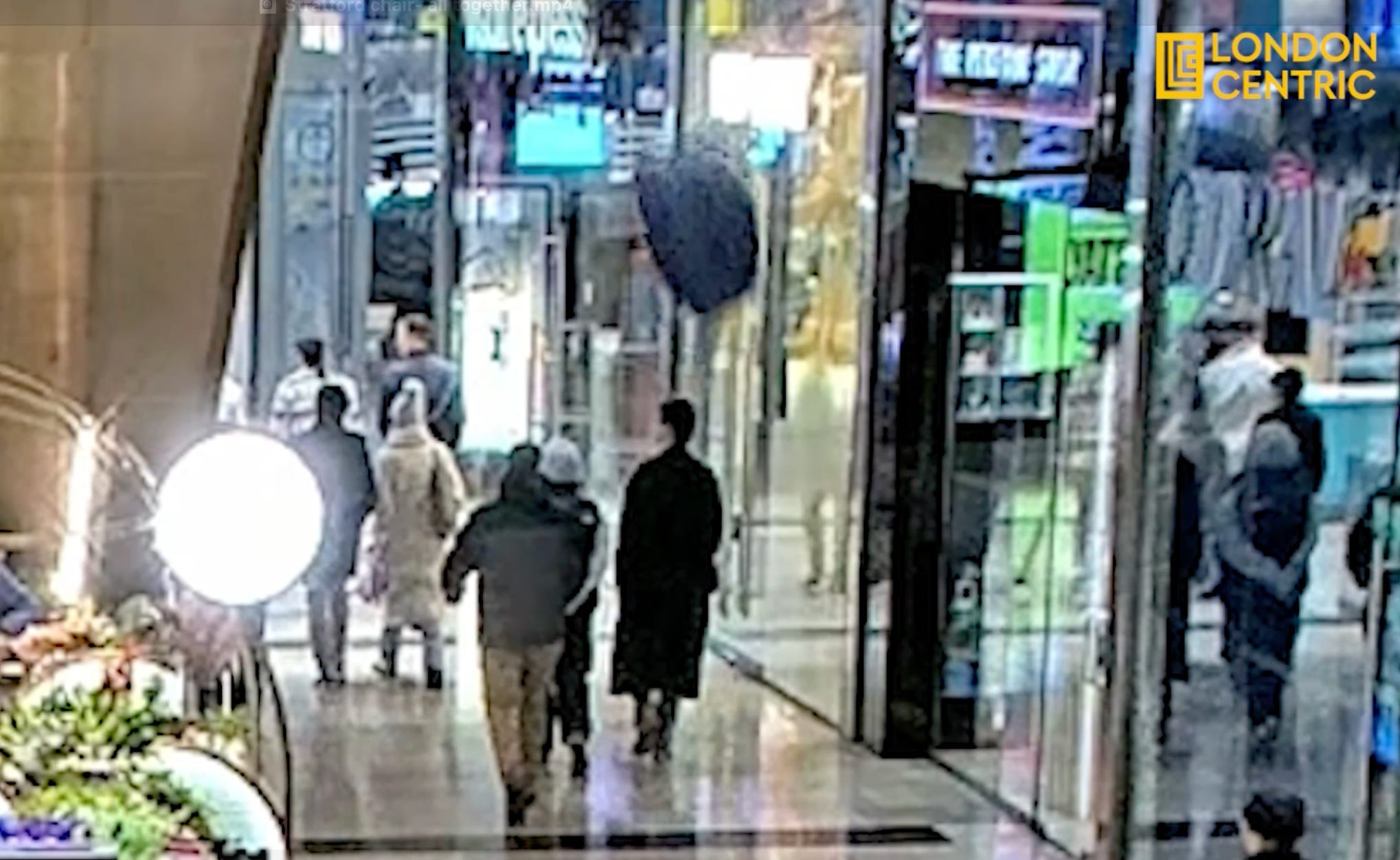
The timid teenager in an east London court this week didn’t show any of the giddiness he had displayed when he filmed the original incident, which was posted on Snapchat with the caption “No way bro almost killed someone” and “Nahhh” followed by laughing emojis. Although the clip of the chair being thrown went viral, London Centric has now obtained exclusive CCTV footage from the floor below, where it landed, narrowly missing passing shoppers.
Repeated delays to the trial date and other problems with the justice system meant this was the boy’s ninth trip to court in little over a year. All of this was to deal with the aftermath of an incident that lasted a few seconds. Over the months the staff had grown to know the teenager well. When he stood for the judge, the court clerk remarked how tall he’d grown.
The boy, who appeared in court the day before his English language GCSE exam, was handed a 12-month referral order, meaning he will now be subject to a curfew between 10pm and 7am each night for three months.
He received a lighter sentence than the one given to the teenager who actually threw the chair, who was previously given an eight-month detention and training order. Both teenagers, neither of whom can be named for legal reasons, were found guilty of criminal damage and recklessly causing a public nuisance.
In the 14 months since their chair-throwing stunt went viral around the world, London Centric reporters have repeatedly travelled to Stratford youth court to watch the case unfold. We’ve sat alongside teams of translators, social workers, family members, and lawyers. We wanted to understand more about the motivation behind one aspect of the capital’s viral video crisis, where teenagers film their own criminal acts for content and then seem surprised when the footage leads to real‐world consequences.
“No way bro almost killed someone”
Neither boy should have been at Westfield Stratford on Saturday 1 March 2025. Three weeks earlier, they’d both been issued with anti-social behaviour notices by police banning them from entering the shopping centre, after security guards had spotted them throwing pebbles over railings at the site.

The shopping centre, built ahead of the 2012 Olympics in one of the poorest parts of the capital, is a hub for local young people. After attending an early court hearing in the summer of 2025, London Centric encountered two youth workers wandering through the shopping centre. They work as part of Newham Council’s Detached Youth Work Team, providing support to young people while they are out and about in the borough.
“This [Westfield] is the biggest youth centre in Newham,” said one of the youth workers, gesturing to the shopping centre, saying kids “come here for the wifi, for the shops”. Outside of school hours and during holidays, the shopping mall is flooded with young people, they said. They said most of the local children just want a place to be and it’s just a small minority who engage in violent or anti-social behaviour “sometimes [due to] boredom, sometimes wrong company, maybe even [they’re] frustrated with the establishment”.
“We must deal with young people as quickly as we can”
That Saturday afternoon last March, the two boys ignored their ban and headed to the shopping centre, where they spent hours wandering around. At 10:30pm the older boy threw a 15kg blue chair over a glass balustrade from Westfield’s top floor as the other filmed, before the pair ran away giggling.
Described by prosecutor Matthew Groves in court as “a large and ungainly item”, the piece of furniture fell 50ft down a void between multiple floors, narrowly missing shoppers.
It was an act that could have had catastrophic consequences. But far from trying to avoid being identified as the perpetrators, the pair had filmed themselves doing it and then shared the footage. The crime was content, and it seemed that getting the content was the purpose of the crime.

New CCTV footage obtained by London Centric shows just how close the chair came to hitting people wandering along the ground floor of the shopping centre.
In a pre-smartphone world that would have probably been the end of the story. But as with hundreds of other clips of disorder in London, the footage quickly went viral around the world, alerting the police to the initial incident. Before long, the teenager who actually threw the chair was identified by a police officer from CCTV footage. Soon afterwards his friend, the person filming the incident, was also arrested. A brief moment of online fame gave way to months of grinding through the capital’s overloaded criminal justice system.
At an early court hearing in May 2025, the judge said: “We must deal with young people as quickly as we can.” But the trial was plagued with setbacks, which meant it was more than a year before proceedings concluded.
The boy who filmed the incident needed his parents in court to support him. Yet the courts often failed to meet the parents’ own complicated requirements for specialist assistance and translators, meaning the case could not proceed. On one occasion, interpreters for the wrong language were booked. There were delays in securing experts, problems locating vital reports, plus issues with the legal aid portal. Sometimes it was as simple as notes not having been retrieved in time for the hearing.
The delays had more than administrative ramifications: there are different sentencing powers for people aged 12 to 14 and 15 to 17. While boys in the older bracket are immediately eligible for custodial sentences, a 14‐year‐old would only receive one if they were a persistent offender, which the teenager was not. The time taken to deal with the case meant the teenager moved into the upper bracket.

The desire to create online content for the dopamine hit of likes and comments is nothing new, but there is an innovative element to the slew of mobile phone videos that show disorder on London’s streets, in that it’s often filmed by the perpetrators.
When teenagers ran through a Marks and Spencer in Clapham earlier this year there were multiple videos uploaded online of the event, many of them filmed not by bystanders but by participants. The footage was often accompanied by the breathless commentary of the teenagers themselves, and no effort was made by anyone to conceal their identity. Those involved seemed either unaware they were incriminating themselves, or so intent on creating content they didn’t care about the consequences.
Often fuelled by the city’s detractors, London’s viral video crisis is becoming self-perpetuating. Teenage misbehaviour is hardly new. But the videos appear to show that petty crime goes unpunished – and can make incredibly viral content. This message isn’t lost on bored kids looking for something to do.
“You know Stratford, it’s always like this”
London Centric visited Westfield Stratford on a busy Monday afternoon in the Easter holidays of 2025, shortly after the video of the chair being thrown was filmed. “It’s just lawless,” said a security guard working for a prominent British retail chain, who asked that he and his store remain anonymous. School holidays are the “worst”, he said, describing the main problem he sees as “youth aggression”.
He has worked there for the past decade, but “it doesn’t feel as safe as it used to”. One Saturday there were six incidents, he said; another viral video incident, with multiple stabbings, occurred just near his store minutes after it closed.
As well as a body camera, he was wearing a stab-proof vest. Weekly weapons searches at the site are unearthing knives “as long as your arm,” he claimed.
He seemed amazed by the aggression he encountered from some teenagers: “I’m double your age, your dad’s age, and you still want to fight me.”
“A laboratory for regeneration schemes”
The site on which Westfield Stratford was built was previously a railway works, when the area was a centre for industry and trade – but by the time the Australian company Westfield bought the site in 2003, it was a disused goods yard.
Regeneration swiftly followed: two years later, London won the bid to host the 2012 Olympics, centred on a plan to radically change Stratford.
Ken Livingstone, then the mayor of London, said in 2008: “I didn’t bid for the Olympics because I wanted three weeks of sport. I bid for the Olympics because it’s the only way to get the billions of pounds out of the government to develop the East End”, describing it as a ploy “to ensnare the government to put money into an area it has neglected for 30 years.”
By the time Westfield Stratford officially opened in 2011, its neighbours included the new Stratford International railway station – something of a misnomer, given that international trains have never actually stopped there – and vast amounts of new residential construction. The Elizabeth Line provided another boost to the area when it opened in 2022, reducing the time taken to travel from central London to the door of Westfield to just 15 minutes. New‐build properties a few minutes’ walk from the shopping centre now sell for well over £1m.

But the story isn’t so simple. While parts of Stratford are full of flashy redevelopment, “the regeneration that’s happened is not a tide which has raised all boats”, cautioned Paul Watt, an urbanist and visiting professor in LSE’s sociology department.
Stratford scores highly on gentrification indices, he explained, but also on deprivation indices: “Essentially, putting it crudely, you’ve got social polarisation.”
This is not unique to Stratford – east London as a whole has been “a laboratory for regeneration schemes since the 1980s”, he said – but the speed and intensity of recent development makes it “most visible” there. A 2021 report by Newham Council found that while house prices in the London borough increased by 87% between 2011 and 2020 and rents went by 55%, wages increased by just 37%. This left some of the area’s poorer residents facing “London levels of rent” on “Blackburn levels of wages”, according to Watt.
While emphasising that he was not “trying in any way to justify crime or anti-social behaviour”, Watt suggested that this dichotomy might be part of the reason behind aggression towards the mall and its “glittering space full of displays of expensive consumer goods”, an exclusionary place “which both attracts and repels”.
“Gets caught up with his peers and does silly things”
When the boy who filmed the chair‐throwing returned to court this week, his lawyer Nimra Ashraf said he had changed. He was now “excelling in sports, focusing on his GCSEs, and getting good grades” and that he was considering starting an apprenticeship as a bricklayer or a car-wrapper. When asked about his future by the judge, the boy told the court he’d taken up drumming, and wanted to “be a successful musician.”
Ashraf added that he’d been on repeated child protection plans, had witnessed domestic violence, and hadn’t committed any other offences. He also had “some significant learning needs”.
The lawyer said that a psychiatric report had found her client had low levels of maturity, leaving him particularly susceptible to peer pressure, something that was echoed by a youth justice worker, who characterised him as someone who “gets caught up with his peers and does silly things.”
The older teenager, who actually threw the chair, had already been convicted of more serious offences, although he is planning to appeal.
At the hearing on Wednesday, District Judge Talwinder Buttar tried to understand the mentality of the younger boy: “Everyone saw what happened because you posted it online. It was horrible to watch. What were you thinking at the time?”
“I thought it was a joke,” said the boy.
He was asked what he thought now about his involvement in the chair‐throwing incident, as he sat in court facing a severe punishment.
“Not good and I’m stressed about it,” the boy said, adding “I’m sorry because of what could have happened. I could have killed someone. That’s serious, very serious.”

The person who threw the chair said "it's not that deep, it did not hit no-one".
By what mechanism did these people end up in the country, out of interest? Why haven't his parents learned how to speak English yet so we not only have to pay for the court case but their translator? How is this cast as a problem of our court system that it isn't set up for this stupidity?
There are so many problems in this country that weren't an issue until 5 minutes ago and then everyone is shocked when we aren't set up for them. Cut back on trading standards officers? Well didn't need them because there wasn't rampant money laundering. No real punishment of fly tipping? Well it's only now I can guarantee every walk I go on i'll see a mattress or computer chair randomly thrown on the pavement.
Again, a story of failed parenting - if not outright neglect - and the public bearing the cost 🤦🏻♂️